Department of Clinical Microbiology, Copenhagen University Hospital Hvidovre, Hvidovre, Denmark.
Department of Clinical Microbiology, Copenhagen University Hospital Rigshospitalet, Copenhagen, Denmark.
Eur J Clin Microbiol Infect Dis. 2024 Apr;43(4):641-648. doi: 10.1007/s10096-024-04754-6. Epub 2024 Jan 25.
To investigate the role of E. coli virulence-associated genes (VAGs) in predicting urinary tract infection (UTI) as the source of bacteremia in two distinct hospital populations, one with a large general catchment area and one dominated by referrals.
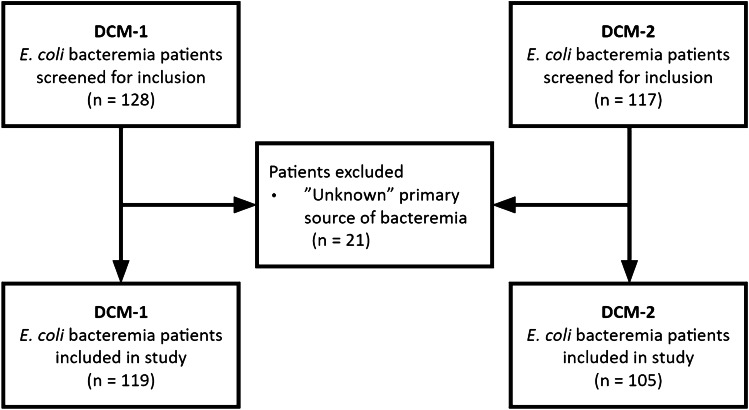
E. coli bacteremias identified at Department of Clinical Microbiology (DCM), Hvidovre Hospital and DCM, Rigshospitalet in the Capital Region of Denmark from October to December 2018. Using whole genome sequencing (WGS), we identified 358 VAGs from 224 E. coli bacteremia. For predictive analysis, VAGs were paired with clinical source of UTI from local bacteremia databases.
VAGs strongly predicting of UTI as primary infection source of bacteremia were primarily found within the pap gene family. papX (PPV 96%, sensitivity 54%) and papGII (PPV 93%, sensitivity 56%) were found highly predictive, but showed low sensitivities. The strength of VAG predictions of UTI as source varied significantly between the two hospital populations. VAGs had weaker predictions in the tertiary referral center (Rigshospitalet), a disparity likely stemming from differences in patient population and department specialization.
WGS data was used to predict the primary source of E. coli bacteremia and is an attempt on a new and different type of infection source identification. Genomic data showed potential to be utilized to predict the primary source of infection; however, discrepancy between the best performing profile of VAGs between acute care hospitals and tertiary hospitals makes it difficult to implement in clinical practice.
研究大肠杆菌毒力相关基因 (VAGs) 在预测尿路感染 (UTI) 作为两个不同医院人群菌血症来源中的作用,一个人群的来源广泛,另一个人群主要来自转诊。
2018 年 10 月至 12 月,在丹麦首都地区的 Hvidovre 医院和 Rigshospitalet 的临床微生物学系 (DCM) 鉴定了大肠杆菌菌血症。使用全基因组测序 (WGS),我们从 224 例大肠杆菌菌血症中鉴定了 358 个 VAGs。为了进行预测分析,VAGs 与当地菌血症数据库中的 UTI 临床来源进行配对。
VAGs 强烈预测 UTI 是菌血症的原发性感染源,主要存在于 pap 基因家族中。papX(PPV96%,敏感性 54%)和 papGII(PPV93%,敏感性 56%)被发现具有高度预测性,但敏感性较低。VAG 对 UTI 作为来源的预测强度在两个医院人群之间存在显著差异。在三级转诊中心(Rigshospitalet),VAGs 的预测能力较弱,这种差异可能源于患者人群和科室专业化的差异。
使用 WGS 数据来预测大肠杆菌菌血症的原发性来源是对新的和不同类型的感染源识别的尝试。基因组数据显示出有潜力用于预测原发性感染源;然而,急性护理医院和三级医院之间表现最佳的 VAG 特征存在差异,使得难以在临床实践中实施。