Watts Gerald F, Jones Laney K, Sarkies Mitchell N, Pang Jing, Gidding Samuel S, Libby Peter, Santos Raul D
School of Medicine, University of Western Australia, Perth, Western Australia, Australia.
Departments of Cardiology and Internal Medicine, Royal Perth Hospital, Perth, Western Australia, Australia.
Glob Heart. 2024 Jan 25;19(1):12. doi: 10.5334/gh.1291. eCollection 2024.
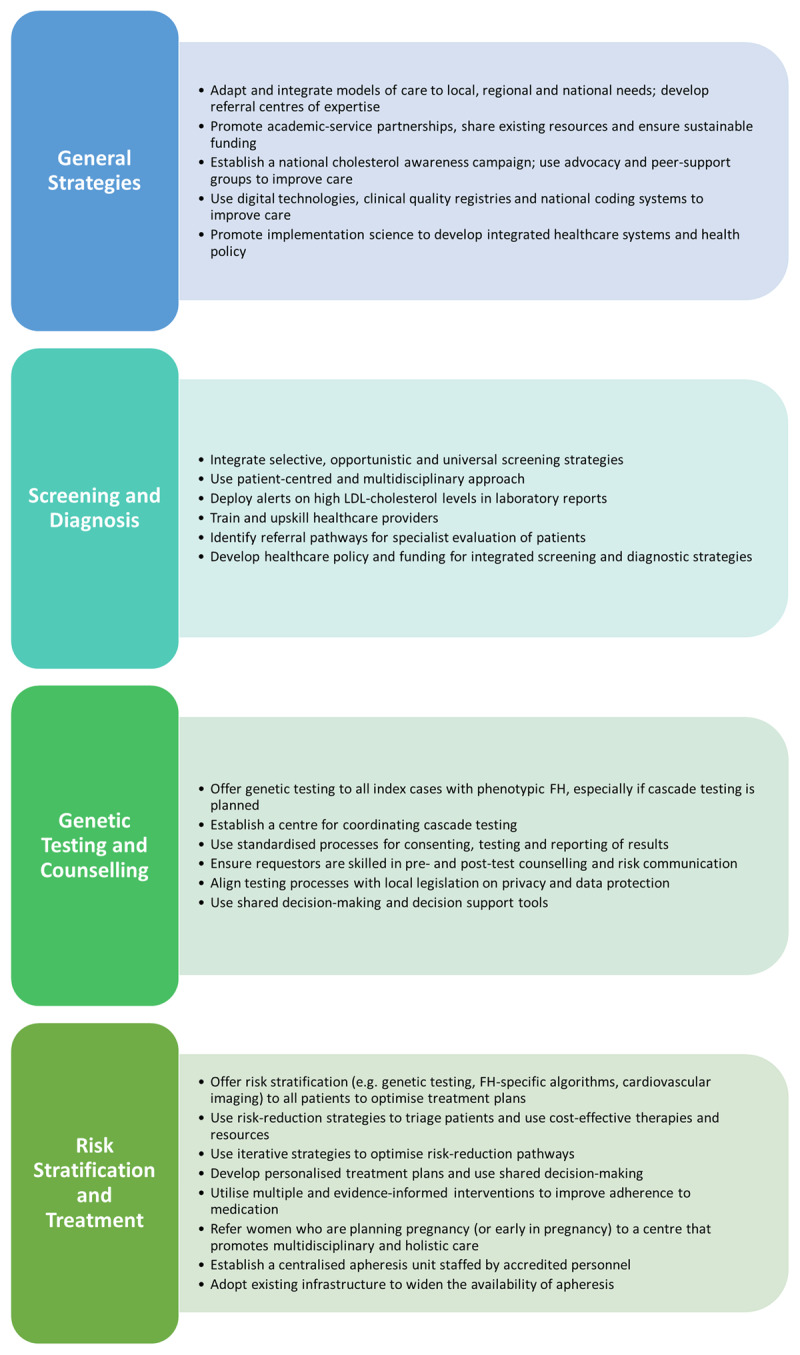
Familial hypercholesterolaemia (FH), a common monogenic disorder, is a preventable cause of premature coronary artery disease and death. Up to 35 million people worldwide have FH, but most remain undetected and undertreated. Several clinical guidelines have addressed the gaps in care of FH, but little focus has been given to implementation science and practice. The International Atherosclerosis Society (IAS) has developed an evidence-informed guidance for the detection and management of patients with FH, supplemented with implementation strategies to optimize contextual models of care. The guidance is partitioned into detection, management and implementation sections. Detection deals with screening, diagnosis, genetic testing and counselling. Management includes risk stratification, treatment of adults and children with heterozygous and homozygous FH, management of FH during pregnancy, and use of lipoprotein apheresis. Specific and general implementation strategies, guided by processes specified by the Expert Recommendations for Implementing Change taxonomy, are provided. Core generic implementation strategies are given for improving care. Nation-specific cholesterol awareness campaigns should be utilized to promote better detection of FH. Integrated models of care should be underpinned by health policy and adapted to meet local, regional and national needs. Clinical centres of excellence are important for taking referrals from the community. General practitioners should work seamlessly with multidisciplinary teams. All health-care providers must receive training in essential skills for caring for patients and families with FH. Management should be supported by shared decision-making and service improvement driven by patient-reported outcomes. Improvements in services require sharing of existing resources that can support care. Advocacy should be utilized to ensure sustainable funding. Digital health technologies and clinical quality registries have special value. Finally, academic-service partnerships need to be developed to identify gaps in care and set priorities for research. This new IAS guidance on FH complements the recent World Heart Federation Cholesterol Roadmap.
家族性高胆固醇血症(FH)是一种常见的单基因疾病,是早发性冠状动脉疾病和死亡的可预防原因。全球多达3500万人患有FH,但大多数人仍未被发现和治疗不足。多项临床指南已解决了FH护理方面的差距,但对实施科学和实践的关注较少。国际动脉粥样硬化学会(IAS)已制定了一份基于证据的FH患者检测和管理指南,并辅以实施策略以优化背景护理模式。该指南分为检测、管理和实施部分。检测涉及筛查、诊断、基因检测和咨询。管理包括风险分层、杂合子和纯合子FH成人及儿童的治疗、孕期FH的管理以及脂蛋白分离术的使用。提供了由《实施变革专家建议分类法》规定的流程指导的具体和一般实施策略。给出了改善护理的核心通用实施策略。应利用各国特定的胆固醇意识宣传活动来促进对FH的更好检测。综合护理模式应以卫生政策为基础,并进行调整以满足当地、区域和国家的需求。卓越临床中心对于接收社区转诊很重要。全科医生应与多学科团队无缝合作。所有医疗保健提供者都必须接受照顾FH患者及其家庭的基本技能培训。管理应得到共同决策和由患者报告结果驱动的服务改进的支持。服务改进需要共享可支持护理的现有资源。应利用宣传来确保可持续资金。数字健康技术和临床质量登记具有特殊价值。最后,需要发展学术 - 服务伙伴关系以识别护理差距并确定研究重点。这份新的IAS关于FH的指南补充了最近的世界心脏联盟胆固醇路线图。