
美国夏令时实施情况与不良心血管事件发生率:一项全国性大型研究中的概率评估
Daylight Saving Time Practice and the Rate of Adverse Cardiovascular Events in the United States: A Probabilistic Assessment in a Large Nationwide Study.
作者信息
Satterfield Benjamin A, Dikilitas Ozan, Van Houten Holly, Yao Xiaoxi, Gersh Bernard J
机构信息
Department of Cardiovascular Medicine, Mayo Clinic, Rochester, MN.
Department of Internal Medicine, Mayo Clinic, Rochester, MN.
出版信息
Mayo Clin Proc Innov Qual Outcomes. 2024 Jan 5;8(1):45-52. doi: 10.1016/j.mayocpiqo.2023.12.006. eCollection 2024 Feb.
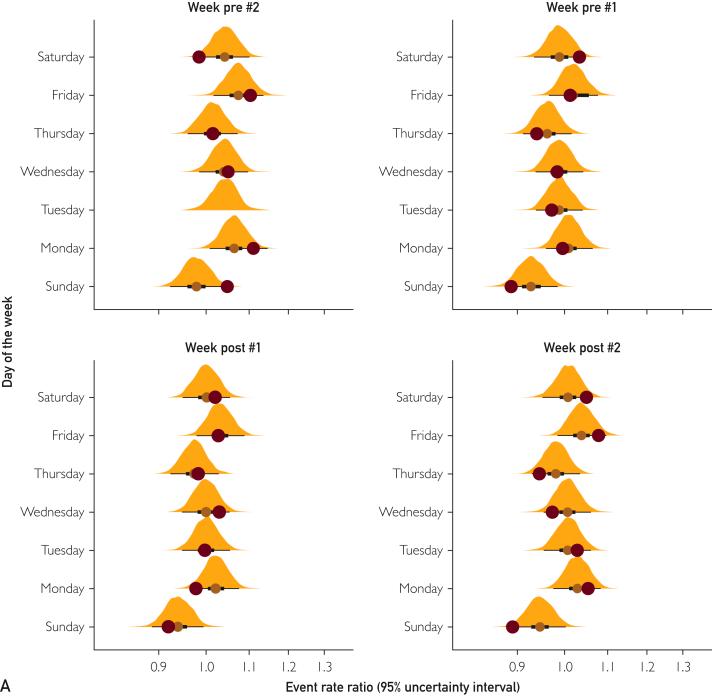
We investigated the association of daylight saving time (DST) transitions with the rates of adverse cardiovascular events in a large, US-based nationwide study. The study cohort included 36,116,951 unique individuals from deidentified administrative claims data of the OptumLabs Data Warehouse. There were 74,722 total adverse cardiovascular events during DST transition and the control weeks (2 weeks before and after) in spring and autumn of 2015-2019. We used Bayesian hierarchical Poisson regression models to estimate event rate ratios representing the ratio of composite adverse cardiovascular event rates between DST transition and control weeks. There was an average increase of 3% (95% uncertainty interval, -3% to -10%) and 4% (95% uncertainty interval, -2% to -12%) in adverse cardiovascular event rates during Monday and Friday of the spring DST transition, respectively. The probability of this being associated with a moderate-to-large increase in the event rates (estimate event rate ratio, >1.10) was estimated to be less than 6% for Monday and Friday, and less than 1% for the remaining days. During autumn DST transition, the probability of any decrease in adverse cardiovascular event rates was estimated to be less than 46% and a moderate-to-large decrease in the event rates to be less than 4% across all days. Results were similar when adjusted by age. In conclusion, spring DST transition had a suggestive association with a minor increase in adverse cardiovascular event rates but with a very low estimated probability to be of clinical importance. Our findings suggest that DST transitions are unlikely to meaningfully impact the rate of cardiovascular events.
在一项基于美国的大型全国性研究中,我们调查了夏令时(DST)转换与不良心血管事件发生率之间的关联。研究队列包括来自OptumLabs数据仓库去识别行政索赔数据的36,116,951名个体。在2015 - 2019年春季和秋季的DST转换期以及对照周(转换前和转换后的2周)期间,共有74,722起不良心血管事件。我们使用贝叶斯分层泊松回归模型来估计事件率比,该比值代表DST转换周与对照周之间复合不良心血管事件率的比值。在春季DST转换的周一和周五,不良心血管事件发生率分别平均增加3%(95%不确定区间,-3%至-10%)和4%(95%不确定区间,-2%至-12%)。周一和周五与事件率中度至大幅增加(估计事件率比>1.10)相关的概率估计分别小于6%,其余日期小于1%。在秋季DST转换期间,估计不良心血管事件率在任何一天下降的概率小于46%,事件率中度至大幅下降的概率在所有日期均小于4%。按年龄调整后的结果相似。总之,春季DST转换与不良心血管事件发生率的小幅增加存在提示性关联,但估计具有临床重要性的概率非常低。我们的研究结果表明,DST转换不太可能对心血管事件发生率产生有意义的影响。

 Zotero 插件