Patel Dhruvi, Louca Chris, Machuca Vargas Carolina
University of Portsmouth Dental Academy, William Beatty Building, Hampshire Terrace, Portsmouth, PO1 2QG, UK.
Br Dent J. 2024 Jan;236(2):111-116. doi: 10.1038/s41415-023-6715-7. Epub 2024 Jan 26.
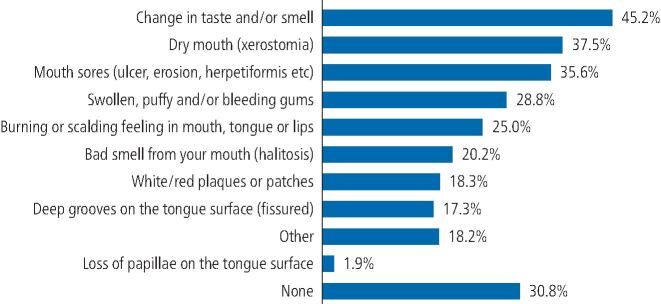
Introduction Oral manifestations have been observed with this condition; however, little is known about their impact on the healthcare professionals routinely managing these patients.Aims To investigate the prevalence of the oral manifestations of long COVID and the healthcare professionals' views, experiences and practices for managing these conditions.Materials and methods A cross-sectional mixed-methods study, including a self-reported online questionnaire (n = 104) and healthcare professionals' (n = 7) semi-structured interviews, was conducted. Descriptive statistics and reflexive thematic analysis were used to analyse the data.Results In total, 78% of respondents reported one or more oral conditions associated with COVID-19. Changes in the sense of taste and/or smell (58%), dry mouth (48.1%) and mouth sores (45.7%) were frequently reported. Themes identified from healthcare professionals' interviews were areas for research, management and interdisciplinary collaboration.Discussion Allied healthcare professionals may assist dental professionals with managing oral manifestations of long COVID. Inadequate access to NHS dentistry is deterring patients worried about their oral symptoms and the limited oral knowledge of healthcare professionals affects their ability to manage patients.Conclusion Healthcare professionals have observed oral manifestations in individuals diagnosed with long COVID; however, further information and training on this topic would assist them with managing patients and increasing awareness among clinicians.
引言 已观察到这种疾病存在口腔表现;然而,对于其对日常管理这些患者的医护人员的影响知之甚少。
目的 调查新冠后长期症状的口腔表现的患病率,以及医护人员对管理这些病症的看法、经验和做法。
材料和方法 开展了一项横断面混合方法研究,包括一份自我报告的在线问卷(n = 104)和对医护人员(n = 7)的半结构化访谈。使用描述性统计和反思性主题分析来分析数据。
结果 总体而言,78%的受访者报告了一种或多种与新冠病毒相关的口腔病症。味觉和/或嗅觉改变(58%)、口干(48.1%)和口腔溃疡(45.7%)是常见的报告症状。从医护人员访谈中确定的主题包括研究领域、管理和跨学科协作。
讨论 专职医疗人员可以协助牙科专业人员管理新冠后长期症状的口腔表现。国民保健署牙科服务获取不足使担心口腔症状的患者望而却步,且医护人员有限的口腔知识影响了他们管理患者的能力。
结论 医护人员已观察到新冠后长期症状患者的口腔表现;然而,关于这一主题的更多信息和培训将有助于他们管理患者并提高临床医生的认识。