Tabara Yasuharu, Okada Yoko, Ochi Masayuki, Ohyagi Yasumasa, Igase Michiya
Graduate School of Public Health, Shizuoka Graduate University of Public Health, Kita-Ando 4-27-2, Aoi-Ku, Shizuoka, 420-0881, Japan.
Center for Genomic Medicine, Kyoto University Graduate School of Medicine, Sakyo-Ku, Kyoto, 606-8507, Japan.
Aging Clin Exp Res. 2024 Jan 28;36(1):7. doi: 10.1007/s40520-023-02665-8.
One-leg standing time (OLST) has been frequently used physical performance measure; however, what muscular characteristics OLST represents remains uncertain.
This cross-sectional study aimed to investigate the association between OLST and muscle characteristics to clarify the possibility of using OLST as a physical performance measure.
Study participants comprised 1144 older adults aged 65 years or older. Computed tomography images provided mid-thigh skeletal muscle cross-sectional area and mean attenuation value. OLST was measured for a maximum of 60 s. Static postural instability was assessed using a posturography.
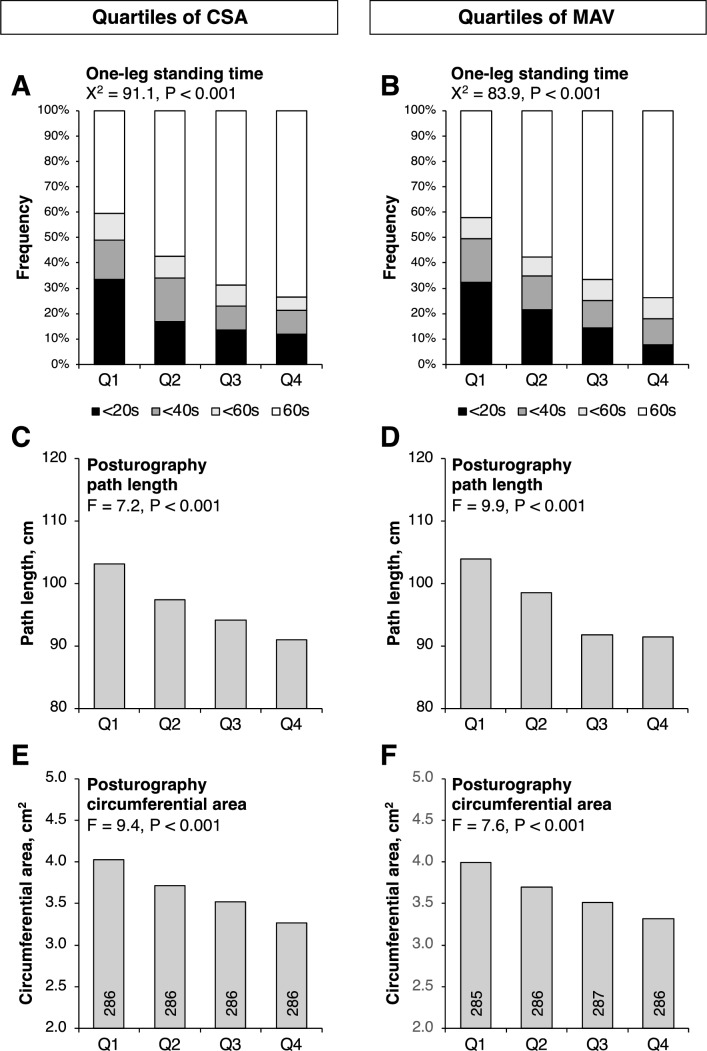
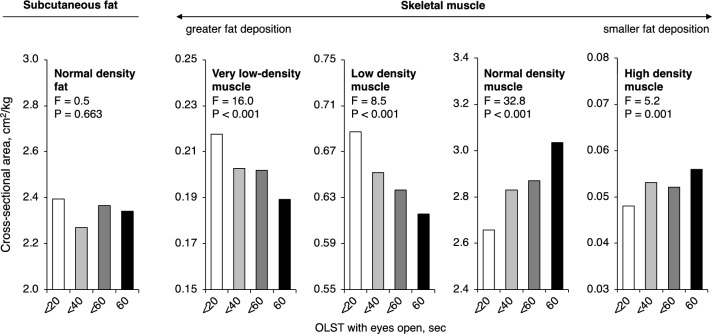
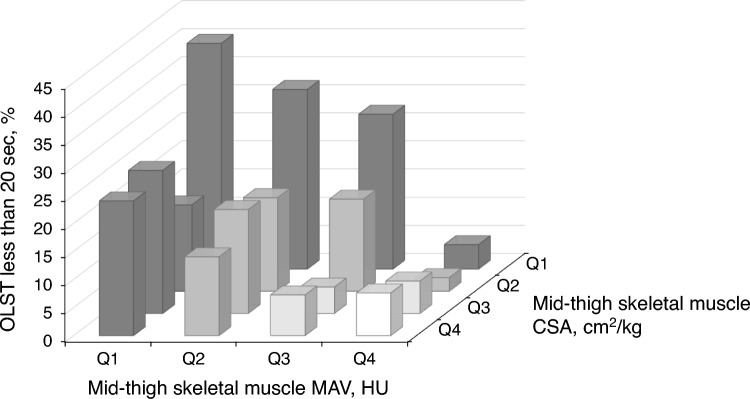
A frequency of OLST < 20 s was increased by quartiles of muscle cross-sectional area (Q1: 33.6, Q2: 12.8, Q3: 13.6, Q4: 11.9%, P < 0.001) and mean attenuation value (Q1: 32.3, Q2: 21.7, Q3: 14.3, Q4: 7.7%, P < 0.001). Results of the multinomial regression analysis indicated that muscle cross-sectional area and mean attenuation value were independently associated with an OLST of less than 20 s. The crude odds ratio of OLST less than 20 s for the lowest quartiles of both cross-sectional area and mean attenuation value was 4.19 (95% CI: 3.01 - 5.84). The cross-sectional area of muscles with greater fat deposition was inversely associated with OLST, while that with smaller fat deposition showed a positive association with OLST, indicating why mean attenuation value and cross-sectional area were independently associated with OLST. No clear relationship was observed with static postural instability.
OLST was a simply measurable quantifiable physical measure representing the loss of muscle mass and quality in older adults.
单腿站立时间(OLST)一直是常用的身体机能测量指标;然而,OLST所代表的肌肉特征仍不明确。
本横断面研究旨在调查OLST与肌肉特征之间的关联,以阐明将OLST用作身体机能测量指标的可能性。
研究参与者包括1144名65岁及以上的老年人。计算机断层扫描图像提供了大腿中部骨骼肌横截面积和平均衰减值。OLST测量时间最长为60秒。使用姿势描记法评估静态姿势不稳。
随着肌肉横截面积四分位数的增加(Q1:33.6%,Q2:12.8%,Q3:13.6%,Q4:11.9%,P<0.001)以及平均衰减值四分位数的增加(Q1:32.3%,Q2:21.7%,Q3:14.3%,Q4:7.7%,P<0.001),OLST<20秒的频率增加。多项回归分析结果表明,肌肉横截面积和平均衰减值与OLST小于20秒独立相关。横截面积和平均衰减值最低四分位数的OLST小于20秒的粗比值比为4.19(95%CI:3.01-5.84)。脂肪沉积较多的肌肉横截面积与OLST呈负相关,而脂肪沉积较少的肌肉横截面积与OLST呈正相关,这表明了平均衰减值和横截面积与OLST独立相关的原因。未观察到与静态姿势不稳有明确关系。
OLST是一种简单可测量的量化身体指标,代表老年人肌肉质量和质量的丧失。