Institute of Pharmaceutical and Biomedical Sciences, Johannes Gutenberg-University Mainz, Staudingerweg 5, 55128, Mainz, Germany.
Institute of Molecular Medicine, University Medical Center Mainz, Langenbeckstr. 1, 55131, Mainz, Germany.
Mol Psychiatry. 2024 May;29(5):1427-1439. doi: 10.1038/s41380-024-02421-y. Epub 2024 Jan 29.
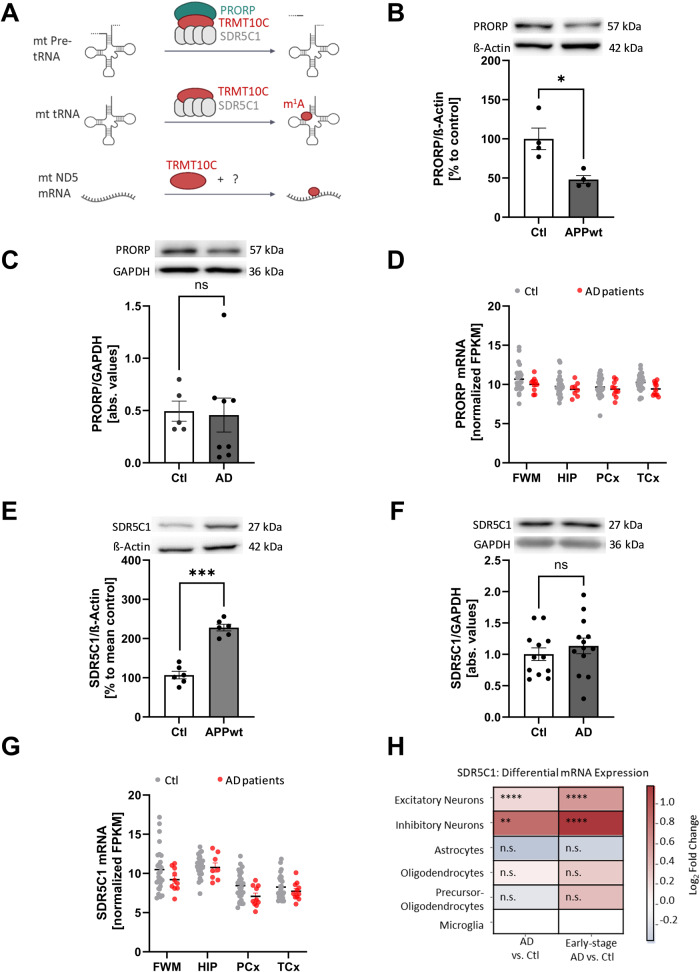
One mechanism of particular interest to regulate mRNA fate post-transcriptionally is mRNA modification. Especially the extent of mA mRNA methylation is highly discussed due to methodological differences. However, one single mA site in mitochondrial ND5 mRNA was unanimously reported by different groups. ND5 is a subunit of complex I of the respiratory chain. It is considered essential for the coupling of oxidation and proton transport. Here we demonstrate that this mA site might be involved in the pathophysiology of Alzheimer's disease (AD). One of the pathological hallmarks of this neurodegenerative disease is mitochondrial dysfunction, mainly induced by Amyloid β (Aβ). Aβ mainly disturbs functions of complex I and IV of the respiratory chain. However, the molecular mechanism of complex I dysfunction is still not fully understood. We found enhanced mA methylation of ND5 mRNA in an AD cell model as well as in AD patients. Formation of this mA methylation is catalyzed by increased TRMT10C protein levels, leading to translation repression of ND5. As a consequence, here demonstrated for the first time, TRMT10C induced mA methylation of ND5 mRNA leads to mitochondrial dysfunction. Our findings suggest that this newly identified mechanism might be involved in Aβ-induced mitochondrial dysfunction.
一个特别引起人们关注的调节 mRNA 命运的机制是 mRNA 修饰。由于方法学上的差异,m6A mRNA 甲基化的程度受到了高度的讨论。然而,不同的研究小组一致报道了线粒体 ND5 mRNA 上的一个单一的 m6A 位点。ND5 是呼吸链复合物 I 的一个亚基。它被认为对氧化和质子运输的偶联是必不可少的。在这里,我们证明了这个 m6A 位点可能与阿尔茨海默病(AD)的病理生理学有关。这种神经退行性疾病的病理标志之一是线粒体功能障碍,主要是由淀粉样β(Aβ)引起的。Aβ主要干扰呼吸链复合物 I 和 IV 的功能。然而,复合物 I 功能障碍的分子机制仍不完全清楚。我们在 AD 细胞模型以及 AD 患者中发现 ND5 mRNA 的 m6A 甲基化增强。这种 m6A 甲基化的形成是由 TRMT10C 蛋白水平的增加催化的,导致 ND5 的翻译抑制。因此,我们首次证明,TRMT10C 诱导的 ND5 mRNA 的 m6A 甲基化导致线粒体功能障碍。我们的研究结果表明,这种新发现的机制可能与 Aβ 诱导的线粒体功能障碍有关。