Institute of Pharmacology, Goethe University, Frankfurt, Germany.
Institute of Pharmaceutical Chemistry, Goethe University, Frankfurt, Germany.
Alzheimers Res Ther. 2018 Feb 13;10(1):18. doi: 10.1186/s13195-018-0342-6.
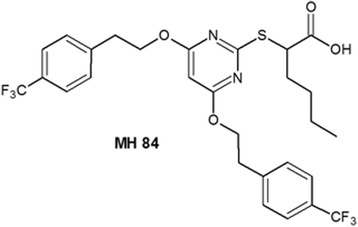
Current approved drugs for Alzheimer's disease (AD) only attenuate symptoms, but do not cure the disease. The pirinixic acid derivate MH84 has been characterized as a dual gamma-secretase/proliferator activated receptor gamma (PPARγ) modulator in vitro. Pharmacokinetic studies in mice showed that MH84 is bioavailable after oral administration and reaches the brain. We recently demonstrated that MH84 improved mitochondrial dysfunction in a cellular model of AD. In the present study, we extended the pharmacological characterization of MH84 to 3-month-old Thy-1 AβPP mice (harboring the Swedish and London mutation in human amyloid precursor protein (APP)) which are characterized by enhanced AβPP processing and cerebral mitochondrial dysfunction, representing a mouse model of early AD.
Three-month-old Thy-1 AβPP mice received 12 mg/kg b.w. MH84 by oral gavage once a day for 21 days. Mitochondrial respiration was analyzed in isolated brain mitochondria, and mitochondrial membrane potential and ATP levels were determined in dissociated brain cells. Citrate synthase (CS) activity was determined in brain tissues and MitoTracker Green fluorescence was measured in HEK293-AβPPwt and HEK293-AβPPsw cells. Soluble Aβ and Aβ levels were determined using ELISA. Western blot analysis and qRT-PCR were used to measure protein and mRNA levels, respectively.
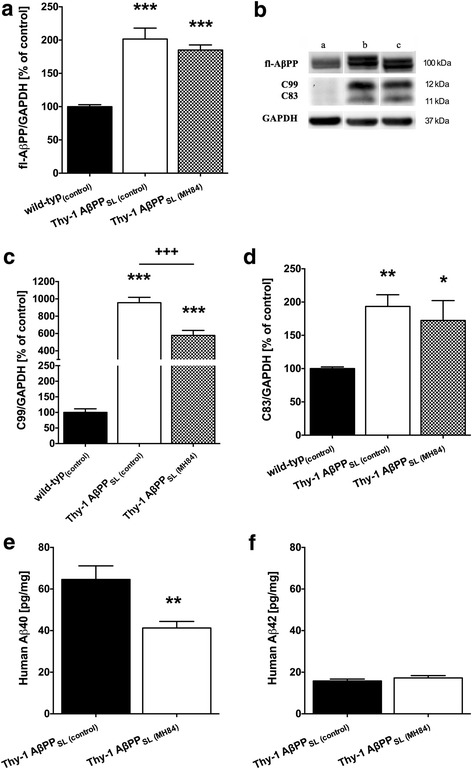
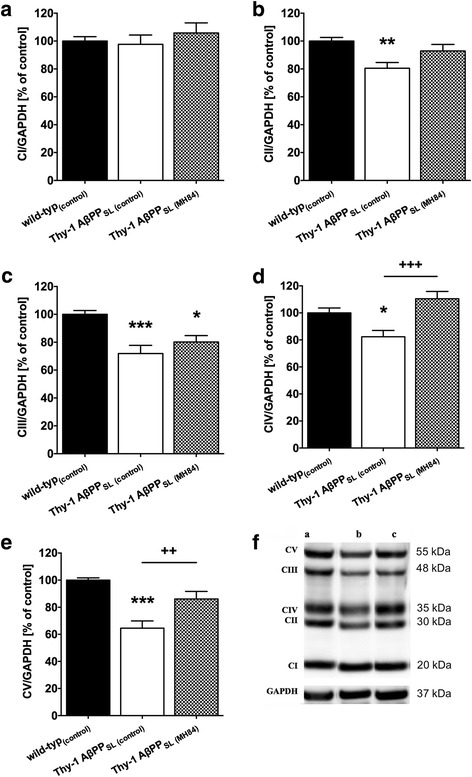
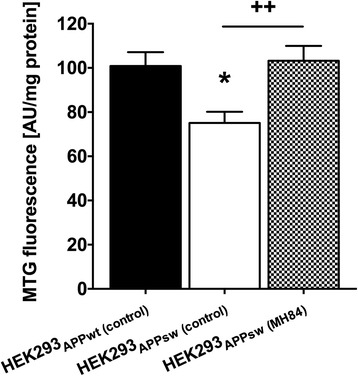
MH84 reduced cerebral levels of the β-secretase-related C99 peptide and of Aβ40 levels. Mitochondrial dysfunction was ameliorated by restoring complex IV (cytochrome-c oxidase) respiration, mitochondrial membrane potential, and levels of ATP. Induction of PPARγ coactivator-1α (PGC-1α) mRNA and protein expression was identified as a possible mode of action that leads to increased mitochondrial mass as indicated by enhanced CS activity, OXPHOS levels, and MitoTracker Green fluorescence.
MH84 modulates β-secretase processing of APP and improves mitochondrial dysfunction by a PGC-1α-dependent mechanism. Thus, MH84 seems to be a new promising therapeutic agent with approved in-vivo activity for the treatment of AD.
目前用于治疗阿尔茨海默病(AD)的获批药物只能缓解症状,而不能治愈该疾病。吡咯烷酮酸衍生物 MH84 已被鉴定为体外的双重 γ-分泌酶/增殖激活受体 γ(PPARγ)调节剂。在小鼠的药代动力学研究中表明 MH84 经口服给药后具有生物利用度,并能到达大脑。我们最近证明 MH84 改善了 AD 细胞模型中的线粒体功能障碍。在本研究中,我们将 MH84 的药理作用特征扩展到 3 月龄的 Thy-1 AβPP 小鼠(携带人淀粉样前体蛋白(APP)的瑞典和伦敦突变),这些小鼠表现出增强的 AβPP 加工和大脑线粒体功能障碍,代表了 AD 的早期小鼠模型。
3 月龄的 Thy-1 AβPP 小鼠每天经口灌胃 12mg/kg 体重 MH84,共 21 天。在分离的脑线粒体中分析线粒体呼吸,在分离的脑细胞中测定线粒体膜电位和 ATP 水平。在脑组织中测定柠檬酸合酶(CS)活性,在 HEK293-AβPPwt 和 HEK293-AβPPsw 细胞中测定 MitoTracker Green 荧光。使用 ELISA 测定可溶性 Aβ 和 Aβ 水平。使用 Western blot 分析和 qRT-PCR 分别测量蛋白和 mRNA 水平。
MH84 降低了大脑中与β-分泌酶相关的 C99 肽和 Aβ40 水平。通过恢复复合物 IV(细胞色素 c 氧化酶)呼吸、线粒体膜电位和 ATP 水平来改善线粒体功能障碍。诱导过氧化物酶体增殖物激活受体γ共激活因子-1α(PGC-1α)mRNA 和蛋白表达被鉴定为一种可能的作用机制,导致 CS 活性、OXPHOS 水平和 MitoTracker Green 荧光增强,从而增加线粒体质量。
MH84 通过 PGC-1α 依赖性机制调节 APP 的 β-分泌酶加工并改善线粒体功能障碍。因此,MH84 似乎是一种新的有前景的治疗药物,具有治疗 AD 的体内批准活性。