
空间技术在癌症研究中的适用性。
Applicability of Spatial Technology in Cancer Research.
机构信息
Department of Pathology, Korea University Anam Hospital, Korea University College of Medicine, Seoul, Korea.
Artificial Intelligence Center, Korea University Anam Hospital, Korea University College of Medicine, Seoul, Korea.
出版信息
Cancer Res Treat. 2024 Apr;56(2):343-356. doi: 10.4143/crt.2023.1302. Epub 2024 Jan 30.
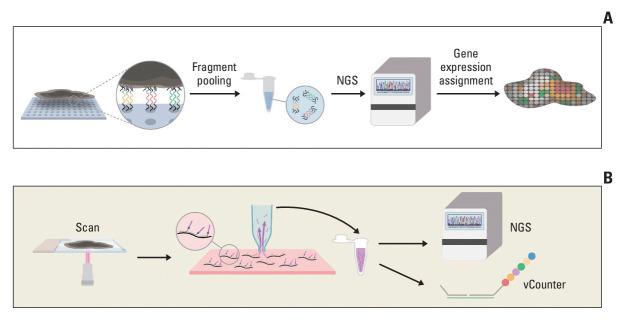
This review explores spatial mapping technologies in cancer research, highlighting their crucial role in understanding the complexities of the tumor microenvironment (TME). The TME, which is an intricate ecosystem of diverse cell types, has a significant impact on tumor dynamics and treatment outcomes. This review closely examines cutting-edge spatial mapping technologies, categorizing them into capture-, imaging-, and antibody-based approaches. Each technology was scrutinized for its advantages and disadvantages, factoring in aspects such as spatial profiling area, multiplexing capabilities, and resolution. Additionally, we draw attention to the nuanced choices researchers face, with capture-based methods lending themselves to hypothesis generation, and imaging/antibody-based methods that fit neatly into hypothesis testing. Looking ahead, we anticipate a scenario in which multi-omics data are seamlessly integrated, artificial intelligence enhances data analysis, and spatiotemporal profiling opens up new dimensions.
本文综述了癌症研究中的空间图谱技术,强调了它们在理解肿瘤微环境(TME)复杂性方面的关键作用。TME 是一个由多种细胞类型组成的复杂生态系统,对肿瘤动力学和治疗结果有重大影响。本文仔细研究了前沿的空间图谱技术,将其分为捕获、成像和基于抗体的方法。每种技术都因其优点和缺点进行了评估,考虑了空间分析面积、多重检测能力和分辨率等因素。此外,我们还注意到研究人员面临的细微选择,基于捕获的方法有助于产生假说,而基于成像/抗体的方法则非常适合假设检验。展望未来,我们预计多组学数据将实现无缝整合,人工智能将增强数据分析,时空分析将开辟新的维度。


 Zotero 插件