Department of Medicine, Case Western Reserve University and University Hospitals Cleveland Medical Center, Cleveland, Ohio, United States of America.
Department of Nutrition, Center for Proteomics and Bioinformatics, Case Western Reserve University School of Medicine, Cleveland, Ohio, United States of America.
PLoS One. 2024 Feb 1;19(2):e0295312. doi: 10.1371/journal.pone.0295312. eCollection 2024.
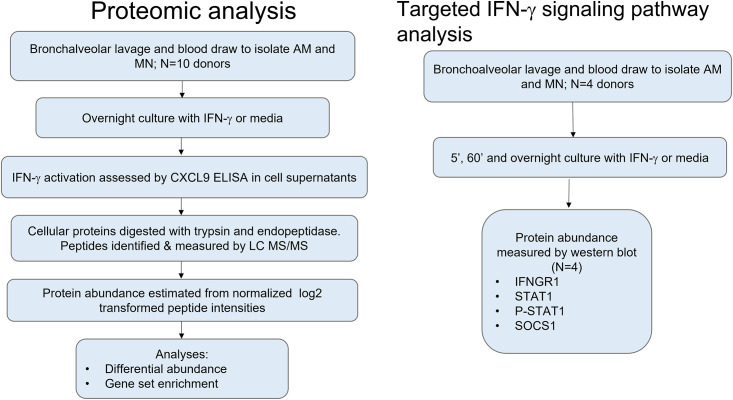
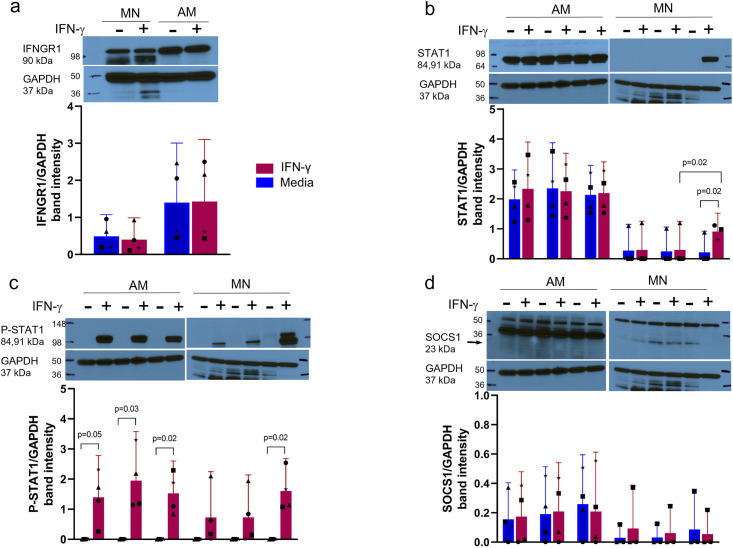
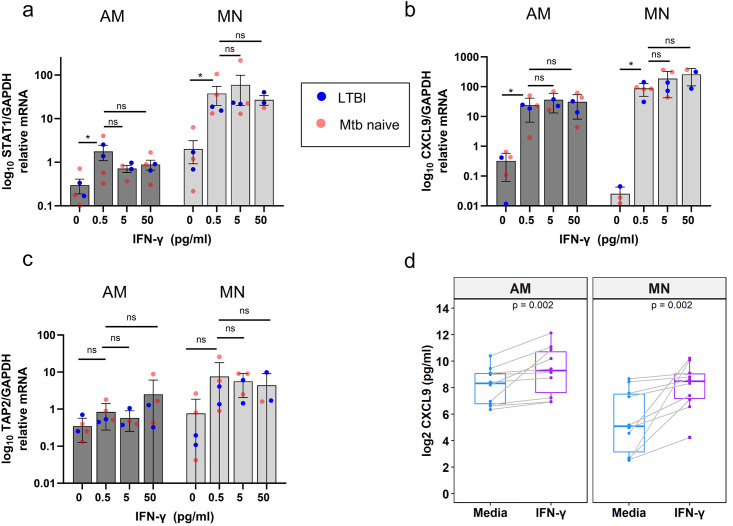
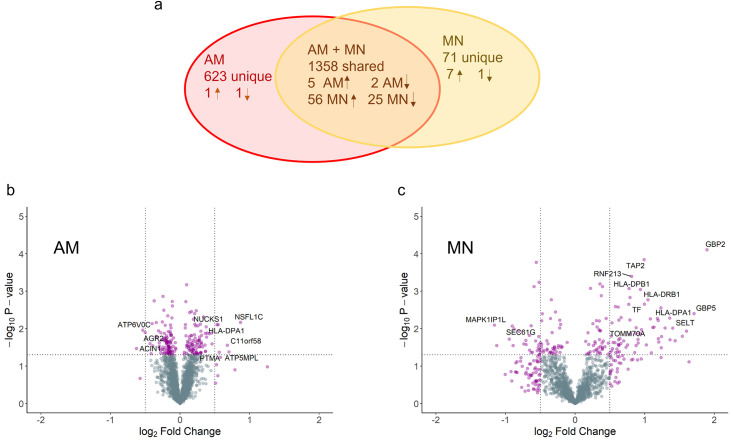
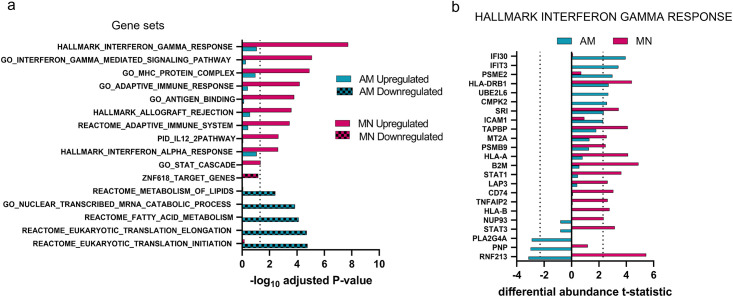
Alveolar macrophages (AM) perform a primary defense mechanism in the lung through phagocytosis of inhaled particles and microorganisms. AM are known to be relatively immunosuppressive consistent with the aim to limit alveolar inflammation and maintain effective gas exchange in the face of these constant challenges. How AM respond to T cell derived cytokine signals, which are critical to the defense against inhaled pathogens, is less well understood. For example, successful containment of Mycobacterium tuberculosis (Mtb) in lung macrophages is highly dependent on IFN-γ secreted by Th-1 lymphocytes, however, the proteomic IFN-γ response profile in AM remains mostly unknown. In this study, we measured IFN-γ induced protein abundance changes in human AM and autologous blood monocytes (MN). AM cells were activated by IFN-γ stimulation resulting in STAT1 phosphorylation and production of MIG/CXCL9 chemokine. However, the global proteomic response to IFN-γ in AM was dramatically limited in comparison to that of MN (9 AM vs 89 MN differentially abundant proteins). AM hypo-responsiveness was not explained by reduced JAK-STAT1 signaling nor increased SOCS1 expression. These findings suggest that AM have a tightly regulated response to IFN-γ which may prevent excessive pulmonary inflammation but may also provide a niche for the initial survival and growth of Mtb and other intracellular pathogens in the lung.
肺泡巨噬细胞 (AM) 通过吞噬吸入的颗粒和微生物,在肺部发挥主要防御机制。已知 AM 具有相对的免疫抑制作用,这与限制肺泡炎症和在面对这些持续挑战时保持有效气体交换的目的一致。AM 如何对 T 细胞衍生的细胞因子信号做出反应,对于对抗吸入的病原体至关重要,但 AM 对细胞因子信号的反应的蛋白质组学特征仍知之甚少。例如,结核分枝杆菌 (Mtb) 在肺巨噬细胞中的成功控制高度依赖于 Th1 淋巴细胞分泌的 IFN-γ,然而,AM 中的 IFN-γ 诱导的蛋白质丰度变化的蛋白质组学反应谱仍大多未知。在这项研究中,我们测量了 IFN-γ 刺激人 AM 和自体血单核细胞 (MN) 引起的蛋白质丰度变化。IFN-γ 刺激导致 STAT1 磷酸化和 MIG/CXCL9 趋化因子的产生,从而激活 AM 细胞。然而,与 MN 相比,AM 对 IFN-γ 的整体蛋白质组学反应受到显著限制(9 个 AM 与 89 个 MN 差异丰度蛋白)。AM 反应低下不能用 JAK-STAT1 信号转导减少或 SOCS1 表达增加来解释。这些发现表明,AM 对 IFN-γ 的反应受到严格调控,这可能防止过度的肺部炎症,但也可能为 Mtb 和其他细胞内病原体在肺部的初始存活和生长提供一个小生境。