Cowie Bradley E, Mears Kristian L, S'ari Mark, Lee Ja Kyung, Briceno de Gutierrez Martha, Kalha Curran, Regoutz Anna, Shaffer Milo S P, Williams Charlotte K
Department of Chemistry, University of Oxford, Chemistry Research Laboratory, 12 Mansfield Road, Oxford OX1 3TA, U.K.
Johnson Matthey, Johnson Matthey, Blounts Court, Sonning Common, Reading RG4 9NH, U.K.
J Am Chem Soc. 2024 Feb 14;146(6):3816-3824. doi: 10.1021/jacs.3c10892. Epub 2024 Feb 1.
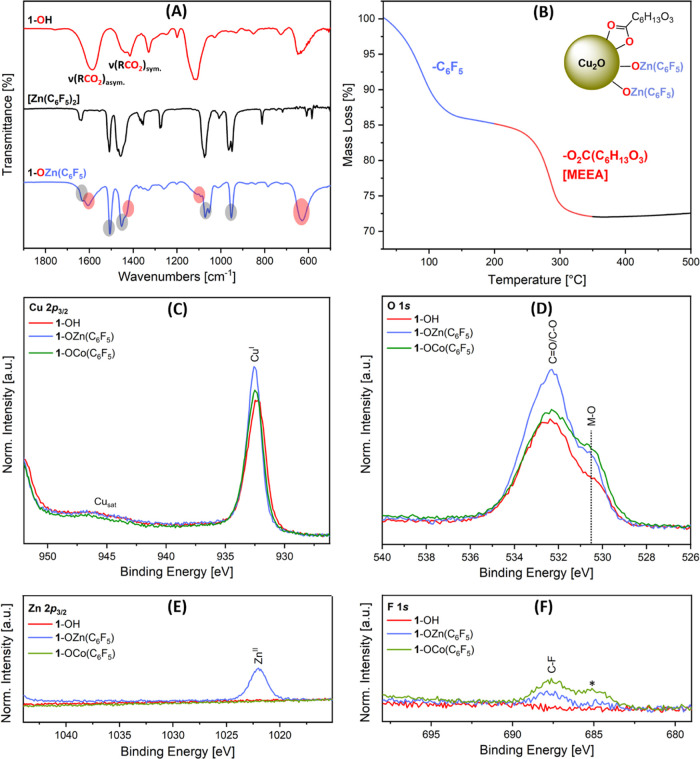
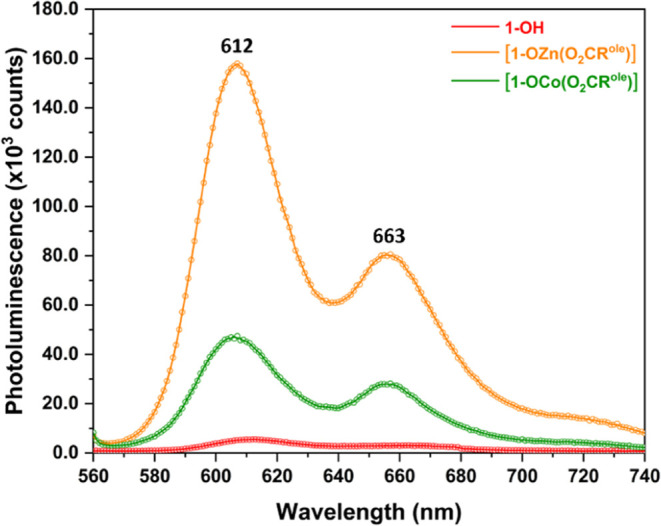
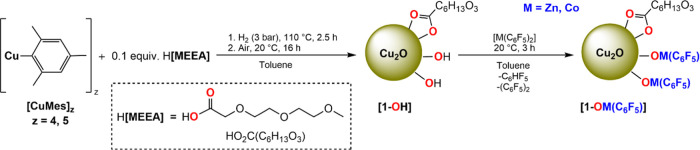
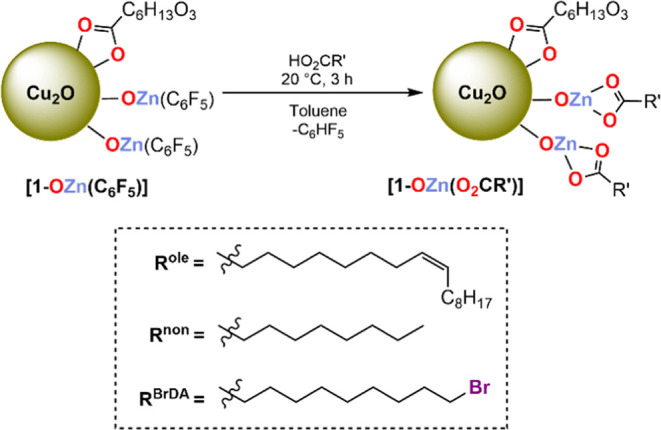
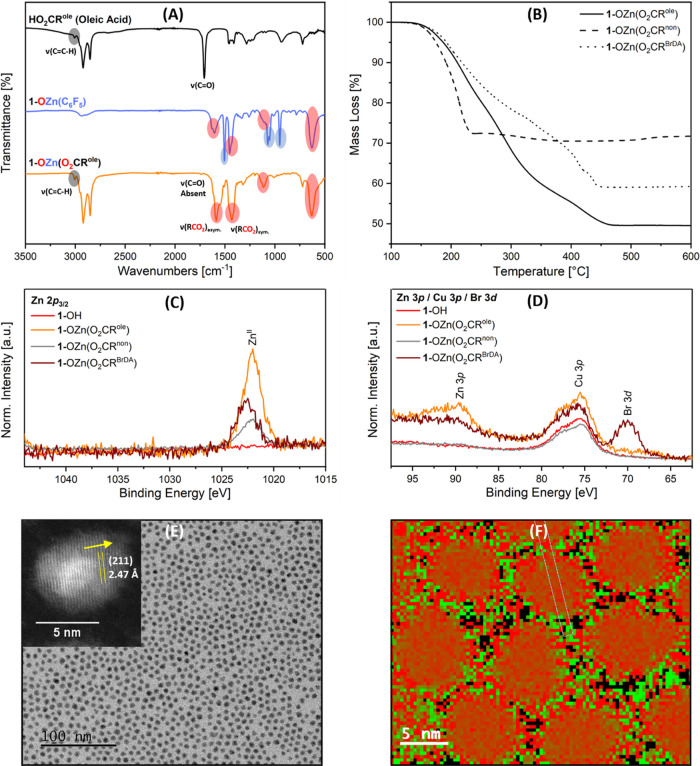
The ligand chemistry of colloidal semiconductor nanocrystals mediates their solubility, band gap, and surface facets. Here, selective organometallic chemistry is used to prepare small, colloidal cuprous oxide nanocrystals and to control their surface chemistry by decorating them with metal complexes. The strategy is demonstrated using small (3-6 nm) cuprous oxide (CuO) colloidal nanocrystals (NC), soluble in organic solvents. Organometallic complexes are coordinated by reacting the surface Cu-OH bonds with organometallic reagents, M(CF), M = Zn(II) and Co(II), at room temperature. These reactions do not disrupt the CuO crystallinity or nanoparticle size; rather, they allow for the selective coordination of a specific metal complex at the surface. Subsequently, the surface-coordinated organometallic complex is reacted with three different carboxylic acids to deliver Cu-O-Zn(OCR') complexes. Selective nanocrystal surface functionalization is established using spectroscopy (IR, F NMR), thermal gravimetric analyses (TGA), transmission electron microscopy (TEM, EELS), and X-ray photoelectron spectroscopy (XPS). Photoluminescence efficiency increases dramatically upon organometallic surface functionalization relative to that of the parent CuO NC, with the effect being most pronounced for Zn(II) decoration. The nanocrystal surfaces are selectively functionalized by both organic ligands and well-defined organometallic complexes; this synthetic strategy may be applicable to many other metal oxides, hydroxides, and semiconductors. In the future, it should allow NC properties to be designed for applications including catalysis, sensing, electronics, and quantum technologies.
胶体半导体纳米晶体的配体化学决定了它们的溶解度、带隙和表面晶面。在此,利用选择性有机金属化学方法制备了小尺寸的胶体氧化亚铜纳米晶体,并通过用金属配合物修饰来控制其表面化学性质。该策略通过使用可溶于有机溶剂的小尺寸(3 - 6纳米)氧化亚铜(CuO)胶体纳米晶体(NC)得以证明。在室温下,通过使表面的Cu - OH键与有机金属试剂M(CF)(M = Zn(II)和Co(II))反应,使有机金属配合物配位。这些反应不会破坏CuO的结晶度或纳米颗粒尺寸;相反,它们允许在表面选择性地配位特定的金属配合物。随后,使表面配位的有机金属配合物与三种不同的羧酸反应,生成Cu - O - Zn(OCR')配合物。利用光谱学(红外光谱、氟核磁共振)、热重分析(TGA)、透射电子显微镜(TEM、电子能量损失谱)和X射线光电子能谱(XPS)确定了选择性纳米晶体表面功能化。相对于母体CuO NC,有机金属表面功能化后光致发光效率显著提高,其中Zn(II)修饰的效果最为明显。纳米晶体表面通过有机配体和定义明确的有机金属配合物进行选择性功能化;这种合成策略可能适用于许多其他金属氧化物、氢氧化物和半导体。未来,它应能使纳米晶体的性质得以设计,用于催化、传感、电子和量子技术等应用领域。