Innovation Field In-vitro Diagnostics, Fraunhofer Institute for Interfacial Engineering and Biotechnology IGB, Stuttgart, Germany.
Institute for Interfacial Engineering and Plasma Technology IGVP, University of Stuttgart, Stuttgart, Germany.
Mol Cancer. 2024 Feb 2;23(1):28. doi: 10.1186/s12943-024-01943-x.
Current diagnostics for the detection of pancreato-biliary cancers (PBCs) need to be optimized. We therefore propose that methylated cell-free DNA (cfDNA) derived from non-invasive liquid biopsies serves as a novel biomarker with the ability to discriminate pancreato-biliary cancers from non-cancer pancreatitis patients.
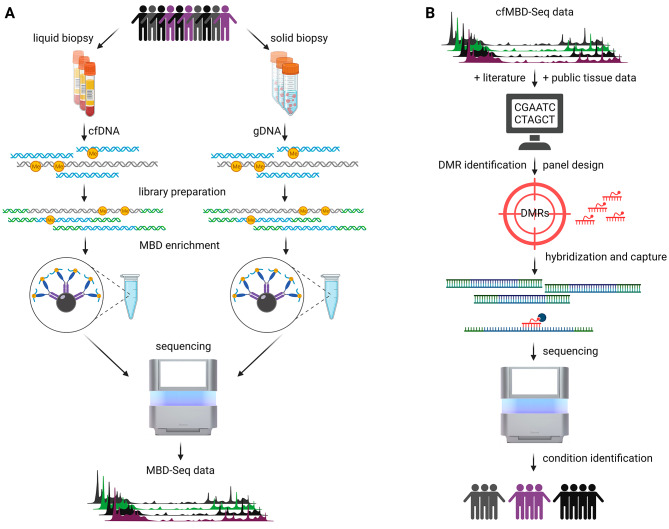
Differentially methylated regions (DMRs) from plasma cfDNA between PBCs, pancreatitis and clinical control samples conditions were identified by next-generation sequencing after enrichment using methyl-binding domains and database searches to generate a discriminatory panel for a hybridization and capture assay with subsequent targeted high throughput sequencing.
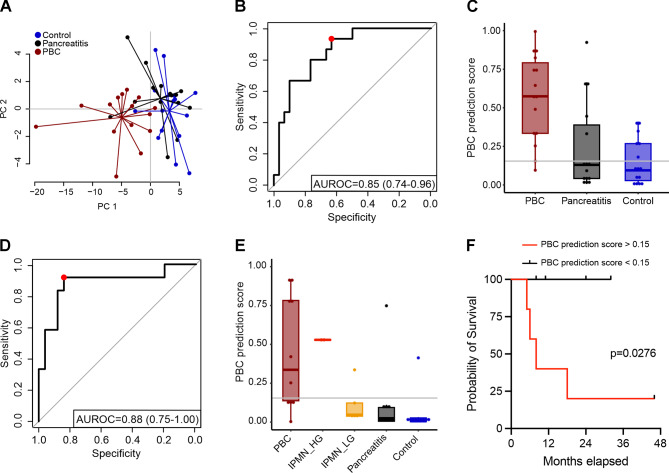
The hybridization and capture panel, covering around 74 kb in total, was applied to sequence a cohort of 25 PBCs, 25 pancreatitis patients, 25 clinical controls, and seven cases of Intraductal Papillary Mucinous Neoplasia (IPMN). An unbiased machine learning approach identified the 50 most discriminatory methylation markers for the discrimination of PBC from pancreatitis and controls resulting in an AUROC of 0.85 and 0.88 for a training (n = 45) and a validation (n = 37) data set, respectively. The panel was also able to distinguish high grade from low grade IPMN samples.
We present a proof of concept for a methylation biomarker panel with better performance and improved discriminatory power than the current clinical marker CA19-9 for the discrimination of pancreato-biliary cancers from non-cancerous pancreatitis patients and clinical controls. This workflow might be used in future diagnostics for the detection of precancerous lesions, e.g. the identification of high grade IPMNs vs. low grade IPMNs.
目前用于检测胰胆管癌(PBC)的诊断方法需要优化。因此,我们提出,源自非侵入性液体活检的甲基化游离 DNA(cfDNA)可作为一种新型生物标志物,用于区分胰胆管癌与非癌性胰腺炎患者。
通过下一代测序,在使用甲基结合域和数据库搜索对血浆 cfDNA 进行富集后,鉴定出 PBC、胰腺炎和临床对照样本之间的差异甲基化区域(DMR),以生成杂交和捕获分析的区分性面板,随后进行靶向高通量测序。
杂交和捕获面板总共覆盖约 74 kb,应用于对 25 例 PBC、25 例胰腺炎患者、25 例临床对照和 7 例导管内乳头状黏液性肿瘤(IPMN)进行测序。一种无偏机器学习方法确定了 50 个最具区分性的甲基化标记物,用于区分 PBC 与胰腺炎和对照组,从而在训练集(n=45)和验证集(n=37)中分别获得 0.85 和 0.88 的 AUC。该面板还能够区分高级别和低级别 IPMN 样本。
我们提出了一个甲基化生物标志物面板的概念验证,该面板在区分胰胆管癌与非癌性胰腺炎患者和临床对照方面的性能优于当前的临床标志物 CA19-9,且具有更高的区分能力。该工作流程可能用于未来的检测,例如识别高级别 IPMN 与低级别 IPMN。