Department of Clinical Science and Services, Royal Veterinary College, Hatfield, UK.
Columbia Stem Cell Initiative, Columbia University, New York, New York, USA.
J Vet Intern Med. 2024 Mar-Apr;38(2):1035-1042. doi: 10.1111/jvim.17004. Epub 2024 Feb 2.
Relapse is a clinical concern in dogs diagnosed with immune-mediated hemolytic anemia (IMHA), thrombocytopenia (ITP), or polyarthritis (IMPA). The average time to relapse is unknown, and evidence that vaccination is associated with disease relapse is lacking.
HYPOTHESIS/OBJECTIVES: Compare the incidence of relapse in groups of dogs with IMHA, ITP, or IMPA over a 24-month period after diagnosis and compare proportions of dogs that received vaccines in those dogs that did and did not relapse.
One hundred sixty client-owned dogs (73 with IMHA, 55 with ITP, 32 with IMPA).
Medical records of dogs were reviewed with the goal of following cases for a minimum of 2 years. Incidence of relapse was calculated for each disease, and relapse rates in dogs that were or were not vaccinated after diagnosis were compared.
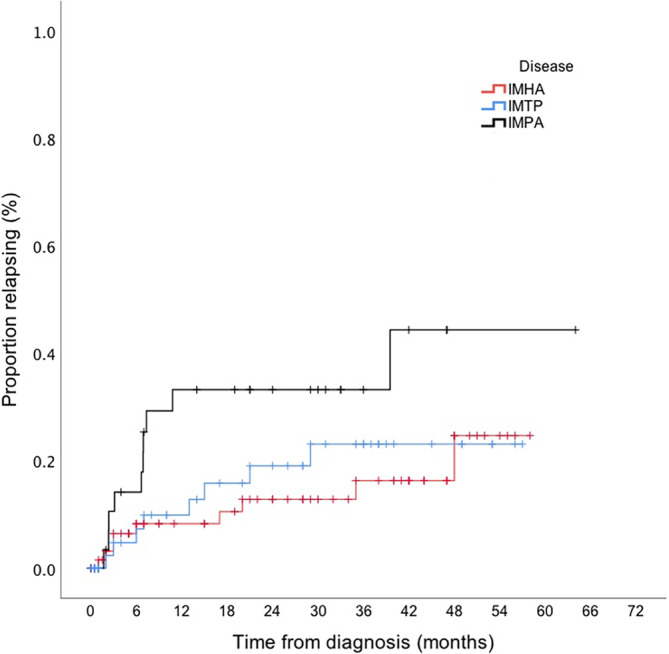
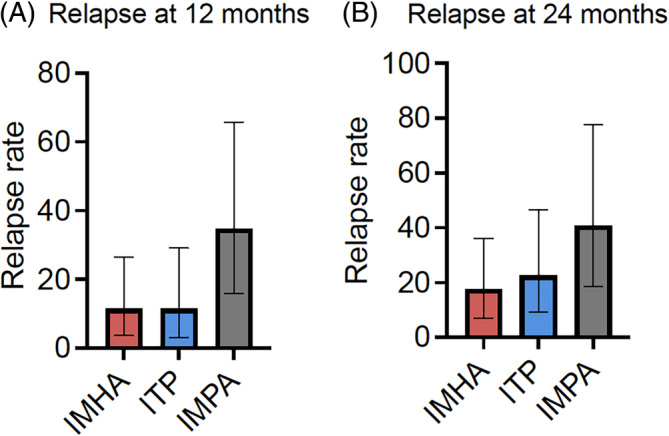
Relapse rates at 12 months differed significantly among disease groups (P = .02), with a higher rate for IMPA (35%) compared to IMHA (11%) or ITP (11%). Relapse rate at 24 months was 41% for IMPA, 18% for IMHA, and 23% for ITP. Ninety percent of IMPA relapses occurred in the first 12 months after diagnosis, compared with 56% for IMHA and 50% for ITP. Vaccine administration after diagnosis was not associated with relapse (P = .78).
Risk of disease relapse in IMPA is highest in the first year after diagnosis, with a higher relapse rate compared with IMHA and ITP. The role of vaccination in disease relapse remains unclear.
在被诊断患有免疫介导性溶血性贫血(IMHA)、血小板减少症(ITP)或多关节炎(IMPA)的犬中,复发是一个临床关注点。复发的平均时间尚不清楚,且缺乏疫苗接种与疾病复发相关的证据。
假设/目的:比较诊断后 24 个月内 IMHA、ITP 或 IMPA 犬组的复发发生率,并比较在复发和未复发的犬中接种疫苗的犬的比例。
160 只患犬(73 只患有 IMHA、55 只患有 ITP、32 只患有 IMPA)。
回顾性分析犬的病历,目标是对至少 2 年的病例进行随访。计算每种疾病的复发率,并比较诊断后接种和未接种疫苗的犬的复发率。
疾病组间 12 个月的复发率差异有统计学意义(P = .02),IMPA(35%)明显高于 IMHA(11%)或 ITP(11%)。24 个月的复发率为 IMPA 41%、IMHA 18%和 ITP 23%。90%的 IMPA 复发发生在诊断后 12 个月内,而 IMHA 为 56%,ITP 为 50%。诊断后疫苗接种与复发无关(P = .78)。
在诊断后第一年,IMPA 的疾病复发风险最高,复发率高于 IMHA 和 ITP。疫苗接种在疾病复发中的作用尚不清楚。