Yang Jing, Gu Zhaowei
Department of Otolaryngology Head and Neck Surgery, Shengjing Hospital of China Medical University, Shenyang, China.
Front Pharmacol. 2024 Jan 19;15:1283465. doi: 10.3389/fphar.2024.1283465. eCollection 2024.
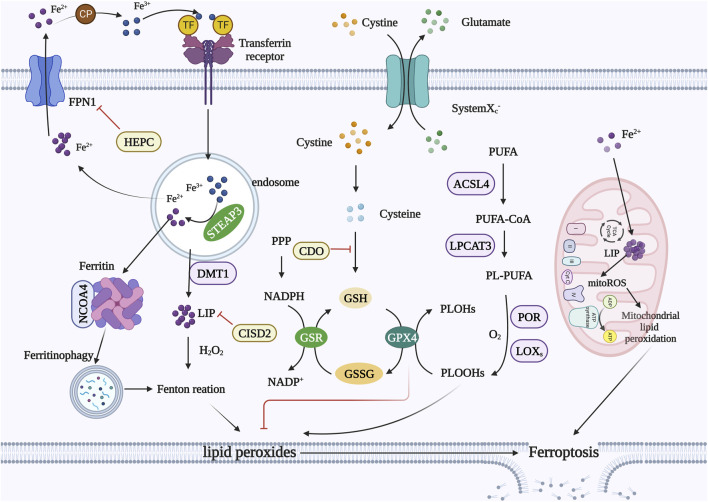
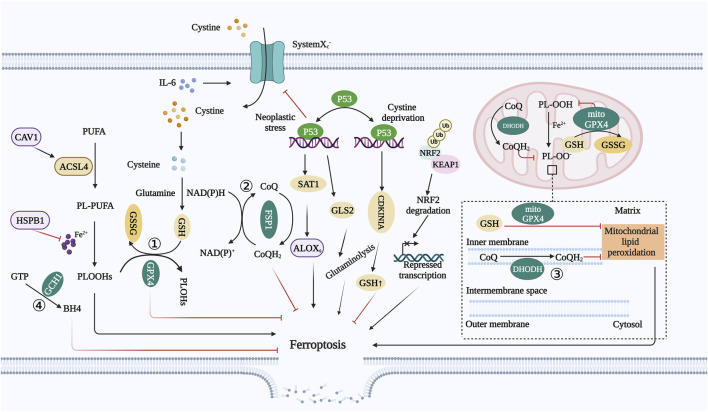
Head and neck squamous cell carcinoma (HNSCC) is the sixth most common malignant tumor worldwide, with high morbidity and mortality. Surgery and postoperative chemoradiotherapy have largely reduced the recurrence and fatality rates for most HNSCCs. Nonetheless, these therapeutic approaches result in poor prognoses owing to severe adverse reactions and the development of drug resistance. Ferroptosis is a kind of programmed cell death which is non-apoptotic. Ferroptosis of tumor cells can inhibit tumor development. Ferroptosis involves various biomolecules and signaling pathways, whose expressions can be adjusted to modulate the sensitivity of cells to ferroptosis. As a tool in the fight against cancer, the activation of ferroptosis is a treatment that has received much attention in recent years. Therefore, understanding the molecular mechanism of ferroptosis in HNSCC is an essential strategy with therapeutic potential. The most important thing to treat HNSCC is to choose the appropriate treatment method. In this review, we discuss the molecular and defense mechanisms of ferroptosis, analyze the role and mechanism of ferroptosis in the inhibition and immunity against HNSCC, and explore the therapeutic strategy for inducing ferroptosis in HNSCC including drug therapy, radiation therapy, immunotherapy, nanotherapy and comprehensive treatment. We find ferroptosis provides a new target for HNSCC treatment.
头颈部鳞状细胞癌(HNSCC)是全球第六大常见恶性肿瘤,发病率和死亡率都很高。手术及术后放化疗在很大程度上降低了大多数HNSCC的复发率和死亡率。尽管如此,由于严重的不良反应和耐药性的产生,这些治疗方法导致预后较差。铁死亡是一种非凋亡性的程序性细胞死亡。肿瘤细胞的铁死亡可以抑制肿瘤发展。铁死亡涉及多种生物分子和信号通路,其表达可被调节以调控细胞对铁死亡的敏感性。作为对抗癌症的一种手段,激活铁死亡是近年来备受关注的一种治疗方法。因此,了解HNSCC中铁死亡的分子机制是一种具有治疗潜力的重要策略。治疗HNSCC最重要的是选择合适的治疗方法。在本综述中,我们讨论了铁死亡的分子和防御机制,分析了铁死亡在抑制HNSCC及免疫方面的作用和机制,并探讨了诱导HNSCC铁死亡的治疗策略,包括药物治疗、放射治疗、免疫治疗、纳米治疗和综合治疗。我们发现铁死亡为HNSCC治疗提供了一个新靶点。