Tugend Margaret, Dattero Jordan, Shore Tsiporah, Korobeynikov Vladislav, Sekula Raymond F
Department of Neurological Surgery, Columbia University, New York Presbyterian Hospital, New York, NY, United States.
Department of Brain and Cognitive Sciences, Massachusetts Institute of Technology, Boston, MA, United States.
Front Oncol. 2024 Jan 19;14:1284577. doi: 10.3389/fonc.2024.1284577. eCollection 2024.
Primary central nervous system, diffuse large B-cell lymphoma, post-transplant lymphoproliferative disorder in the cerebellopontine angle after an allogeneic stem cell transplantation has never been reported in the literature. Typically, diffuse large B-cell lymphoma is non-polyploid. We report the first case of a patient with polyploid post-transplant lymphoproliferative disorder in the cerebellopontine angle who presented with back pain.
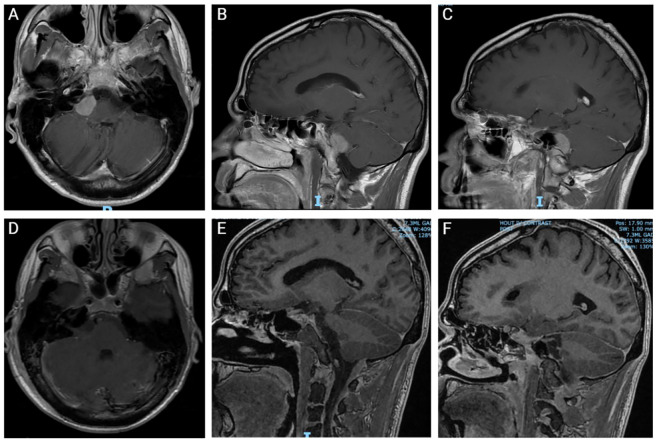
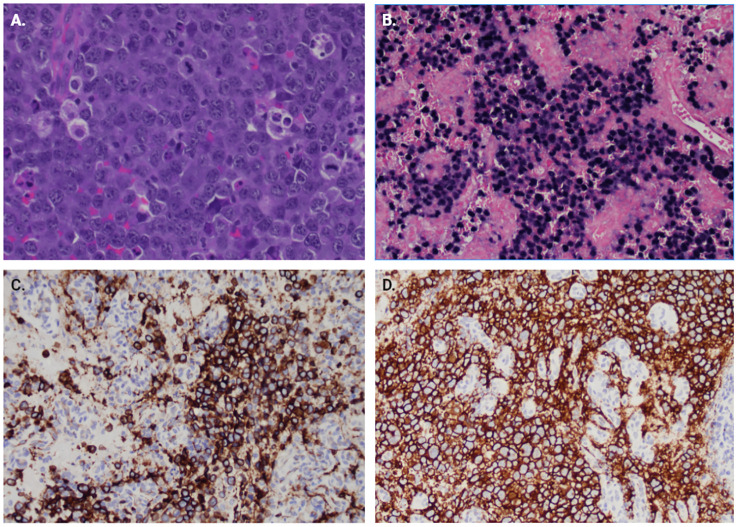
A 45-year-old man with a history of nodular sclerosing classic Hodgkin lymphoma stage IIB treated with systemic chemotherapy, external radiation and autologous stem cell transplant and double umbilical cord allogeneic transplant presented with several weeks of back pain. He was found to have a small right cerebellopontine angle mass thought to be consistent with a meningioma. Patient presented again two weeks later with acute onset of severe headache, right sided ptosis, right facial numbness, weakness and possible seizure event. Repeat MRI scans showed an interval and significant increase of the right cerebellopontine angle lesion. Biopsy of the cerebellopontine angle lesion was planned with suspicion of lymphoma. Intraoperative pathology consultation findings were not consistent with an acoustic neuroma, meningioma, or epidermoid cyst. Lymphoma could not be definitively identified by intra-operative frozen section. However, it was suspected, and a portion of fresh specimen was submitted for flow cytometry analysis. A near total resection of the tumor and decompression of the brainstem was achieved. Final pathologic analysis was positive for post-transplant lymphoproliferative disorder, monomorphic type, diffuse large B-cell lymphoma, non-germinal center B-cell type, EBV+, post-transplant (allogeneic stem cell) setting (post-transplant lymphoproliferative disorder (PTLD), monomorphic type, diffuse large B-cell lymphoma, non-germinal center B-cell type (non-GCB), EBV-positive under pre-2022 WHO terminology). The patient began a high-dose methotrexate-based regimen (the MATRIX regimen).
Our case illustrates an unusual presentation of post-transplant lymphoproliferative disorder in the cerebellopontine angle in a patient with a remote history of allogeneic stem cell transplantation. It demonstrates the importance of keeping primary central nervous system post-transplant lymphoproliferative disorder on the differential for patients who present with back pain or headache that have a history of allogeneic stem cell transplant.
原发性中枢神经系统弥漫性大B细胞淋巴瘤,异基因干细胞移植后桥小脑角处的移植后淋巴细胞增殖性疾病,此前文献中从未有过报道。通常,弥漫性大B细胞淋巴瘤不是多倍体。我们报告首例桥小脑角处出现多倍体移植后淋巴细胞增殖性疾病且伴有背痛的患者。
一名45岁男性,有结节硬化型经典霍奇金淋巴瘤IIB期病史,接受过全身化疗、外照射、自体干细胞移植及双脐带异基因移植,出现数周背痛。发现其右侧桥小脑角有一个小肿块,考虑与脑膜瘤相符。两周后患者再次就诊,出现急性严重头痛、右侧上睑下垂、右侧面部麻木、无力及可能的癫痫发作。重复MRI扫描显示右侧桥小脑角病变在短期内显著增大。因怀疑淋巴瘤,计划对桥小脑角病变进行活检。术中病理会诊结果与听神经瘤、脑膜瘤或表皮样囊肿不符。术中冰冻切片无法明确诊断为淋巴瘤。然而,怀疑为淋巴瘤,遂将一部分新鲜标本送去做流式细胞术分析。肿瘤实现了近全切除及脑干减压。最终病理分析显示移植后淋巴细胞增殖性疾病呈阳性,为单形性、弥漫性大B细胞淋巴瘤、非生发中心B细胞型、EBV阳性、移植后(异基因干细胞)情况(按照2-22年之前的世界卫生组织术语,为移植后淋巴细胞增殖性疾病(PTLD),单形性、弥漫性大B细胞淋巴瘤、非生发中心B细胞型(非GCB)、EBV阳性)。患者开始接受基于大剂量甲氨蝶呤的方案(MATRIX方案)。
我们的病例说明了一名有远期异基因干细胞移植病史的患者,桥小脑角处出现不寻常的移植后淋巴细胞增殖性疾病。它表明对于有异基因干细胞移植病史且出现背痛或头痛的患者,鉴别诊断时考虑原发性中枢神经系统移植后淋巴细胞增殖性疾病的重要性。