Department of Pharmacy Practice, Faculty of Pharmacy, Bahauddin Zakariya University, Multan, Pakistan.
Discipline of Social and Administrative Pharmacy, School of Pharmaceutical Sciences, University Sains Malaysia, Penang, Malaysia.
Ann Med. 2024 Dec;56(1):2313683. doi: 10.1080/07853890.2024.2313683. Epub 2024 Feb 12.
The Directly Observed Treatment-Short Course (DOTS) Programme was implemented by WHO and includes a combination of four anti-tuberculosis (TB) drugs (isoniazid, pyrazinamide, ethambutol and rifampicin) for a period of six months to eradicate the TB infection completely. Diabetes mellitus (DM) is recognized as one of a strong contributor of TB according to World Health Organization (WHO). The presence of diabetes mellitus type 2 (DM type 2) makes TB treatment complicated. Thus, the objective of the current meta-analysis was to identify and quantify the impact of type 2 DM on treatment outcomes of TB patients treated under the DOTS Programme.
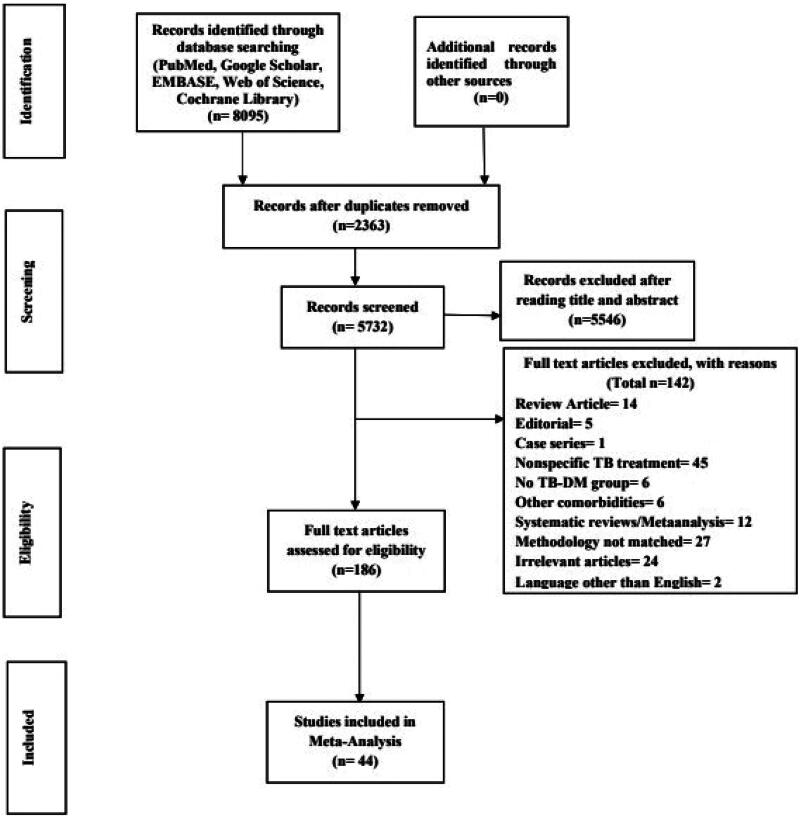
This meta-analysis was performed according to the Preferred Reporting Items for Systematic Reviews and Meta-Analyses (PRISMA) guidelines. Through a systematic review of relevant literature, we focused on studies investigating treatment outcomes including extended treatment duration and recurrence for individuals with both TB and DM undergoing DOTS therapy. The extracted information included study designs, sample sizes, patient characteristics and reported treatment results.
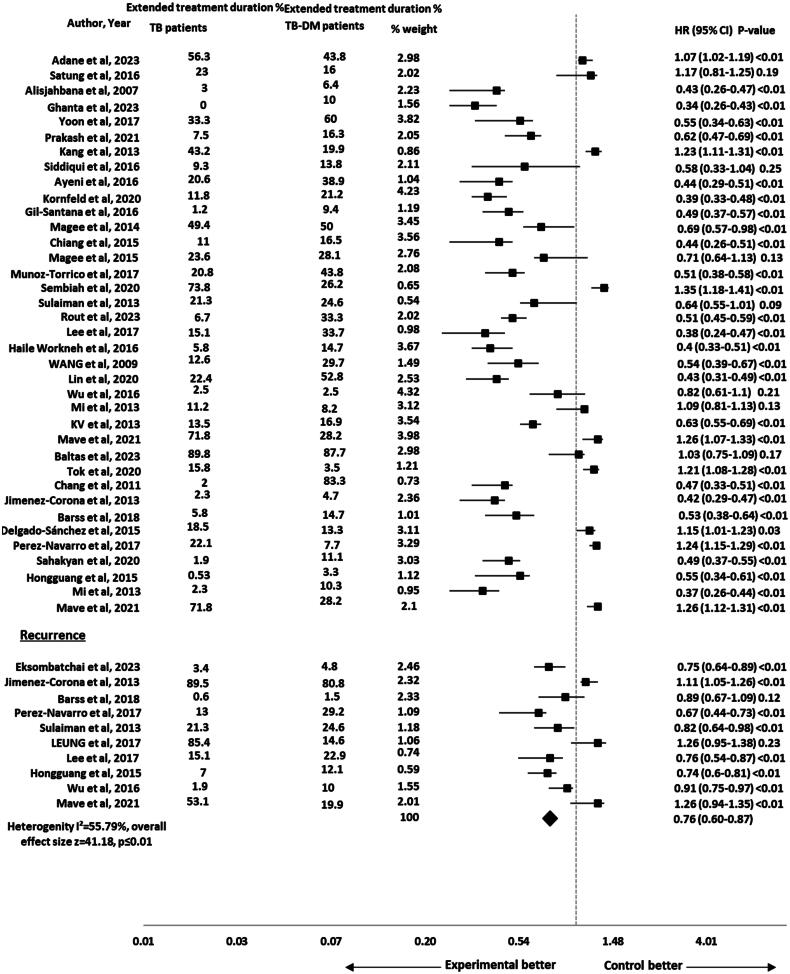
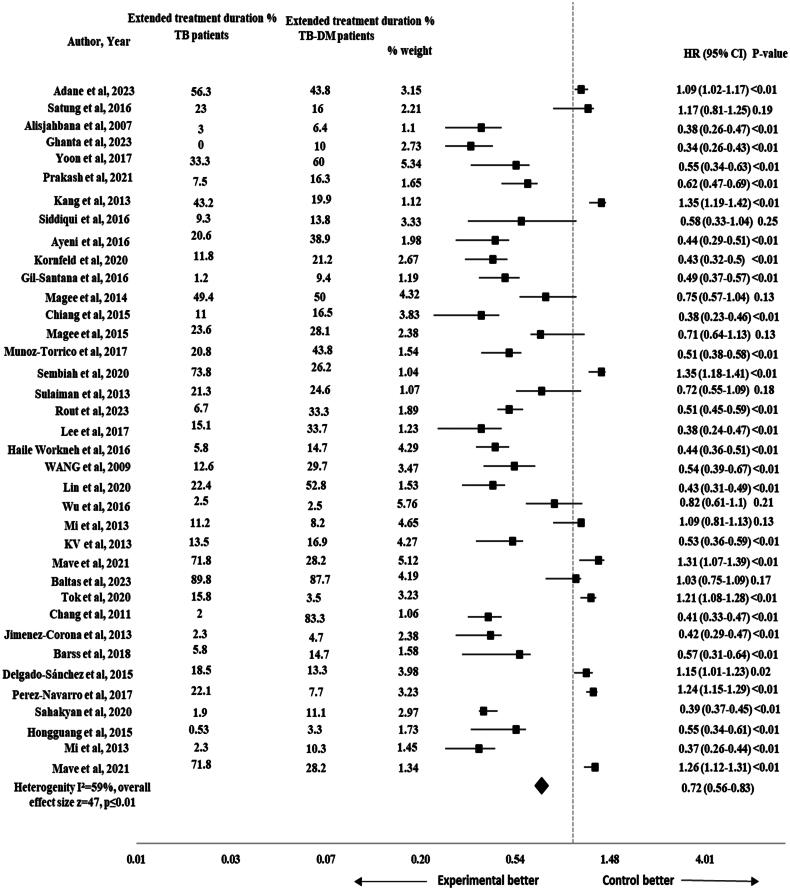
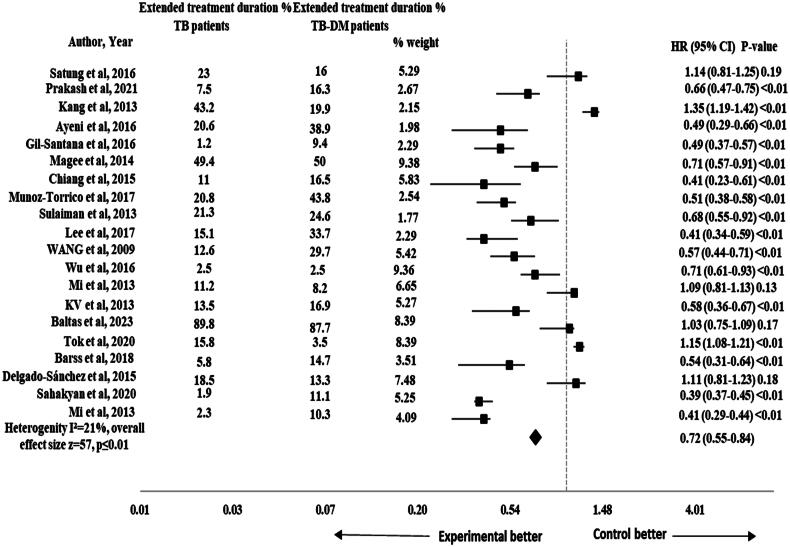
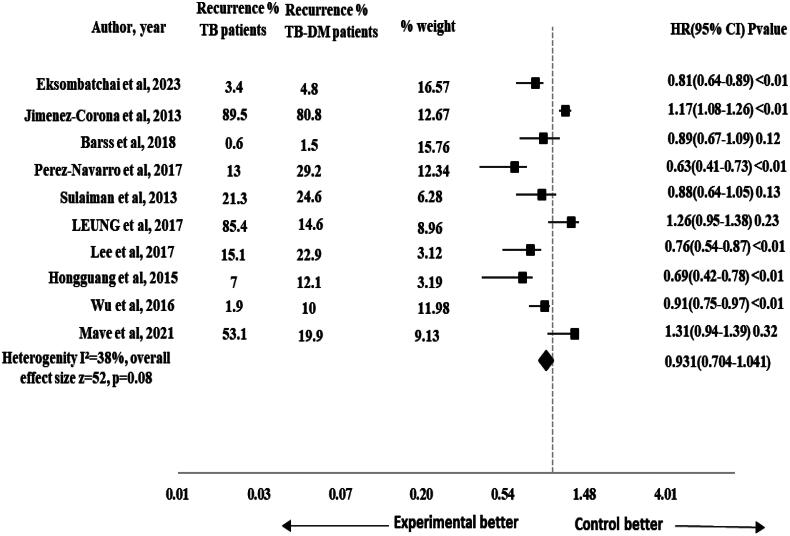
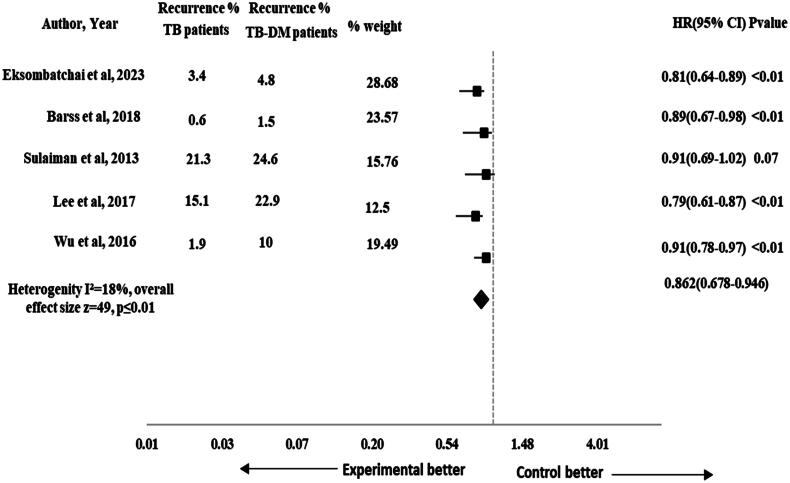
In 44 studies from different parts of the world, the pooled HR for the impact of DM on extended treatment duration and reoccurrence were HR 0.72, 95% CI 0.56-0.83, < .01 and HR 0.93, 95% CI 0.70-1.04, = .08, respectively. The pooled HR for impact of DM on composite TB treatment outcomes was calculated as 0.76 (95% CI 0.60-0.87), < .01 with an effect size of 41.18. The heterogeneity observed among the included studies was moderate ( = 55.79%).
A negative impact of DM was found on recurrence and extended treatment duration in TB patients treated with DOTS therapy. DM type 2 is responsible for the TB treatment prolongation and TB recurrence rates. By implementing effective management strategies and advancing research, the challenges can be mitigated, arising due to the complex interaction between DM and TB.
直接观察治疗短期疗程(DOTS)计划由世界卫生组织(WHO)实施,包括四种抗结核(TB)药物(异烟肼、吡嗪酰胺、乙胺丁醇和利福平)联合使用,为期六个月,以彻底消除 TB 感染。糖尿病(DM)被认为是 TB 的一个主要致病因素。根据世界卫生组织(WHO)的说法,2 型糖尿病(DM 2 型)的存在使 TB 治疗复杂化。因此,目前荟萃分析的目的是确定并量化 2 型糖尿病对接受 DOTS 治疗的 TB 患者治疗结果的影响。
本荟萃分析按照系统评价和荟萃分析的首选报告项目(PRISMA)指南进行。通过对相关文献的系统回顾,我们重点关注了研究治疗结果的研究,包括接受 DOTS 治疗的同时患有 TB 和 DM 的个体延长治疗时间和复发的情况。提取的信息包括研究设计、样本量、患者特征和报告的治疗结果。
在来自世界各地的 44 项研究中,DM 对延长治疗时间和复发的影响的汇总 HR 分别为 HR 0.72,95%CI 0.56-0.83,<0.01 和 HR 0.93,95%CI 0.70-1.04,=0.08。DM 对复合 TB 治疗结果影响的汇总 HR 计算为 0.76(95%CI 0.60-0.87),<0.01,其效应大小为 41.18。纳入研究的异质性为中等(=55.79%)。
在接受 DOTS 治疗的 TB 患者中,DM 对复发和延长治疗时间有负面影响。2 型糖尿病是导致 TB 治疗延长和 TB 复发率增加的原因。通过实施有效的管理策略和推进研究,可以减轻由于 DM 和 TB 之间的复杂相互作用而带来的挑战。