Lim Byeong Min, Lee Yu Min, Yoo Chan Sik, Kim Minjae, Kim Seung Ju, Kim Sungkyu, Yang J Joshua, Lee Hong-Sub
Department of Advanced Materials Engineering for Information and Electronics, Kyung Hee University, Yongin 17104, Republic of Korea.
Integrated Education Institute for Frontier Science & Technology (BK21 Four), Kyung Hee University, Yongin 17104, Republic of Korea.
ACS Nano. 2024 Feb 27;18(8):6373-6386. doi: 10.1021/acsnano.3c11325. Epub 2024 Feb 13.
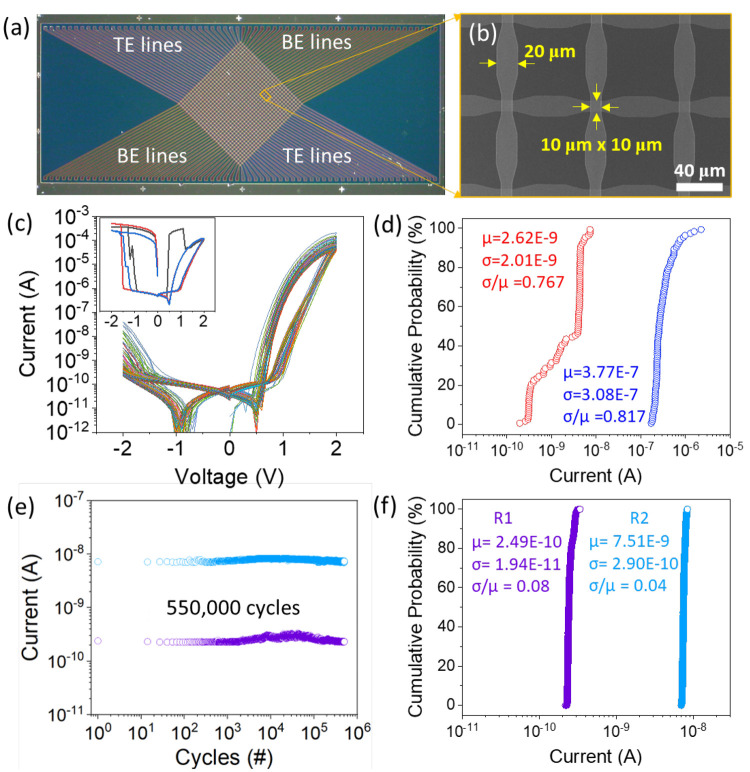
Ionic memristor devices are crucial for efficient artificial neural network computations in neuromorphic hardware. They excel in multi-bit implementation but face challenges like device reliability and sneak currents in crossbar array architecture (CAA). Interface-type ionic memristors offer low variation, self-rectification, and no forming process, making them suitable for CAA. However, they suffer from slow weight updates and poor retention and endurance. To address these issues, the study demonstrated an alkali ion self-rectifying memristor with an alkali metal reservoir formed by a bottom electrode design. By adopting Li metal as the adhesion layer of the bottom electrode, an alkali ion reservoir was formed at the bottom of the memristor layer by diffusion occurring during the atomic layer deposition process for the Na:TiO memristor layer. In addition, Al dopant was used to improve the retention characteristics by suppressing the diffusion of alkali cations. In the memristor device with optimized Al doping, retention characteristics of more than 20 h at 125 °C, endurance characteristics of more than 5.5 × 10, and high linearity/symmetry of weight update characteristics were achieved. In reliability tests on 100 randomly selected devices from a 32 × 32 CAA device, device-to-device and cycle-to-cycle variations showed low variation values within 81% and 8%, respectively.
离子忆阻器器件对于神经形态硬件中高效的人工神经网络计算至关重要。它们在多位实现方面表现出色,但在交叉阵列架构(CAA)中面临诸如器件可靠性和潜行电流等挑战。界面型离子忆阻器具有低变化、自整流且无需形成过程的特点,使其适用于CAA。然而,它们存在权重更新缓慢以及保持性和耐久性较差的问题。为了解决这些问题,该研究展示了一种通过底部电极设计形成碱金属储存器的碱离子自整流忆阻器。通过采用锂金属作为底部电极的粘附层,在用于Na:TiO忆阻器层的原子层沉积过程中,通过扩散在忆阻器层底部形成了一个碱离子储存器。此外,使用铝掺杂剂通过抑制碱阳离子的扩散来改善保持特性。在具有优化铝掺杂的忆阻器器件中,在125°C下实现了超过20小时的保持特性、超过5.5×10的耐久性特性以及权重更新特性的高线性/对称性。在从32×32 CAA器件中随机选择的100个器件的可靠性测试中,器件间和循环间的变化分别在81%和8%以内显示出较低的变化值。