
通过对临床文档的自然语言处理识别痴呆患者的功能状态障碍:横断面研究。
Identifying Functional Status Impairment in People Living With Dementia Through Natural Language Processing of Clinical Documents: Cross-Sectional Study.
机构信息
Department of Medicine, Brigham and Women's Hospital, Boston, MA, United States.
Harvard Medical School, Boston, MA, United States.
出版信息
J Med Internet Res. 2024 Feb 13;26:e47739. doi: 10.2196/47739.
BACKGROUND
Assessment of activities of daily living (ADLs) and instrumental ADLs (iADLs) is key to determining the severity of dementia and care needs among older adults. However, such information is often only documented in free-text clinical notes within the electronic health record and can be challenging to find.
OBJECTIVE
This study aims to develop and validate machine learning models to determine the status of ADL and iADL impairments based on clinical notes.
METHODS
This cross-sectional study leveraged electronic health record clinical notes from Mass General Brigham's Research Patient Data Repository linked with Medicare fee-for-service claims data from 2007 to 2017 to identify individuals aged 65 years or older with at least 1 diagnosis of dementia. Notes for encounters both 180 days before and after the first date of dementia diagnosis were randomly sampled. Models were trained and validated using note sentences filtered by expert-curated keywords (filtered cohort) and further evaluated using unfiltered sentences (unfiltered cohort). The model's performance was compared using area under the receiver operating characteristic curve and area under the precision-recall curve (AUPRC).
RESULTS
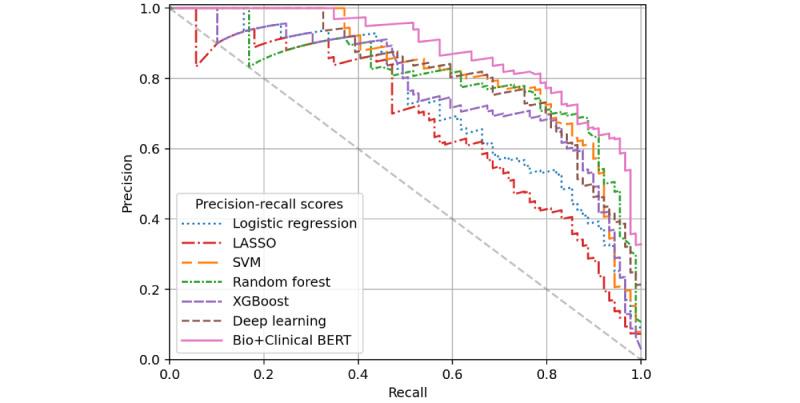
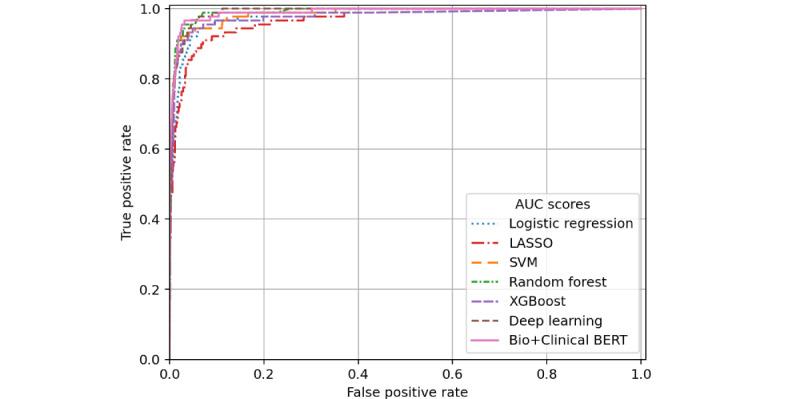
The study included 10,000 key-term-filtered sentences representing 441 people (n=283, 64.2% women; mean age 82.7, SD 7.9 years) and 1000 unfiltered sentences representing 80 people (n=56, 70% women; mean age 82.8, SD 7.5 years). Area under the receiver operating characteristic curve was high for the best-performing ADL and iADL models on both cohorts (>0.97). For ADL impairment identification, the random forest model achieved the best AUPRC (0.89, 95% CI 0.86-0.91) on the filtered cohort; the support vector machine model achieved the highest AUPRC (0.82, 95% CI 0.75-0.89) for the unfiltered cohort. For iADL impairment, the Bio+Clinical bidirectional encoder representations from transformers (BERT) model had the highest AUPRC (filtered: 0.76, 95% CI 0.68-0.82; unfiltered: 0.58, 95% CI 0.001-1.0). Compared with a keyword-search approach on the unfiltered cohort, machine learning reduced false-positive rates from 4.5% to 0.2% for ADL and 1.8% to 0.1% for iADL.
CONCLUSIONS
In this study, we demonstrated the ability of machine learning models to accurately identify ADL and iADL impairment based on free-text clinical notes, which could be useful in determining the severity of dementia.
背景
评估日常生活活动(ADL)和工具性日常生活活动(iADL)是确定老年人痴呆严重程度和护理需求的关键。然而,这些信息通常仅记录在电子健康记录中的自由文本临床记录中,并且难以找到。
目的
本研究旨在开发和验证机器学习模型,以基于临床记录确定 ADL 和 iADL 损伤的状态。
方法
这项横断面研究利用了马萨诸塞州综合医院 Brigham 的研究患者数据存储库中的电子健康记录临床记录,并与 2007 年至 2017 年的医疗保险按服务收费数据相关联,以确定至少有 1 次痴呆诊断的 65 岁及以上的个体。从痴呆诊断的第一个日期之前和之后的 180 天随机抽取就诊记录。使用经过专家精心策划的关键字(过滤队列)过滤的注释句子来训练和验证模型,并使用未过滤的句子(未过滤队列)进一步评估模型。使用接收器操作特征曲线下面积和精度-召回曲线下面积(AUPRC)比较模型的性能。
结果
该研究包括 10000 个关键词过滤句子,代表 441 人(n=283,64.2%为女性;平均年龄 82.7,标准差 7.9 岁)和 1000 个未过滤句子,代表 80 人(n=56,70%为女性;平均年龄 82.8,标准差 7.5 岁)。最佳 ADL 和 iADL 模型在两个队列上的接收器操作特征曲线下面积均较高(>0.97)。对于 ADL 损伤识别,随机森林模型在过滤队列中实现了最佳的 AUPRC(0.89,95%CI 0.86-0.91);支持向量机模型在未过滤队列中实现了最高的 AUPRC(0.82,95%CI 0.75-0.89)。对于 iADL 损伤,基于生物+临床双向转换器表示(BERT)的模型具有最高的 AUPRC(过滤:0.76,95%CI 0.68-0.82;未过滤:0.58,95%CI 0.001-1.0)。与未过滤队列上的关键字搜索方法相比,机器学习将 ADL 的假阳性率从 4.5%降低到 0.2%,将 iADL 的假阳性率从 1.8%降低到 0.1%。
结论
在这项研究中,我们证明了机器学习模型基于自由文本临床记录准确识别 ADL 和 iADL 损伤的能力,这可能有助于确定痴呆的严重程度。


 Zotero 插件