Wageningen Bioveterinary Research, Wageningen University & Research, Lelystad, Netherlands.
Research and Development, Smivet B.V., Wijchen, Netherlands.
Front Immunol. 2024 Jan 30;15:1346328. doi: 10.3389/fimmu.2024.1346328. eCollection 2024.
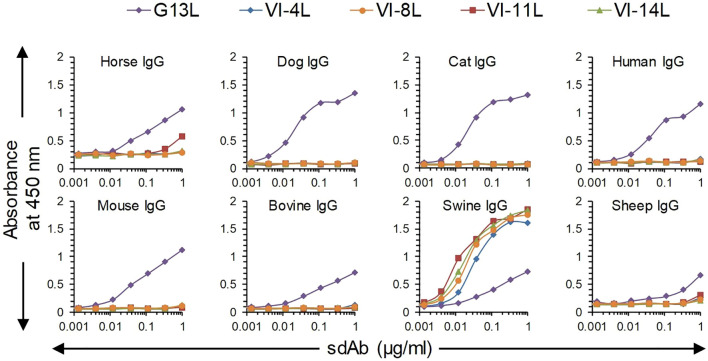
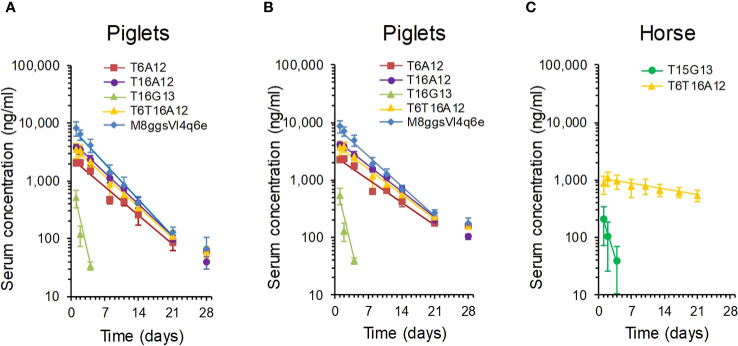
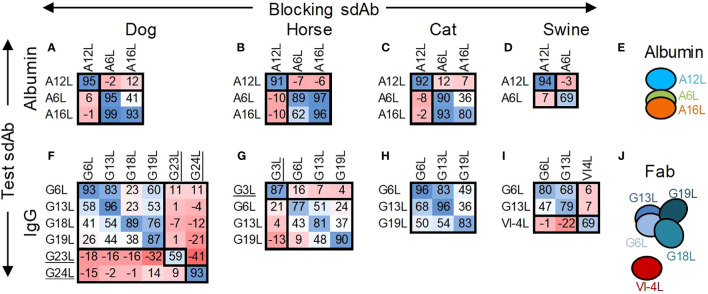
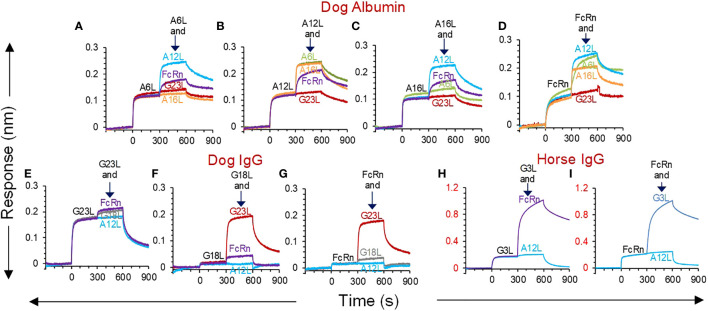
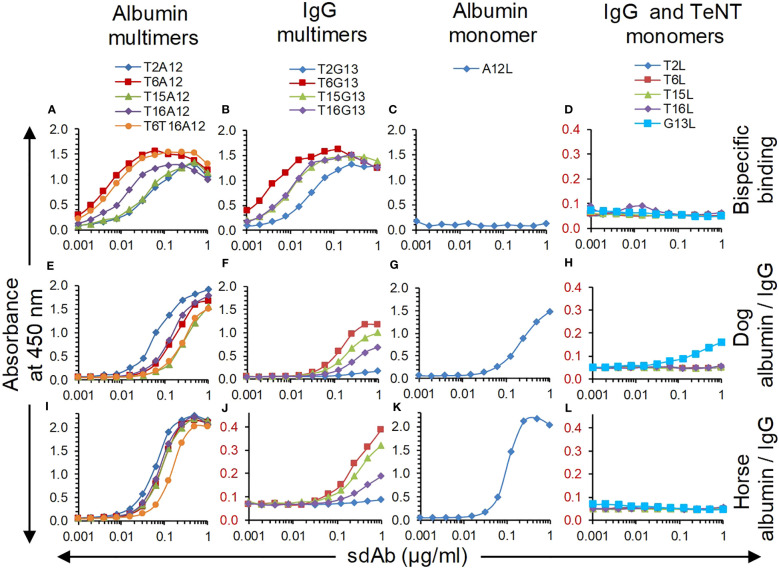
Single-domain antibody fragments (sdAbs) can be isolated from heavy-chain-only antibodies that occur in camelids or the heavy chain of conventional antibodies, that also occur in camelids. Therapeutic application of sdAbs is often complicated by their low serum half-life. Fusion to sdAb that bind to long-lived serum proteins albumin or IgG can prolong serum half-life of fusion partners. Such studies mostly focused on human application. For half-life prolongation in multiple animal species novel species cross-reacting sdAb are needed. We here describe the isolation from immunized llamas of sdAbs G6 and G13 that bound IgG of 9-10 species analysed, including horse, dog, cat, and swine, as well as sdAb A12 that bound horse, dog, swine and cat albumin. A12 bound albumin with 13 to 271 nM affinity dependent on the species. G13 affinity was difficult to determine by biolayer interferometry due to low and heterogeneous signals. G13 and G6 compete for the same binding domain on Fab fragments. Furthermore, they both lack the hallmark residues typical of camelid sdAbs derived from heavy-chain antibodies and had sequence characteristics typical of human sdAbs with high solubility and stability. This suggests they are derived from conventional llama antibodies. They most likely bind IgG through pairing with VL domains at the VH-VL interface rather than a paratope involving complementarity determining regions. None of the isolated sdAb interfered with FcRn binding to albumin or IgG, and thus do not prevent endosomal albumin/IgG-sdAb complex recycling. Fusions of albumin-binding sdAb A12 to several tetanus neurotoxin (TeNT) binding sdAbs prolonged the terminal serum half-life in piglets to about 4 days, comparable to authentic swine albumin. However, G13 conferred a much lower half-life of 0.84 days. Similarly, in horse, G13 prolonged half-life to only 1.2 days whereas A12 fused to two TeNT binding domains (T6T16A12) had a half-life of 21 days. The high half-life of T6T16A12, which earlier proved to be a highly potent TeNT antitoxin, further supports its therapeutic value. Furthermore, we have identified several additional sdAbs that enable tailored half-life extension of biologicals in multiple animal species.
单域抗体片段(sdAbs)可从重链抗体中分离出来,重链抗体仅存在于骆驼或常规抗体的重链中,骆驼也存在常规抗体。sdAbs 的治疗应用通常因血清半衰期短而复杂化。与结合白蛋白或 IgG 的长寿血清蛋白的融合可延长融合伙伴的血清半衰期。此类研究主要集中在人类应用上。为了延长多种动物物种的半衰期,需要新型的种间交叉反应性 sdAbs。在这里,我们描述了从免疫的美洲驼中分离出的 sdAbs G6 和 G13,它们结合了 9-10 种分析的 IgG,包括马、狗、猫和猪,以及结合马、狗、猪和 cat 白蛋白的 sdAb A12。A12 与白蛋白的结合亲和力为 13 至 271 nM,具体取决于物种。由于信号低且不均匀,Biolayer interferometry 难以确定 G13 的亲和力。G13 和 G6 竞争 Fab 片段上的相同结合域。此外,它们都缺乏典型的骆驼 sdAbs 的标志性残基,这些残基来自重链抗体,并且具有高溶解度和稳定性的典型人 sdAbs 的序列特征。这表明它们是由常规的美洲驼抗体衍生而来。它们很可能通过与 VH-VL 界面上的 VL 结构域配对来结合 IgG,而不是通过涉及互补决定区的表位来结合 IgG。分离出的 sdAb 均不干扰 FcRn 与白蛋白或 IgG 的结合,因此不会阻止内体白蛋白/sdAb 复合物的再循环。白蛋白结合 sdAb A12 与几种破伤风神经毒素(TeNT)结合 sdAb 的融合将仔猪的终末血清半衰期延长至约 4 天,与天然猪白蛋白相当。然而,G13 赋予的半衰期低至 0.84 天。同样,在马中,G13 将半衰期延长至仅 1.2 天,而与两个 TeNT 结合结构域(T6T16A12)融合的 A12 的半衰期为 21 天。T6T16A12 的半衰期较长,半衰期为 21 天,这进一步证明了其治疗价值。此外,我们已经鉴定出几种额外的 sdAbs,它们可以针对多种动物物种的生物制剂进行定制的半衰期延长。