The Second Clinical College, Guangzhou University of Chinese Medicine, Guangzhou, China.
State Key Laboratory of Dampness Syndrome of Chinese Medicine, The Second Affiliated Hospital, Guangzhou University of Chinese Medicine, Guangzhou, China.
Pharm Biol. 2024 Dec;62(1):214-221. doi: 10.1080/13880209.2024.2316195. Epub 2024 Feb 14.
Polyporus polysaccharide (PPS), the leading bioactive ingredient extracted from (Pers.) Fr. (Polyporaceae), has been demonstrated to exert anti-bladder cancer and immunomodulatory functions in macrophages.
To explore the effects of homogeneous Polyporus polysaccharide (HPP) on the proliferation and autophagy of bladder cancer cells co-cultured with macrophages.
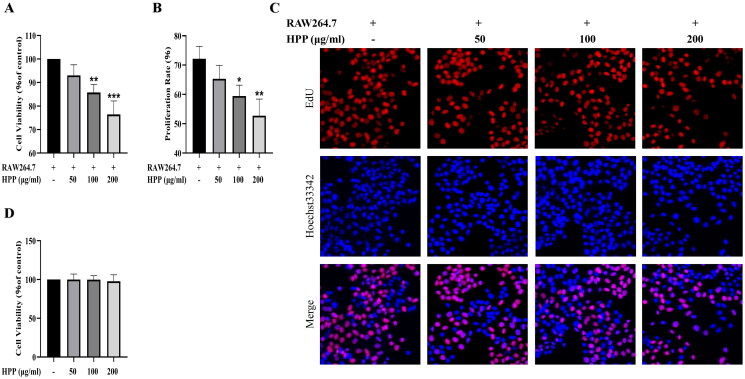
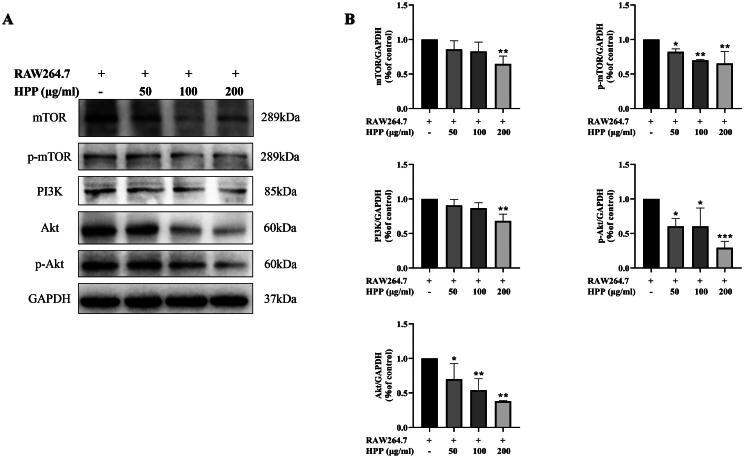
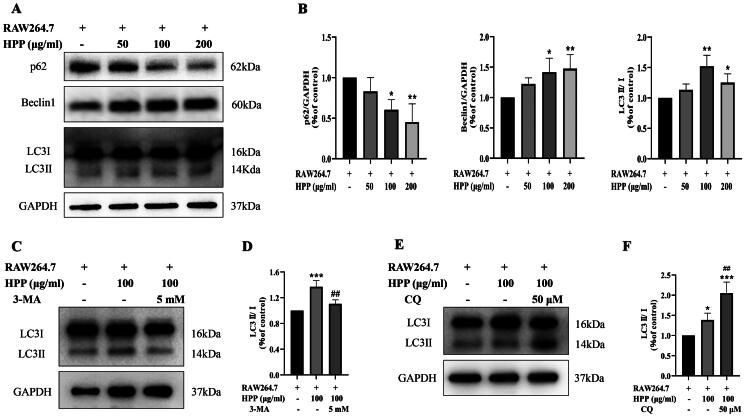
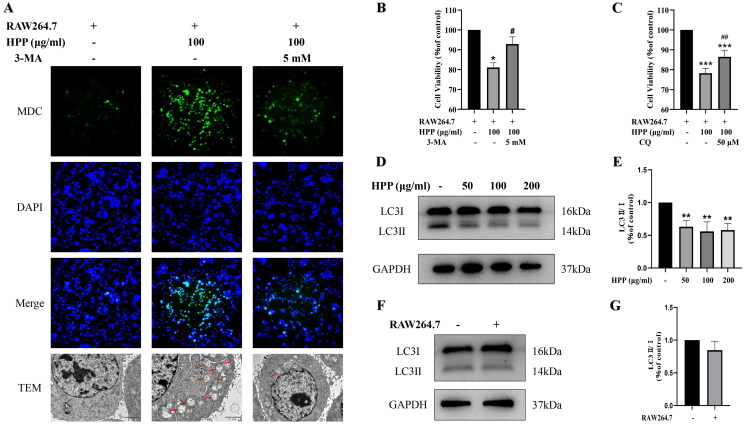
MB49 bladder cancer cells and RAW264.7 macrophages were co-cultured with or without HPP intervention (50, 100, or 200 μg/mL) for 24 h. The cell counting kit-8 (CCK-8) assay and 5-ethynyl-2″-deoxyuridine (EdU) staining evaluated MB49 cell proliferation. Monodansylcadaverine (MDC) staining and transmission electron microscopy (TEM) observed autophagosomes. Western blotting detected the expression levels of autophagy-related proteins and PI3K/Akt/mTOR pathway proteins.
HPP inhibited the proliferation of MB49 cells co-cultured with RAW264.7 cells but not MB49 cells alone. HPP altered the expression of autophagy-related proteins and promoted the formation of autophagosomes in MB49 cells in the co-culture system. Autophagy inhibitors 3-methyladenine (3-MA) and chloroquine (CQ) not only antagonized HPP-induced autophagy but also attenuated the inhibitory effects of HPP on MB49 cell proliferation in the co-culture system. HPP or RAW264.7 alone was not sufficient to induce autophagy in MB49 cells. In addition, HPP suppressed the protein expression of the PI3K/Akt/mTOR pathway in MB49 cells in the co-culture system.
HPP induced bladder cancer cell autophagy by regulating macrophages in the co-culture system, resulting in the inhibition of cancer cell proliferation. The PI3K/Akt/mTOR pathway was involved in HPP-induced autophagy in the co-culture system.
从多孔菌科真菌云芝(Pers.)Fr. 中提取的主要生物活性成分云芝多糖(PPS)已被证明对膀胱癌具有抗作用,并可调节巨噬细胞的免疫功能。
探讨同种云芝多糖(HPP)对与巨噬细胞共培养的膀胱癌细胞增殖和自噬的影响。
将 MB49 膀胱癌细胞和 RAW264.7 巨噬细胞与或不与 HPP 干预(50、100 或 200μg/ml)共培养 24h。用细胞计数试剂盒-8(CCK-8)检测 MB49 细胞增殖,用 5-乙炔基-2'-脱氧尿苷(EdU)染色观察 MB49 细胞增殖。用单丹磺酰尸胺(MDC)染色和透射电子显微镜(TEM)观察自噬体。用 Western blot 检测自噬相关蛋白和 PI3K/Akt/mTOR 通路蛋白的表达水平。
HPP 抑制与 RAW264.7 细胞共培养的 MB49 细胞的增殖,但不抑制单独培养的 MB49 细胞的增殖。HPP 改变了共培养体系中 MB49 细胞自噬相关蛋白的表达,并促进了自噬体的形成。自噬抑制剂 3-甲基腺嘌呤(3-MA)和氯喹(CQ)不仅拮抗了 HPP 诱导的自噬,而且减弱了 HPP 对共培养体系中 MB49 细胞增殖的抑制作用。单独的 HPP 或 RAW264.7 不足以诱导 MB49 细胞自噬。此外,HPP 抑制了共培养体系中 MB49 细胞 PI3K/Akt/mTOR 通路蛋白的表达。
HPP 通过调节共培养体系中的巨噬细胞诱导膀胱癌细胞自噬,从而抑制癌细胞增殖。PI3K/Akt/mTOR 通路参与了共培养体系中 HPP 诱导的自噬。