Center for Autoimmune Diseases Research (CREA), School of Medicine and Health Sciences, Universidad del Rosario, Bogota, Colombia.
Clínica del Occidente, Bogota, Colombia.
BMJ Open. 2024 Feb 14;14(2):e072784. doi: 10.1136/bmjopen-2023-072784.
A paucity of predictive models assessing risk factors for COVID-19 mortality that extend beyond age and gender in Latino population is evident in the current academic literature.
To determine the associated factors with mortality, in addition to age and sex during the first year of the pandemic.
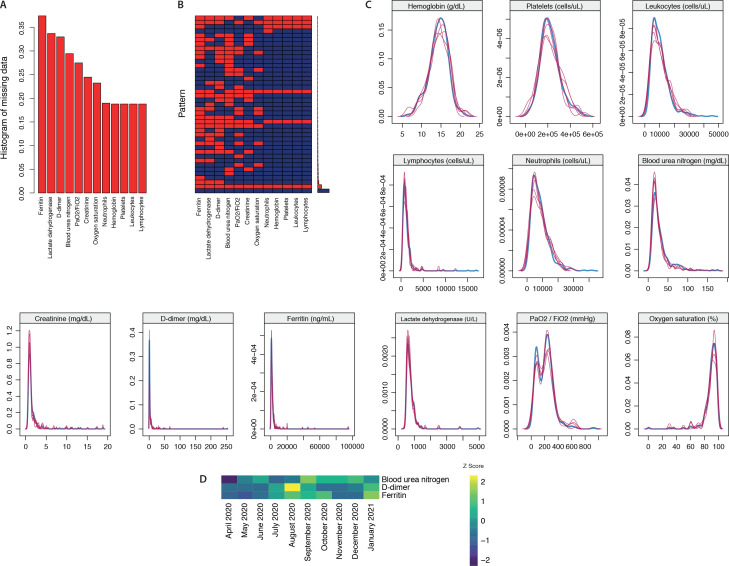
A case-control study with retrospective revision of clinical and paraclinical variables by systematic revision of clinical records was conducted. Multiple imputations by chained equation were implemented to account for missing variables. Classification and regression trees (CART) were estimated to evaluate the interaction of associated factors on admission and their role in predicting mortality during hospitalisation. No intervention was performed.
High-complexity centre above 2640 m above sea level (masl) in Colombia.
A population sample of 564 patients admitted to the hospital with confirmed COVID-19 by PCR. Deceased patients (n=282) and a control group (n=282), matched by age, sex and month of admission, were included.
Mortality during hospitalisation.
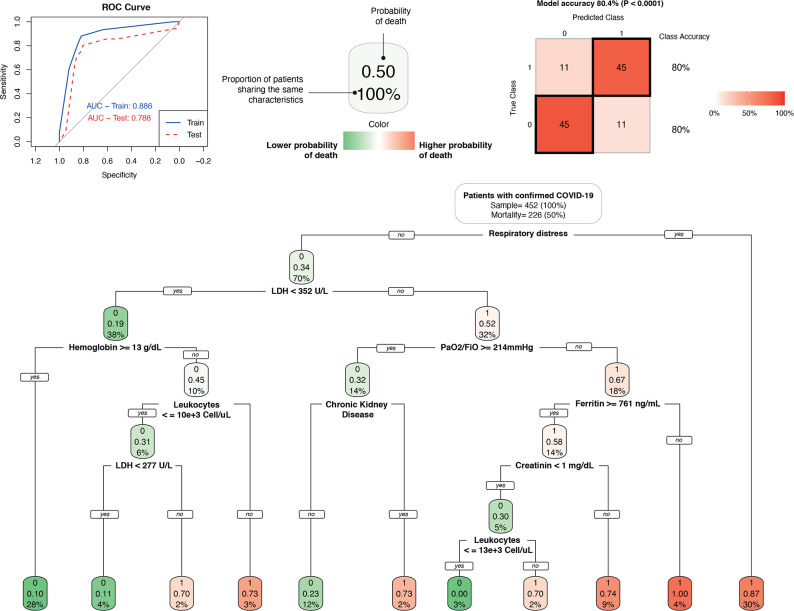
After the imputation of datasets, CART analysis estimated 11 clinical profiles based on respiratory distress, haemoglobin, lactate dehydrogenase, partial pressure of oxygen to inspired partial pressure of oxygen ratio, chronic kidney disease, ferritin, creatinine and leucocytes on admission. The accuracy model for prediction was 80.4% (95% CI 71.8% to 87.3%), with an area under the curve of 78.8% (95% CI 69.63% to 87.93%).
This study discloses new interactions between clinical and paraclinical features beyond age and sex influencing mortality in COVID-19 patients. Furthermore, the predictive model could offer new clues for the personalised management of this condition in clinical settings.
在当前的学术文献中,明显缺乏能够预测拉丁裔人群 COVID-19 死亡率的风险因素的预测模型,这些模型不仅限于年龄和性别。
确定除年龄和性别以外,在大流行的第一年与死亡率相关的因素。
这是一项病例对照研究,通过系统地审查临床记录对临床和临床前变量进行回顾性修订。采用链式方程进行多重插补,以解决缺失变量的问题。采用分类回归树(CART)评估入院时相关因素的相互作用及其在预测住院期间死亡率中的作用。未进行任何干预。
哥伦比亚海拔 2640 米以上的高复杂度中心。
该研究纳入了一个由 564 名经 PCR 确诊为 COVID-19 的住院患者组成的人群样本。包括死亡患者(n=282)和对照组(n=282),按年龄、性别和入院月份匹配。
住院期间的死亡率。
在数据集的插补后,CART 分析根据入院时的呼吸窘迫、血红蛋白、乳酸脱氢酶、氧分压与吸入氧分压比、慢性肾脏病、铁蛋白、肌酐和白细胞估计了 11 个临床特征。预测准确率模型为 80.4%(95%CI 71.8%至 87.3%),曲线下面积为 78.8%(95%CI 69.63%至 87.93%)。
这项研究揭示了除年龄和性别以外,影响 COVID-19 患者死亡率的临床和临床前特征之间的新的相互作用。此外,该预测模型可为临床环境中该疾病的个体化管理提供新的线索。