Pontifícia Universidade Católica do Rio Grande do Sul, Hospital São Lucas, Pneumology Division - Porto Alegre (RS), Brazil.
Hospital Moinhos de Vento, Pneumology Division - Porto Alegre (RS), Brazil.
Rev Assoc Med Bras (1992). 2023 Apr 14;69(4):e20221271. doi: 10.1590/1806-9282.20221271. eCollection 2023.
The coronavirus disease pandemic has become a major global health crisis since 2019. Recent data show the association of diabetes, hypertension, and obesity with poor related outcomes in coronavirus disease infection. This descriptive study aimed to identify the clinical and laboratory parameters in patients with acute respiratory syndrome and confirmed severe acute respiratory syndrome coronavirus 2 infection.
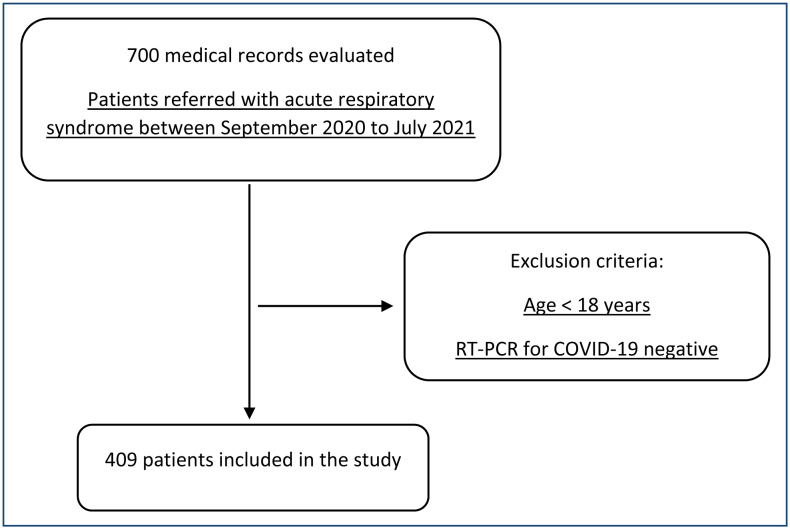
In this cross-sectional study, we analyzed data of 409 patients admitted to a referral hospital in Rio Grande do Sul, Brazil, with coronavirus disease infection confirmed by reverse transcription polymerase chain reaction. Clinical, laboratory, and imaging data were collected retrospectively from electronic medical records using a template with the variables of interest.
The average age was 64 years (52-73), and the body mass index was 27 kg/m² (22.1-31.2). Hypertension, diabetes, and obesity were observed in 58, 33, and 32% of the patients, respectively. Patients admitted to an intensive care unit were older [66 years (53-74) vs. 59 years (42.2-71.7)], with significantly higher impairment on chest computed tomography [75% (50-75) vs. 50% (25-60)] and received higher doses of corticosteroid therapy [39.4 mg (14.3-70.3) vs. 6 mg (6-14.7)]. Hematological parameters were lower in critically ill patients, with greater differences observed on the fifth day of hospitalization [hemoglobin 11.5 g/dL (9.5-13.1) vs. 12.8 g/dL (11.5-14.2), platelets 235,000 μL (143,000-357,000) vs. 270,000 μL (192,000-377,000), and lymphocytes 900 μL (555-1,500) vs. 1,629 μL (1,141-2,329)]. C-reactive protein levels and kidney function were also worse in intensive care unit patients. The mortality rate was significantly higher in the intensive care unit compared to the basic care unit (62.8 vs. 12.2%).
Our findings suggest that metabolic and cardiovascular comorbidities, as well as abnormal hematological parameters, are common findings among patients with severe respiratory syndrome related to coronavirus disease.
自 2019 年以来,冠状病毒病已成为全球主要的卫生健康危机。最近的数据表明,糖尿病、高血压和肥胖症与冠状病毒病感染的不良相关结局有关。本描述性研究旨在确定患有急性呼吸综合征并确诊严重急性呼吸综合征冠状病毒 2 感染的患者的临床和实验室参数。
在这项横断面研究中,我们分析了巴西南里奥格兰德州一家转诊医院 409 名经逆转录聚合酶链反应确诊为冠状病毒病感染的患者的数据。使用带有感兴趣变量的模板,从电子病历中回顾性地收集临床、实验室和影像学数据。
平均年龄为 64 岁(52-73 岁),体重指数为 27kg/m²(22.1-31.2)。高血压、糖尿病和肥胖症分别在 58%、33%和 32%的患者中观察到。入住重症监护病房的患者年龄更大[66 岁(53-74 岁)比 59 岁(42.2-71.7 岁)],胸部计算机断层扫描(CT)损伤显著更高[75%(50-75)比 50%(25-60)],并接受更高剂量的皮质类固醇治疗[39.4mg(14.3-70.3)比 6mg(6-14.7)]。重症患者的血液学参数较低,住院第 5 天差异更大[血红蛋白 11.5g/dL(9.5-13.1)比 12.8g/dL(11.5-14.2),血小板 235,000μL(143,000-357,000)比 270,000μL(192,000-377,000),淋巴细胞 900μL(555-1500)比 1629μL(1141-2329)]。重症监护病房患者的 C 反应蛋白水平和肾功能也更差。与基础护理病房相比,重症监护病房的死亡率明显更高(62.8%比 12.2%)。
我们的研究结果表明,代谢和心血管合并症以及异常的血液学参数是与冠状病毒病相关的严重呼吸综合征患者的常见表现。