Department of Laboratory Medicine, Neurochemistry Laboratory, Amsterdam, UMC location VrijeUniversiteit Amsterdam, Boelelaan 1117, Amsterdam, 1081 HV, The Netherlands.
ADx NeuroSciences, Technologiepark-Zwijnaarde 6, 9052, Gent, Belgium.
Alzheimers Res Ther. 2024 Feb 14;16(1):34. doi: 10.1186/s13195-024-01409-8.
Lack of early molecular biomarkers in sporadic behavioral variants of frontotemporal dementia (bvFTD) and its clinical overlap with primary psychiatric disorders (PPD) hampers its diagnostic distinction. Synaptic dysfunction is an early feature in bvFTD and identification of specific biomarkers might improve its diagnostic accuracy. Our goal was to understand the differential diagnostic potential of cerebrospinal fluid (CSF) synaptic biomarkers in bvFTD versus PPD and their specificity towards bvFTD compared with Alzheimer's disease (AD) and controls. Additionally, we explored the association of CSF synaptic biomarkers with social cognition, cognitive performance, and disease severity in these clinical groups.
Participants with probable bvFTD (n = 57), PPD (n = 71), AD (n = 60), and cognitively normal controls (n = 39) with available CSF, cognitive tests, and disease severity as frontotemporal lobar degeneration-modified clinical dementia rating scale (FTLD-CDR) were included. In a subset of bvFTD and PPD cases, Ekman 60 faces test scores for social cognition were available. CSF synaptosomal-associated protein 25 (SNAP25), neurogranin (Ng), neuronal pentraxin 2 (NPTX2), and glutamate receptor 4 (GluR4) were measured, along with neurofilament light (NfL), and compared between groups using analysis of covariance (ANCOVA) and logistic regression. Diagnostic accuracy was assessed using ROC analyses, and biomarker panels were selected using Wald's backward selection. Correlations with cognitive measures were performed using Pearson's partial correlation analysis.
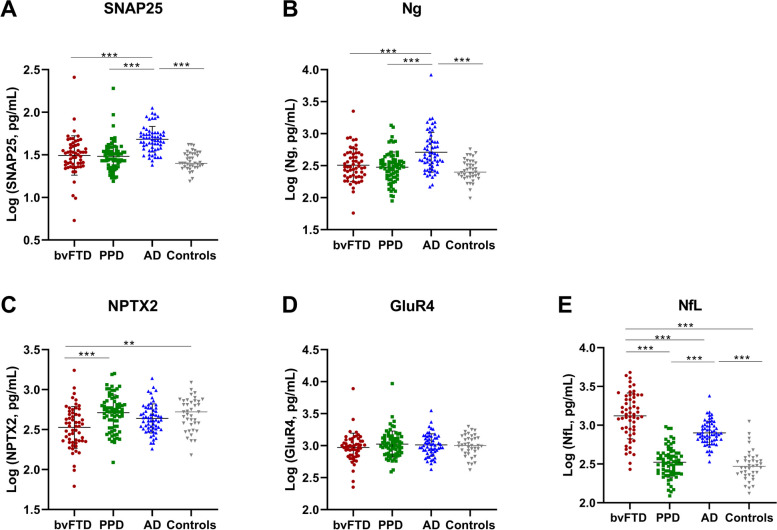
NPTX2 concentrations were lower in the bvFTD group compared with PPD (p < 0.001) and controls (p = 0.003) but not compared with AD. Concentrations of SNAP25 (p < 0.001) and Ng (p < 0.001) were elevated in patients with AD versus those with bvFTD and controls. The modeled panel for differential diagnosis of bvFTD versus PPD consisted of NfL and NPTX2 (AUC = 0.96, CI: 0.93-0.99, p < 0.001). In bvFTD versus AD, the modeled panel consisted of NfL, SNAP25, Ng, and GluR4 (AUC = 0.86, CI: 0.79-0.92, p < 0.001). In bvFTD, lower NPTX2 (Pearson's r = 0.29, p = 0.036) and GluR4 (Pearson's r = 0.34, p = 0.014) concentrations were weakly associated with worse performance of total cognitive score. Lower GluR4 concentrations were also associated with worse MMSE scores (Pearson's r = 0.41, p = 0.002) as well as with worse executive functioning (Pearson's r = 0.36, p = 0.011) in bvFTD. There were no associations between synaptic markers and social cognition or disease severity in bvFTD.
Our findings of involvement of NTPX2 in bvFTD but not PPD contribute towards better understanding of bvFTD disease pathology.
散发性额颞叶痴呆(bvFTD)的早期分子生物标志物缺乏及其与原发性精神障碍(PPD)的临床重叠,阻碍了其诊断区分。突触功能障碍是 bvFTD 的早期特征,识别特定的生物标志物可能会提高其诊断准确性。我们的目标是了解脑脊液(CSF)突触生物标志物在 bvFTD 与 PPD 中的差异诊断潜力,以及与 AD 和对照组相比,它们对 bvFTD 的特异性。此外,我们还探讨了 CSF 突触生物标志物与这些临床组中社会认知、认知表现和疾病严重程度的相关性。
纳入了可能患有 bvFTD(n = 57)、PPD(n = 71)、AD(n = 60)和认知正常对照组(n = 39)的参与者,这些参与者具有可用的 CSF、认知测试和疾病严重程度,表现为额颞叶变性改良临床痴呆评定量表(FTLD-CDR)。在 bvFTD 和 PPD 病例的亚组中,可用 Ekman 60 张面孔测试来评估社会认知。测量了突触相关蛋白 25(SNAP25)、神经颗粒蛋白(Ng)、神经元五肽 2(NPTX2)和谷氨酸受体 4(GluR4),以及神经丝轻链(NfL),并使用协方差分析(ANCOVA)和逻辑回归对组间进行比较。使用 ROC 分析评估诊断准确性,并使用 Wald 向后选择选择生物标志物面板。使用 Pearson 偏相关分析评估与认知测量的相关性。
与 PPD(p < 0.001)和对照组(p = 0.003)相比,bvFTD 组的 NPTX2 浓度较低,但与 AD 相比则没有差异。AD 患者的 SNAP25(p < 0.001)和 Ng(p < 0.001)浓度升高,与 bvFTD 和对照组相比。用于区分 bvFTD 与 PPD 的模型化生物标志物组合包括 NfL 和 NPTX2(AUC = 0.96,CI:0.93-0.99,p < 0.001)。在 bvFTD 与 AD 中,模型化生物标志物组合包括 NfL、SNAP25、Ng 和 GluR4(AUC = 0.86,CI:0.79-0.92,p < 0.001)。在 bvFTD 中,较低的 NPTX2(Pearson's r = 0.29,p = 0.036)和 GluR4(Pearson's r = 0.34,p = 0.014)浓度与总认知评分较差的表现呈弱相关。较低的 GluR4 浓度也与 bvFTD 中 MMSE 评分较差(Pearson's r = 0.41,p = 0.002)以及执行功能较差(Pearson's r = 0.36,p = 0.011)相关。在 bvFTD 中,突触标志物与社会认知或疾病严重程度之间没有相关性。
我们发现 NTPX2 参与 bvFTD 但不参与 PPD,这有助于更好地理解 bvFTD 的疾病病理学。