Viral Pathogens Research Theme, Medical Research Council, Uganda Virus Research Institute and London School of Hygiene and Tropical Medicine, Uganda Research Unit, Entebbe, Uganda.
Department of Immunology, Uganda Virus Research Institute, Entebbe, Uganda.
Front Immunol. 2024 Jan 31;15:1348905. doi: 10.3389/fimmu.2024.1348905. eCollection 2024.
This study sought to elucidate the long-term antibody responses to the Moderna mRNA-1273 COVID-19 vaccine within a Ugandan cohort, aiming to contribute to the sparse data on m-RNA vaccine immunogenicity in Sub-Saharan Africa.
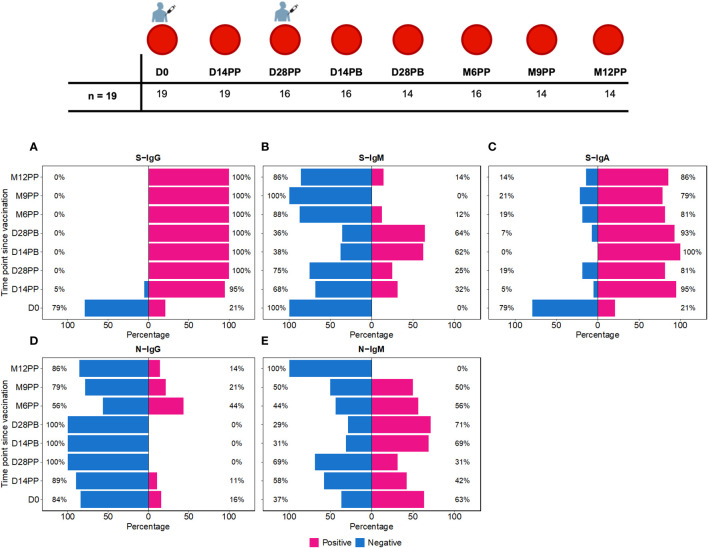
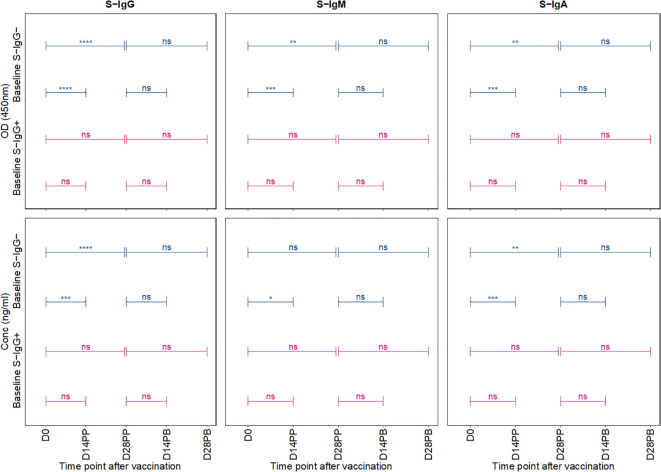
We tracked the development and persistence of the elicited antibodies in 19 participants aged 18 to 67, who received two doses of the mRNA-1273 vaccine. A validated enzyme-linked immunosorbent assay (ELISA) was used to quantify SARS-CoV-2-specific IgG, IgM, and IgA antibodies against the spike (S) and nucleoproteins (N). The study's temporal scope extended from the baseline to one year, capturing immediate and long-term immune responses. Statistical analyses were performed using the Wilcoxon test to evaluate changes in antibody levels across predetermined intervals with the Hochberg correction for multiple comparisons.
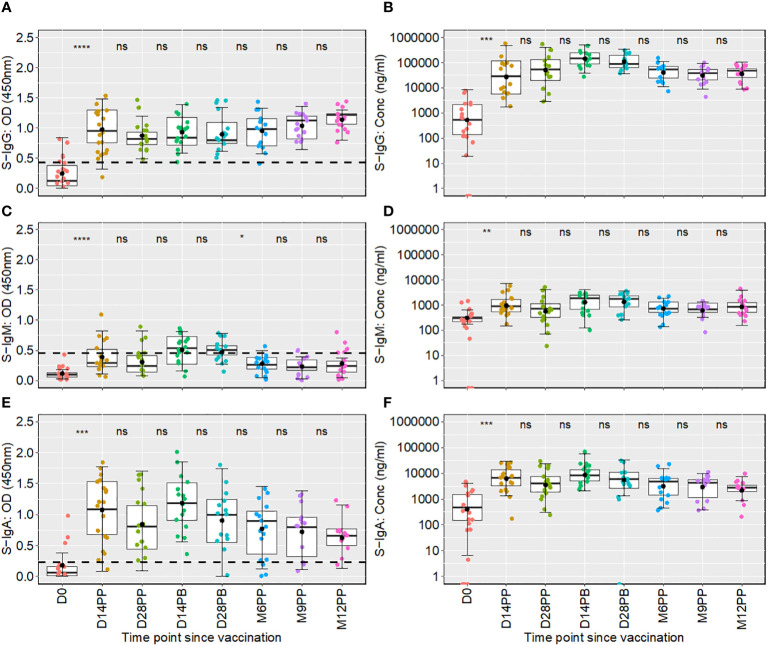
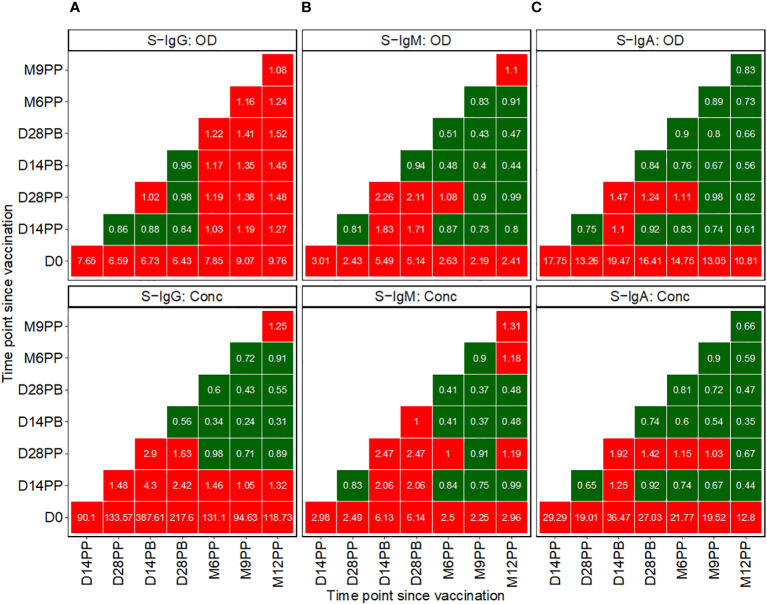
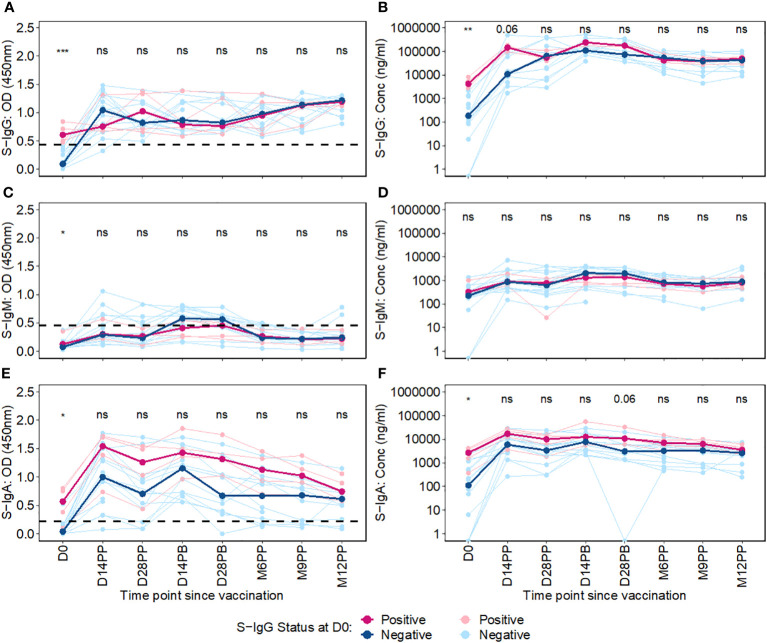
Our results showed a significant initial rise in spike-directed IgG (S-IgG) and spike-directed IgA (S-IgA) levels, which remained elevated for the duration of the study. The S-IgG concentrations peaked 14 days afterboosting, while spike-directed IgM (S-IgM) levels were transient, aligning with their early response role. Notably, post-booster antibody concentrations did not significantly change. Prior S-IgG status influenced the post-priming S-IgA dynamics, with baseline S-IgG positive individuals maintaining higher S-IgA responses, a difference that did not reach statistical difference post-boost. Three instances of breakthrough infections: two among participants who exhibited baseline seropositivity for S-IgG, and one in a participant initially seronegative for S-IgG.
In conclusion, the mRNA-1273 vaccine elicited robust and persistent S-IgG and S-IgA antibody responses, particularly after the first dose, indicating potential for long-term immunity. Prior viral exposure enhances post-vaccination S-IgA responses compared to naive individuals, which aligned with the prior-naïve, post-boost. The stable antibody levels observed post-booster dose, remaining high over an extended period, with no significant secondary rise, and no difference by baseline exposure, suggest that initial vaccination may sufficiently prime the immune system for prolonged protection in this population, allowing for potential to delay booster schedules as antibody responses remained high at the time of boosting. This finding calls for a reassessment of the booster dose scheduling in this demographic.
本研究旨在阐明乌干达队列中接受 Moderna mRNA-1273 COVID-19 疫苗接种者的长期抗体反应,旨在为撒哈拉以南非洲地区关于 m-RNA 疫苗免疫原性的稀缺数据做出贡献。
我们跟踪了 19 名 18 至 67 岁参与者接种两剂 mRNA-1273 疫苗后产生的抗体的发展和持续情况。使用经过验证的酶联免疫吸附试验(ELISA)来定量针对刺突(S)和核蛋白(N)的 SARS-CoV-2 特异性 IgG、IgM 和 IgA 抗体。研究的时间范围从基线扩展到一年,捕捉即时和长期的免疫反应。使用 Wilcoxon 检验进行统计分析,以评估在 Hochberg 多重比较校正的预定间隔内抗体水平的变化。
我们的结果显示,刺突定向 IgG(S-IgG)和刺突定向 IgA(S-IgA)水平最初显著升高,在整个研究期间仍保持升高。S-IgG 浓度在加强针后 14 天达到峰值,而刺突定向 IgM(S-IgM)水平则是短暂的,与其早期反应作用一致。值得注意的是,加强针后的抗体浓度没有显著变化。先前的 S-IgG 状态影响了加强针后的 S-IgA 动态,基线时 S-IgG 阳性个体保持更高的 S-IgA 反应,但在加强针后未达到统计学差异。出现了三例突破性感染:两名参与者在基线时 S-IgG 呈血清阳性,一名参与者最初 S-IgG 血清阴性。
总之,mRNA-1273 疫苗引发了强烈而持久的 S-IgG 和 S-IgA 抗体反应,尤其是在第一剂之后,表明具有长期免疫力的潜力。与初次接种者相比,先前的病毒暴露增强了接种后的 S-IgA 反应,这与初次接种者、加强针后一致。加强针后观察到的稳定抗体水平在较长时间内保持较高水平,没有明显的二次升高,且基线暴露无差异,这表明初始接种可能足以使该人群的免疫系统为长期保护做好准备,从而有可能延迟加强针接种计划,因为在加强针接种时抗体水平仍然很高。这一发现呼吁重新评估该人群的加强针接种时间表。