Foundation for Disease Elimination and Control of India, Mumbai, India.
Asia Pacific Leaders' Malaria Alliance, Singapore, Singapore.
Malar J. 2024 Feb 15;23(1):50. doi: 10.1186/s12936-024-04872-8.
Despite the progress made in this decade towards malaria elimination, it remains a significant public health concern in India and many other countries in South Asia and Asia Pacific region. Understanding the historical trends of malaria incidence in relation to various commodity and policy interventions and identifying the factors associated with its occurrence can inform future intervention strategies for malaria elimination goals.
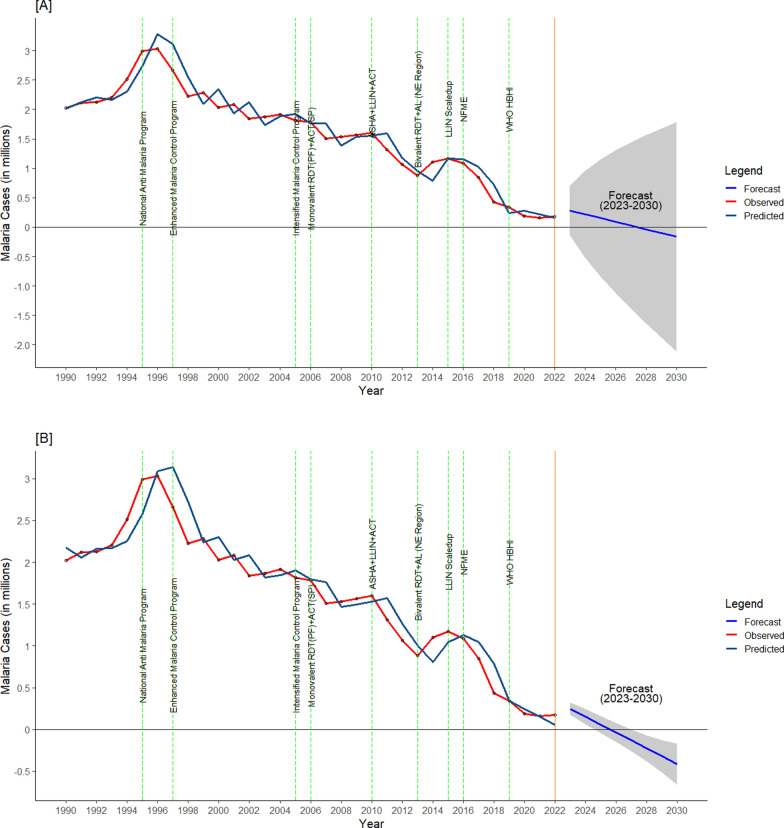
This study analysed historical malaria cases in India from 1990 to 2022 to assess the annual trends and the impact of key anti-malarial interventions on malaria incidence. Factors associated with malaria incidence were identified using univariate and multivariate linear regression analyses. Generalized linear, smoothing, autoregressive integrated moving averages (ARIMA) and Holt's models were used to forecast malaria cases from 2023 to 2030.
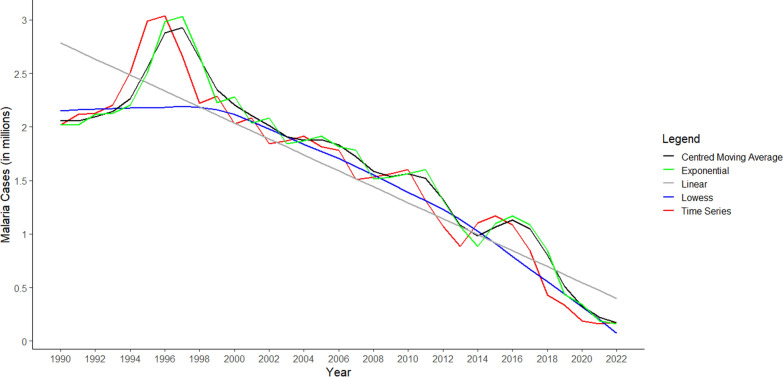
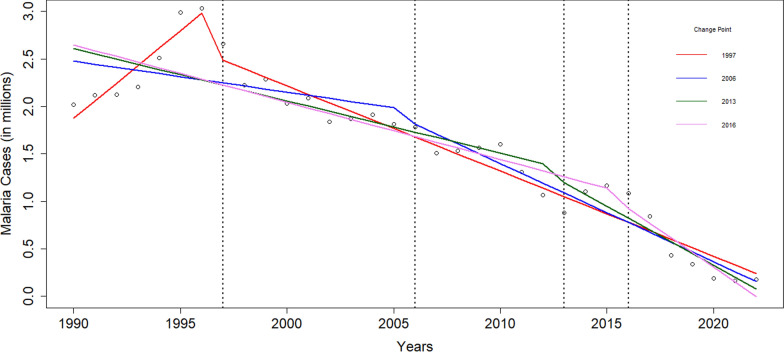
The reported annual malaria cases in India during 1990-2000 were 2.38 million, which dropped to 0.73 million cases annually during 2011-2022. The overall reduction from 1990 (2,018,783) to 2022 (176,522) was 91%. The key interventions of the Enhanced Malaria Control Project (EMCP), Intensified Malaria Control Project (IMCP), use of bivalent rapid diagnostic tests (RDT-Pf/Pv), artemisinin-based combination therapy (ACT), and involvement of the Accredited Social Health Activists (ASHAs) as front-line workers were found to result in the decline of malaria significantly. The ARIMA and Holt's models projected a continued decline in cases with the potential for reaching zero indigenous cases by 2027-2028. Important factors influencing malaria incidence included tribal population density, literacy rate, health infrastructure, and forested and hard-to-reach areas.
Studies aimed at assessing the impact of major commodity and policy interventions on the incidence of disease and studies of disease forecasting will inform programmes and policymakers of steps needed during the last mile phase to achieve malaria elimination. It is proposed that these time series and disease forecasting studies should be performed periodically using granular (monthly) and meteorological data to validate predictions of prior studies and suggest any changes needed for elimination efforts at national and sub-national levels.
尽管在过去十年中,在消除疟疾方面取得了进展,但疟疾仍是印度和南亚及亚太地区许多其他国家的一个重大公共卫生关切。了解疟疾发病率与各种商品和政策干预措施相关的历史趋势,并确定与疟疾发病率相关的因素,可以为实现消除疟疾目标的未来干预策略提供信息。
本研究分析了印度 1990 年至 2022 年期间的历史疟疾病例,以评估年度趋势和关键抗疟干预措施对疟疾发病率的影响。使用单变量和多变量线性回归分析确定与疟疾发病率相关的因素。广义线性、平滑、自回归综合移动平均 (ARIMA) 和霍尔特模型用于预测 2023 年至 2030 年的疟疾病例。
1990-2000 年期间,印度报告的年疟疾病例为 238 万例,2011-2022 年期间降至每年 73 万例。从 1990 年(2018783 例)到 2022 年(176522 例),总体降幅为 91%。强化疟疾控制项目(EMCP)、强化疟疾控制项目(IMCP)、使用双价快速诊断检测(RDT-Pf/Pv)、青蒿素为基础的联合疗法(ACT)和认证的社会卫生活动家(ASHAs)作为一线工作者等关键干预措施被发现显著降低了疟疾发病率。ARIMA 和霍尔特模型预测病例将继续下降,到 2027-2028 年有达到零本土病例的潜力。影响疟疾发病率的重要因素包括部落人口密度、识字率、卫生基础设施以及森林和难以到达地区。
评估主要商品和政策干预措施对疾病发病率影响的研究以及疾病预测研究将为规划人员和决策者提供在实现消除疟疾目标的最后一英里阶段所需的步骤信息。建议使用粒度(每月)和气象数据定期进行这些时间序列和疾病预测研究,以验证先前研究的预测,并为国家和次国家一级的消除努力提出任何必要的更改。