Kim Sung-A, Maeda Megumi, Murata Fumiko, Fujii Takayuki, Ueda Emi, Ono Rei, Fukuda Haruhisa
Department of Healthcare Administration and Management, Graduate School of Medical Sciences, Kyushu University, Fukuoka, Japan.
St. Mary's Research Center, Kurume, Japan.
J Alzheimers Dis. 2024;98(1):197-207. doi: 10.3233/JAD-230806.
The prevalence of Alzheimer's disease (AD) is increasing in Japan due to population aging. The association between sensory impairment and incident AD remains unclear.
This study aimed to investigate the impact of sensory impairment on incident AD.
We analyzed residents of five municipalities participating in the Longevity Improvement & Fair Evidence (LIFE) Study. The participants comprised individuals who had newly applied for long-term care needs certification between 2017 and 2022 and had no cognitive impairment upon application or AD diagnosis within the preceding six months. Participants were classified according to sensory impairment status: visual impairment (VI), hearing impairment (HI), neither sensory impairment (NSI), and dual sensory impairment (DSI). The month succeeding the certification application was set as the index month, and the interval from that month until AD onset was assessed. Multivariable Cox proportional hazards analysis was performed to calculate the risk of AD onset according to sensory impairment status while adjusting for sex, age, dependence level, self-reliance level, and comorbidities.
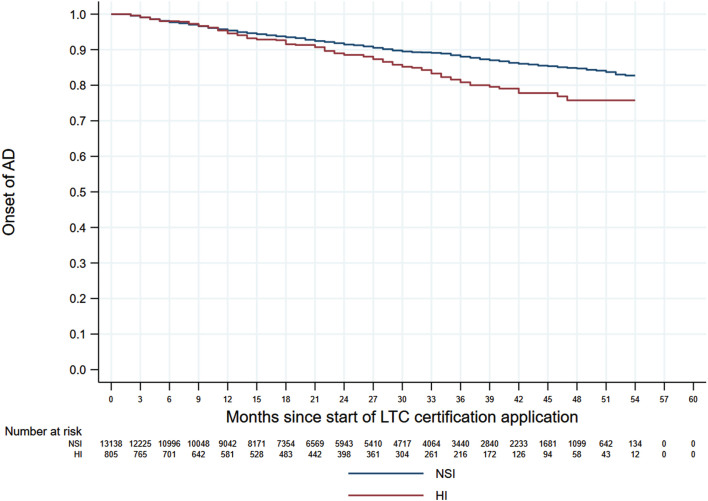
Among 14,186 participants, we identified 1,194 (8.4%) who developed AD over a median follow-up period of 22.6 months. VI and HI only were not associated with incident AD. However, DSI conferred a significantly higher risk (HR: 1.6, CI: 1.1-2.2, p = 0.008) of AD onset than NSI.
Individuals with concurrent DSI have a higher risk of developing AD than those with single or NSI. Preventing and treating sensory impairment may not only improve functional outcomes, but could also help to reduce the future risk of AD.
由于人口老龄化,日本阿尔茨海默病(AD)的患病率正在上升。感觉障碍与AD发病之间的关联尚不清楚。
本研究旨在调查感觉障碍对AD发病的影响。
我们分析了参与长寿改善与公平证据(LIFE)研究的五个城市的居民。参与者包括2017年至2022年间新申请长期护理需求认证且申请时无认知障碍或在过去六个月内未被诊断为AD的个体。参与者根据感觉障碍状况进行分类:视力障碍(VI)、听力障碍(HI)、无感觉障碍(NSI)和双重感觉障碍(DSI)。认证申请后的月份设为索引月,并评估从该月到AD发病的间隔时间。进行多变量Cox比例风险分析,以计算根据感觉障碍状况调整性别、年龄、依赖程度、自理水平和合并症后的AD发病风险。
在14186名参与者中,我们确定了1194名(8.4%)在中位随访期22.6个月内发生AD的患者。仅VI和HI与AD发病无关。然而,与NSI相比,DSI使AD发病风险显著更高(HR:1.6,CI:1.1-2.2,p = 0.008)。
并发DSI的个体比单一感觉障碍或无感觉障碍的个体患AD的风险更高。预防和治疗感觉障碍不仅可以改善功能结局,还可能有助于降低未来患AD的风险。