Department of Cell & Systems Biology, University of Toronto, Toronto, ON, M5S 3G3, Canada.
Department of Psychology, University of Toronto Mississauga, Mississauga, ON, L5L 1C6, Canada.
Neuropsychopharmacology. 2024 Jul;49(8):1285-1295. doi: 10.1038/s41386-024-01817-2. Epub 2024 Feb 16.
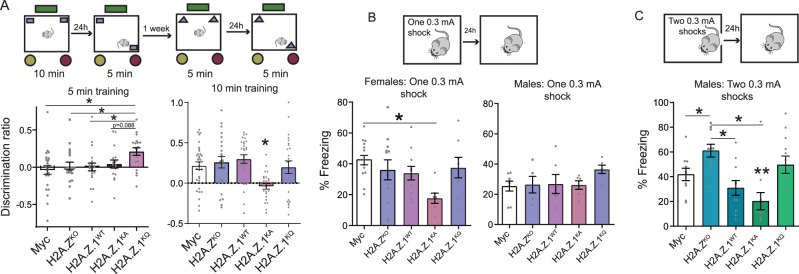
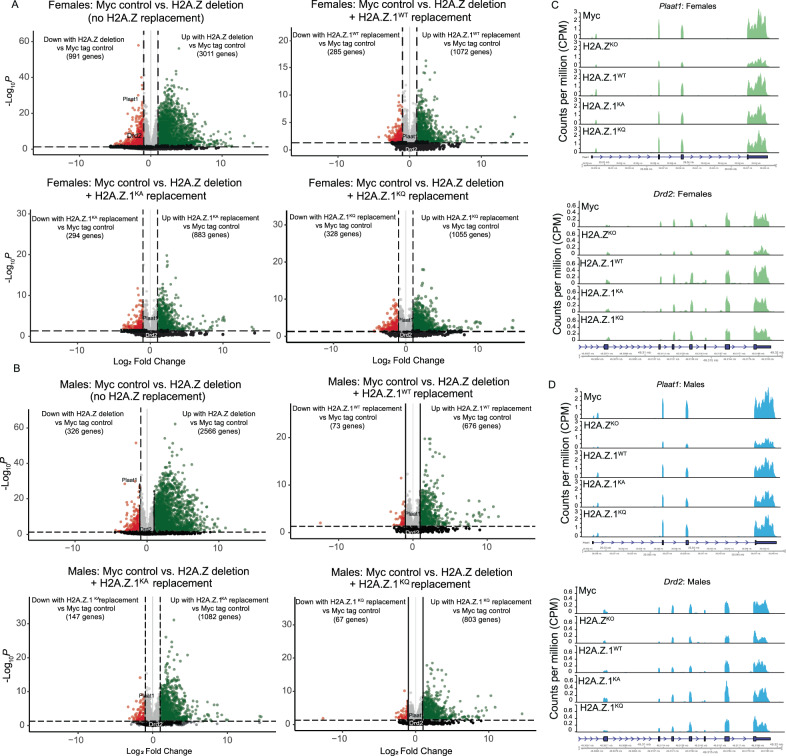
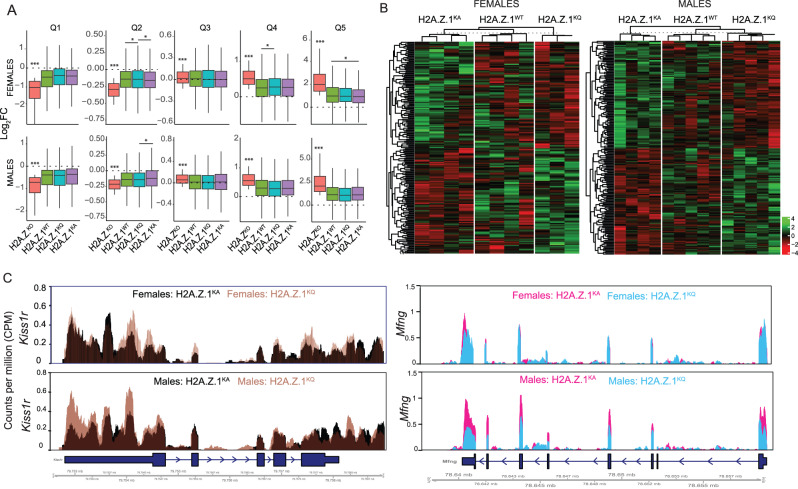
Creating long-lasting memories requires learning-induced changes in gene expression, which are impacted by epigenetic modifications of DNA and associated histone proteins. Post-translational modifications (PTMs) of histones are key regulators of transcription, with different PTMs producing unique effects on gene activity and behavior. Although recent studies implicate histone variants as novel regulators of memory, effects of PTMs on the function of histone variants are rarely considered. We previously showed that the histone variant H2A.Z suppresses memory, but it is unclear if this role is impacted by H2A.Z acetylation, a PTM that is typically associated with positive effects on transcription and memory. To answer this question, we used a mutation approach to manipulate acetylation on H2A.Z without impacting acetylation of other histone types. Specifically, we used adeno-associated virus (AAV) constructs to overexpress mutated H2A.Z.1 isoforms that either mimic acetylation (acetyl-mimic) by replacing lysines 4, 7 and 11 with glutamine (KQ), or H2A.Z.1 with impaired acetylation (acetyl-defective) by replacing the same lysines with alanine (KA). Expressing the H2A.Z.1 acetyl-mimic (H2A.Z.1) improved memory under weak learning conditions, whereas expressing the acetyl-defective H2A.Z.1 generally impaired memory, indicating that the effect of H2A.Z.1 on memory depends on its acetylation status. RNA sequencing showed that H2A.Z.1 and H2A.Z.1 uniquely impact the expression of different classes of genes in both females and males. Specifically, H2A.Z.1 preferentially impacts genes involved in synaptic function, suggesting that acetyl-defective H2A.Z.1 impairs memory by altering synaptic regulation. Finally, we describe, for the first time, that H2A.Z is also involved in alternative splicing of neuronal genes, whereby H2A.Z depletion, as well as expression of H2A.Z.1 lysine mutants influence transcription and splicing of different gene targets, suggesting that H2A.Z.1 can impact behavior through effects on both splicing and gene expression. This is the first study to demonstrate that direct manipulation of H2A.Z post-translational modifications regulates memory, whereby acetylation adds another regulatory layer by which histone variants can fine tune higher brain functions through effects on gene expression and splicing.
形成长期记忆需要学习诱导的基因表达变化,这受到 DNA 和相关组蛋白的表观遗传修饰的影响。组蛋白的翻译后修饰(PTMs)是转录的关键调节剂,不同的 PTMs 对基因活性和行为产生独特的影响。尽管最近的研究表明组蛋白变体是记忆的新型调节剂,但 PTMs 对组蛋白变体功能的影响很少被考虑。我们之前表明组蛋白变体 H2A.Z 抑制记忆,但尚不清楚这种作用是否受到 H2A.Z 乙酰化的影响,H2A.Z 乙酰化通常与转录和记忆的积极影响相关。为了回答这个问题,我们使用突变方法来操纵 H2A.Z 上的乙酰化,而不影响其他组蛋白类型的乙酰化。具体来说,我们使用腺相关病毒(AAV)构建体过表达突变的 H2A.Z.1 异构体,这些异构体通过用谷氨酰胺(Q)取代赖氨酸 4、7 和 11 来模拟乙酰化(乙酰化模拟),或者通过用丙氨酸(KA)取代相同的赖氨酸来模拟乙酰化缺陷的 H2A.Z.1。表达 H2A.Z.1 乙酰化模拟物(H2A.Z.1)可在弱学习条件下改善记忆,而表达乙酰化缺陷的 H2A.Z.1 通常会损害记忆,表明 H2A.Z.1 对记忆的影响取决于其乙酰化状态。RNA 测序显示,H2A.Z.1 和 H2A.Z.1 分别在雌性和雄性中影响不同类别的基因的表达。具体而言,H2A.Z.1 优先影响与突触功能相关的基因,这表明乙酰化缺陷的 H2A.Z.1 通过改变突触调节来损害记忆。最后,我们首次描述了 H2A.Z 还参与神经元基因的选择性剪接,其中 H2A.Z 耗竭以及 H2A.Z.1 赖氨酸突变体的表达影响不同基因靶标的转录和剪接,这表明 H2A.Z.1 可以通过影响剪接和基因表达来影响行为。这是第一项研究表明,直接操纵 H2A.Z 翻译后修饰可调节记忆,其中乙酰化通过影响基因表达和剪接来通过影响基因表达和剪接来作为组蛋白变体微调大脑高级功能的另一个调节层。