Ahmadi Vasmehjani Azam, Seyed Hosseini Seyed Mostafa, Khayyatzadeh Sayyed Saeid, Madadizadeh Farzan, Mazaheri-Naeini Mahta, Yavari Mahdie, Darabi Zahra, Beigrezaei Sara, Taftian Marzieh, Arabi Vahid, Motallaei Maryam, Salehi-Abargouei Amin, Nadjarzadeh Azadeh
Research Center for Food Hygiene and Safety, School of Public Health Shahid Sadoughi University of Medical Sciences Yazd Iran.
Department of Nutrition, School of Public Health Shahid Sadoughi University of Medical Sciences Yazd Iran.
Food Sci Nutr. 2023 Nov 28;12(2):1012-1022. doi: 10.1002/fsn3.3815. eCollection 2024 Feb.
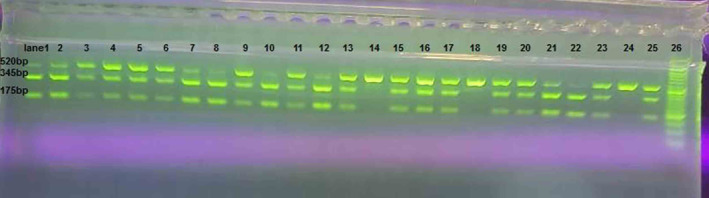
The association of CETP Taq1B polymorphism with some metabolic traits is still controversial. The interaction of adherence to dietary indices with this polymorphism on the severity of coronary artery stenosis and serum lipid parameters needs to be investigated. This study aimed to test this hypothesis. This cross-sectional study included 453 patients who were referred from Afshar Hospital of Yazd and undergoing coronary angiography from 2020 to 2021. Dietary intake was evaluated by a 178-item validated and reliable dietary questionnaire. Dietary indices such as dietary antioxidant index (DAI), dietary antioxidant quality score (DAQS), and dietary phytochemical index (DPI) are determined according to dietary guidelines. The Taq1B variant was genotyped by the polymerase chain reaction-restriction fragment length polymorphism method (PCR-RFLP). Two-way ANOVA was used to test the interaction between Taq1B polymorphism and dietary indices. The results of the frequency analysis of Taq1B genotypes showed that 10.4% were B1B1, 72.4% B1B2, and 17.2% B2B2. No significant interaction was found between the Taq1B variant with high adherence to DAQS, DAI, and DPI on total cholesterol (TC), high-density lipoprotein cholesterol (HDL), low-density lipoprotein cholesterol (LDL), triglyceride (TG) levels, and Gensini score (GS) and Syntax score (SS). In high-adherence dietary indices, lipid profile and coronary artery stenosis scores did not differ significantly in Taq1B genotypes. Due to the insignificant results in this research, further studies are needed to investigate the role of Taq1B SNP in modulating dyslipidemia and the severity of the CAD in interaction with dietary indices.
胆固醇酯转运蛋白(CETP)Taq1B基因多态性与某些代谢特征之间的关联仍存在争议。需要研究饮食指标依从性与这种多态性在冠状动脉狭窄严重程度和血脂参数方面的相互作用。本研究旨在验证这一假设。这项横断面研究纳入了453例于2020年至2021年从亚兹德阿夫沙尔医院转诊并接受冠状动脉造影的患者。通过一份经过验证且可靠的包含178个条目的饮食问卷对饮食摄入进行评估。根据饮食指南确定饮食抗氧化指数(DAI)、饮食抗氧化质量评分(DAQS)和饮食植物化学指数(DPI)等饮食指标。采用聚合酶链反应-限制性片段长度多态性方法(PCR-RFLP)对Taq1B变异体进行基因分型。使用双向方差分析来检验Taq1B基因多态性与饮食指标之间的相互作用。Taq1B基因型频率分析结果显示,B1B1型占10.4%,B1B2型占72.4%,B2B2型占17.2%。在总胆固醇(TC)、高密度脂蛋白胆固醇(HDL)、低密度脂蛋白胆固醇(LDL)、甘油三酯(TG)水平以及Gensini评分(GS)和Syntax评分(SS)方面,未发现Taq1B变异体与高依从性的DAQS、DAI和DPI之间存在显著相互作用。在高依从性饮食指标中,Taq1B基因型的血脂谱和冠状动脉狭窄评分无显著差异。鉴于本研究结果不显著,需要进一步研究来探讨Taq1B单核苷酸多态性(SNP)在与饮食指标相互作用中调节血脂异常和冠心病严重程度方面的作用。