Mullaivendhan Janani, Akbar Idhayadhulla, Ahamed Anis, Abdulrahman Alodaini Hissah
Research Department of Chemistry, Nehru Memorial College (Affiliated Bharathidasan University), Puthanampatti, 621007, Tamil Nadu, India.
Department of Botany and Microbiology, College of Science, King Saud University, P.O. Box 2455, Riyadh, 11451, Saudi Arabia.
Heliyon. 2024 Feb 5;10(4):e25285. doi: 10.1016/j.heliyon.2024.e25285. eCollection 2024 Feb 29.
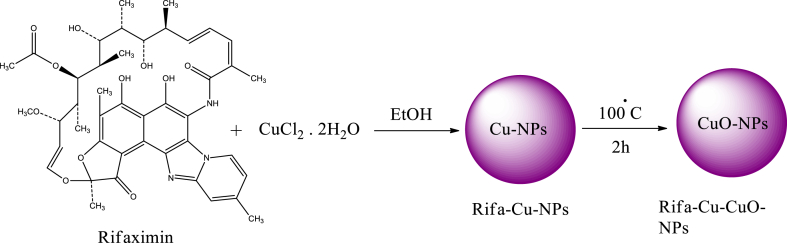
In this study, rifaximin with copper (Cu) and copper oxide (CuO) nanoparticles (NPs) were synthesised. The resultant CuO nanoparticles were used to degrade Rhodamine B (RhB) and Coomassie Brilliant Blue (G250). Rifaximin copper and copper oxide nanoparticles were characterised using Fourier-transform infrared spectroscopy (FTIR), X-ray diffraction (XRD), scanning electron microscopy (SEM), ultraviolet-visible spectroscopy (UV), X-ray Photoelectron Spectroscopy (XPS), Transmission Electron Microscopy (TEM), and gas chromatography-electrochemical mass spectrometry (GC-EI-MS). An FT-IR study confirmed the formation of Cu in the 562 cm peak range. Rifaximin Cu and CuO Nanoparticles displayed UV absorption peaks at 253 nm and 230 nm, respectively. Coomassie Brilliant Blue G250 was completely decolourised in Cu nanoparticles at 100 %, and Rhodamine B was also decolourised in Rifaximin CuO nanoparticles at 73 %, although Coomassie Brilliant Blue G250 Rifaximin Cu nanoparticles absorbed a high percentage of dye decolorization. The aerobic oxidation of isopropanol conversion was confirmed by GC-MS analysis. Retention time of 27.35 and 30.32 was confirmed using Cu and CuO nanoparticles as the final products of 2-propanone. It is used in the textile and pharmaceutical industries for aerobic alcohol oxidation. Rifaximin CuO nanoparticles highly active in aerobic oxidation. The novelty of this study is that, for the first time, rifaximin was used for the synthesis of copper and copper oxide nanoparticles, and it successfully achieved decolorization and aerobic oxidation.
在本研究中,合成了含铜(Cu)和氧化铜(CuO)纳米颗粒(NPs)的利福昔明。所得的氧化铜纳米颗粒用于降解罗丹明B(RhB)和考马斯亮蓝(G250)。利用傅里叶变换红外光谱(FTIR)、X射线衍射(XRD)、扫描电子显微镜(SEM)、紫外可见光谱(UV)、X射线光电子能谱(XPS)、透射电子显微镜(TEM)以及气相色谱 - 电化学质谱(GC - EI - MS)对利福昔明铜和氧化铜纳米颗粒进行了表征。FT - IR研究证实了在562 cm峰范围内铜的形成。利福昔明铜和氧化铜纳米颗粒分别在253 nm和230 nm处显示出紫外吸收峰。考马斯亮蓝G250在铜纳米颗粒中100%完全脱色,而罗丹明B在利福昔明氧化铜纳米颗粒中也有73%脱色,尽管考马斯亮蓝G250利福昔明铜纳米颗粒吸收了高百分比的染料脱色。通过GC - MS分析证实了异丙醇转化的需氧氧化。使用铜和氧化铜纳米颗粒作为2 - 丙酮的最终产物,确认了保留时间为27.35和30.32。它用于纺织和制药行业的需氧醇氧化。利福昔明氧化铜纳米颗粒在需氧氧化中具有高活性。本研究的新颖之处在于,首次将利福昔明用于合成铜和氧化铜纳米颗粒,并成功实现了脱色和需氧氧化。