Zimnik Andrew J, Cora Ames K, An Xinyue, Driscoll Laura, Lara Antonio H, Russo Abigail A, Susoy Vladislav, Cunningham John P, Paninski Liam, Churchland Mark M, Glaser Joshua I
Department of Neuroscience, Columbia University Medical Center, New York, NY, USA.
Zuckerman Institute, Columbia University, New York, NY, USA.
bioRxiv. 2024 Feb 6:2024.02.05.578988. doi: 10.1101/2024.02.05.578988.
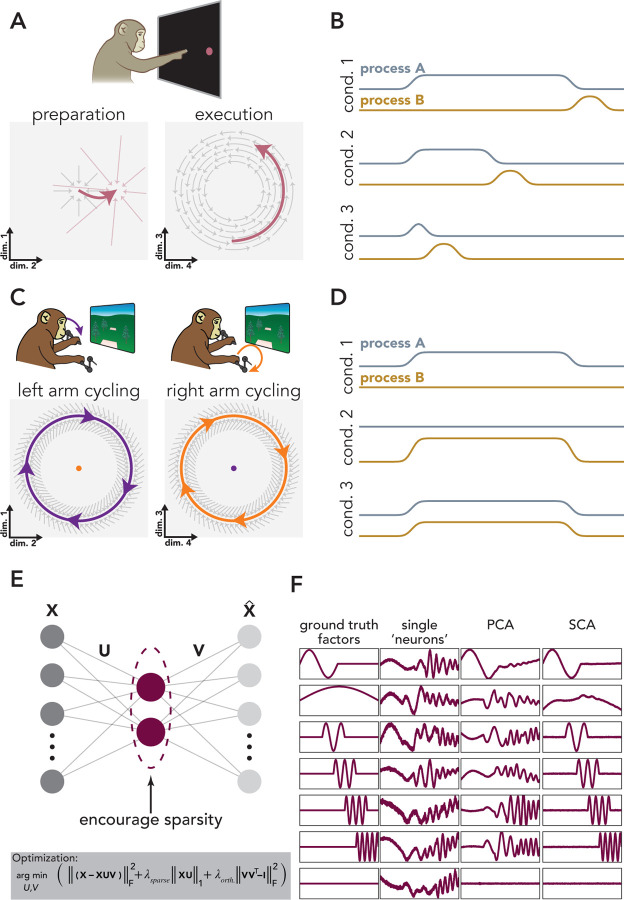
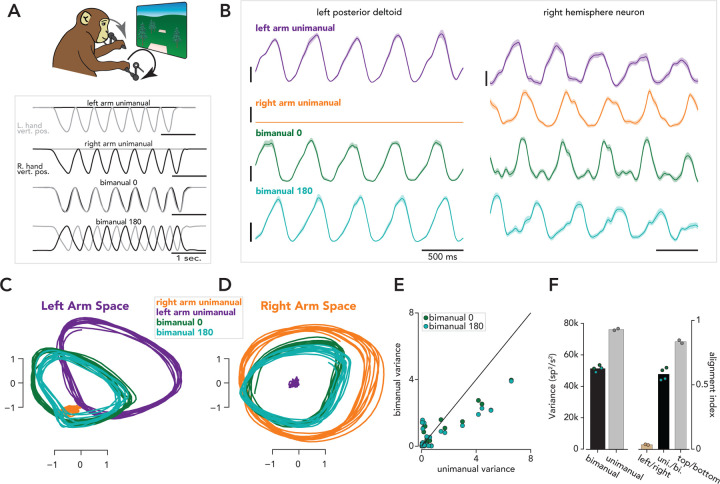
In many neural populations, the computationally relevant signals are posited to be a set of 'latent factors' - signals shared across many individual neurons. Understanding the relationship between neural activity and behavior requires the identification of factors that reflect distinct computational roles. Methods for identifying such factors typically require supervision, which can be suboptimal if one is unsure how (or whether) factors can be grouped into distinct, meaningful sets. Here, we introduce Sparse Component Analysis (SCA), an unsupervised method that identifies interpretable latent factors. SCA seeks factors that are sparse in time and occupy orthogonal dimensions. With these simple constraints, SCA facilitates surprisingly clear parcellations of neural activity across a range of behaviors. We applied SCA to motor cortex activity from reaching and cycling monkeys, single-trial imaging data from , and activity from a multitask artificial network. SCA consistently identified sets of factors that were useful in describing network computations.
在许多神经群体中,计算相关信号被假定为一组“潜在因子”——许多单个神经元共享的信号。理解神经活动与行为之间的关系需要识别反映不同计算作用的因子。识别此类因子的方法通常需要监督,如果不确定如何(或是否)将因子分组为不同的、有意义的集合,这种方法可能不是最优的。在这里,我们介绍稀疏成分分析(SCA),这是一种无监督方法,可识别可解释的潜在因子。SCA寻找时间上稀疏且占据正交维度的因子。通过这些简单的约束,SCA有助于在一系列行为中对神经活动进行惊人清晰的划分。我们将SCA应用于来自伸手和骑自行车猴子的运动皮层活动、来自[具体来源未提及]的单试验成像数据以及多任务人工网络的活动。SCA始终能识别出有助于描述网络计算的因子集。