Altuwairqi Abdullah, Ali Abdulah H, Alariefy Abdulaziz A, Bahlas Sami, AlZahrani Samer K, Zarei Essam W, Alshaikh Adnan E, Khan Ahmed H, Attar Abdullah A
Department of Orthopaedics, King Abdulaziz University Hospital, Jeddah, SAU.
Department of Medicine, King Abdulaziz University Faculty of Medicine, Jeddah, SAU.
Cureus. 2024 Jan 18;16(1):e52492. doi: 10.7759/cureus.52492. eCollection 2024 Jan.
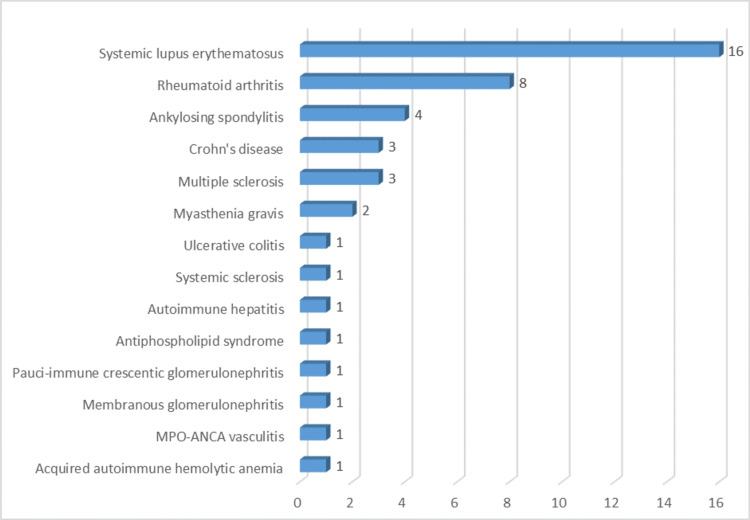
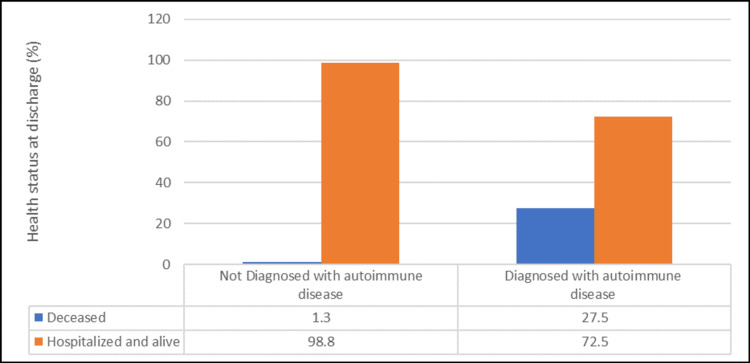
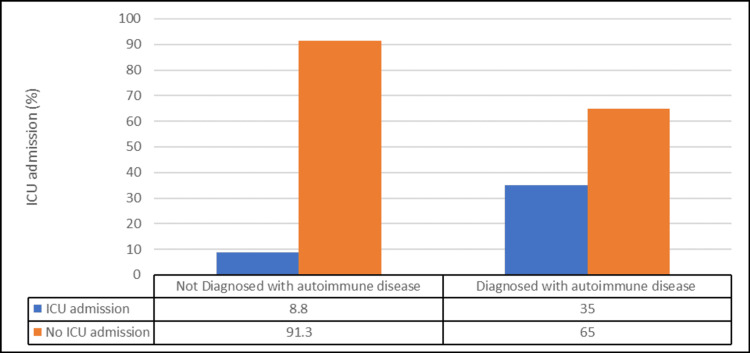
Background The coronavirus disease 2019 (COVID-19) pandemic has raised significant concerns about the effects of the virus on patients with autoimmune diseases. Therefore, understanding the COVID-19 outcomes in this population is crucial for effective prevention and management. Objective This study aimed to investigate the association between autoimmune diseases and the severity of COVID-19 in terms of mortality and morbidity. Despite substantial advancements in pandemic-related research concerning COVID-19 and autoimmune diseases, there remain noteworthy gaps in our comprehension of this association, particularly due to limited investigations conducted in Saudi Arabia. Methods This was a retrospective record review of a tertiary center from January 2020 to January 2022. We included 120 patients, among whom 40 were diagnosed with autoimmune diseases, and 80 were age- and sex-matched controls. Afterward, we assessed their demographics, year of admission, intensive care unit (ICU) admission, health status, length of hospitalization, comorbidities, diagnosis of autoimmune diseases, and type of immunosuppressant therapy. Results Most of the included patients (mean age: 45.4 years) were females (65.8%). The ratio of non-autoimmune diseases to autoimmune diseases was 2:1, the mean length of hospitalization was 8.83 ± 8.16 days, and the median was seven days (interquartile range (IQR) = 3 to 11 days). Among them, 17.5% were admitted to the ICU and 10% died. The prevalence of autoimmune diseases was higher in women than in men (77.5%). The most common diseases were systemic lupus erythematosus (40%), rheumatoid arthritis (20%), and ankylosing spondylitis (10%). Regarding COVID-19 outcomes, ICU admissions were higher among patients with autoimmune diseases than those with non-autoimmune diseases (35% vs. 8.8%) (p<0.05). This trend was also observed in mortality, with a higher percentage of deaths among patients with autoimmune diseases (27.5% vs. 1.7%) (p<0.05). In addition, there were no significant differences between genders in terms of ICU admission, health status outcomes, or length of hospitalization among patients with autoimmune diseases (p>0.05). Notably, 25 patients were administered immunosuppressants. Of these, 18 (72%) used steroids only, while seven (28%) used both biological and steroid therapy. However, no significant associations were observed between the type of treatment used and outcomes such as ICU admission, health status at discharge, and length of hospitalization (p>0.05). Conclusion This study suggests that individuals with autoimmune diseases have more severe COVID-19 outcomes, as shown by ICU admission and mortality rates, than patients with non-autoimmune diseases. Furthermore, we observed that the use of immunosuppressant medications among patients with autoimmune diseases showed no noticeable effect on these outcomes.
背景 2019 冠状病毒病(COVID-19)大流行引发了人们对该病毒对自身免疫性疾病患者影响的重大担忧。因此,了解这一人群的 COVID-19 结局对于有效预防和管理至关重要。目的 本研究旨在探讨自身免疫性疾病与 COVID-19 在死亡率和发病率方面严重程度之间的关联。尽管在与大流行相关的 COVID-19 和自身免疫性疾病研究方面取得了重大进展,但我们对这种关联的理解仍存在显著差距,特别是由于沙特阿拉伯进行的调查有限。方法 这是一项对一家三级中心 2020 年 1 月至 2022 年 1 月的回顾性病历审查。我们纳入了 120 名患者,其中 40 名被诊断患有自身免疫性疾病,80 名是年龄和性别匹配的对照组。随后,我们评估了他们的人口统计学特征、入院年份、重症监护病房(ICU)入院情况、健康状况、住院时间、合并症、自身免疫性疾病诊断以及免疫抑制治疗类型。结果 纳入的大多数患者(平均年龄:45.4 岁)为女性(65.8%)。非自身免疫性疾病与自身免疫性疾病的比例为 2:1,平均住院时间为 8.83±8.16 天,中位数为 7 天(四分位间距(IQR)=3 至 11 天)。其中,17.5%的患者入住了 ICU,10%的患者死亡。女性自身免疫性疾病的患病率高于男性(77.5%)。最常见的疾病是系统性红斑狼疮(40%)、类风湿性关节炎(20%)和强直性脊柱炎(10%)。关于 COVID-19 结局,自身免疫性疾病患者的 ICU 入院率高于非自身免疫性疾病患者(35%对 8.8%)(p<0.05)。在死亡率方面也观察到了这种趋势,自身免疫性疾病患者的死亡百分比更高(27.5%对 1.7%)(p<0.05)。此外,在自身免疫性疾病患者中,性别在 ICU 入院、健康状况结局或住院时间方面没有显著差异(p>0.05)。值得注意的是,25 名患者接受了免疫抑制治疗。其中,18 名(72%)仅使用了类固醇,而 7 名(28%)同时使用了生物制剂和类固醇治疗。然而,在使用的治疗类型与诸如 ICU 入院、出院时的健康状况和住院时间等结局之间未观察到显著关联(p>0.05)。结论 本研究表明,与非自身免疫性疾病患者相比,自身免疫性疾病患者的 COVID-19 结局更严重,如通过 ICU 入院率和死亡率所示。此外,我们观察到自身免疫性疾病患者使用免疫抑制药物对这些结局没有明显影响。