Tian Liuhong, Liu Ke, Li Li, Wu Wenwen, Zhang Ningrui
School of Public Health and Management, Wenzhou Medical University, Wenzhou, 325035, Zhejiang Province, China.
School of Public Health, Guangzhou Medical University, Guangzhou, 511436, Guangdong Province, China.
Heliyon. 2024 Feb 9;10(4):e26137. doi: 10.1016/j.heliyon.2024.e26137. eCollection 2024 Feb 29.
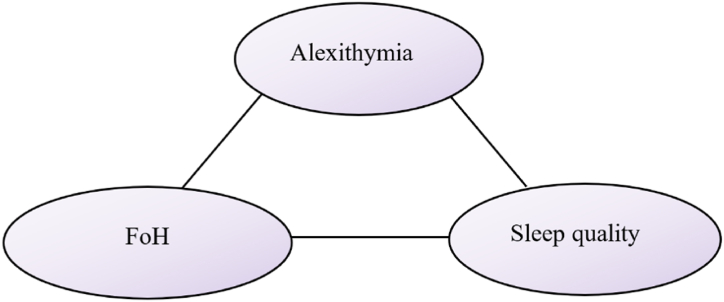
Patients with type 2 diabetes mellitus (T2DM) commonly experience poor sleep quality. This study aimed to investigate whether alexithymia mediates the association between fear of hypoglycaemia (FoH) and sleep quality in patients with T2DM.
From September 2021 to November 2021, a cross-sectional survey was conducted on 407 patients with T2DM in China. Data collection was made possible through the administration of the Chinese Version of the Worry Scale, Toronto Alexithymia Scale and Chinese version of the Pittsburgh Sleep Quality Index (CPSQI). Multiple linear regression analyses were also performed.
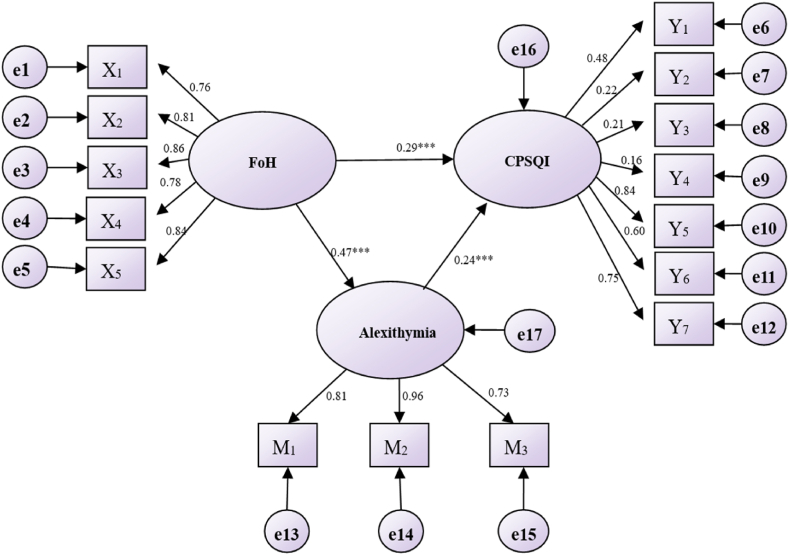
A total of 65.6% of the participants were male, and 75.7% were aged 18-40 years. FoH showed a moderate and positive correlation with CPSQI scores (r = 0.308, p < 0.001). Alexithymia was weakly and positively correlated with CPSQI scores (r = 0.185, p < 0.001). Meanwhile, FoH exhibited a moderate and positive correlation with alexithymia (r = 0.422, p < 0.001), and difficulty in identifying (r = 0.414, p < 0.001) and describing feelings (r = 0.416, p < 0.001) and a weak and positive correlation with externally oriented thinking (r = 0.221, p < 0.001). The total effect (β = 0.408, p < 0.001) of FoH on CPSQI comprised not only the direct (β = 0.293, 95% confidence interval: 0.174-0.411, p < 0.001) but also the indirect effect (β = 0.115, p < 0.001) of alexithymia.
Alexithymia can mediate the association between FoH and sleep quality. Clinicians should recognize the potential effect of alexithymia and incorporate it in intervention planning and care. Addressing the affective disturbances arising from FoH can enhance emotional expression and sleep quality among T2DM patients.
2型糖尿病(T2DM)患者普遍存在睡眠质量差的问题。本研究旨在探讨述情障碍是否介导了T2DM患者低血糖恐惧(FoH)与睡眠质量之间的关联。
2021年9月至2021年11月,对中国407例T2DM患者进行了横断面调查。通过使用中文版担忧量表、多伦多述情障碍量表和中文版匹兹堡睡眠质量指数(CPSQI)来收集数据。还进行了多重线性回归分析。
共有65.6%的参与者为男性,75.7%的参与者年龄在18 - 40岁之间。FoH与CPSQI评分呈中度正相关(r = 0.308,p < 0.001)。述情障碍与CPSQI评分呈弱正相关(r = 0.185,p < 0.001)。同时,FoH与述情障碍呈中度正相关(r = 0.422,p < 0.001),与识别情感困难(r = 0.414,p < 0.001)和描述情感困难(r = 0.416,p < 0.001)呈中度正相关,与外向性思维呈弱正相关(r = 0.221,p < 0.001)。FoH对CPSQI的总效应(β = 0.408,p < 0.001)不仅包括直接效应(β = 0.293,95%置信区间:0.174 - 0.411,p < 0.001),还包括述情障碍的间接效应(β = 0.115,p < 0.001)。
述情障碍可介导FoH与睡眠质量之间的关联。临床医生应认识到述情障碍的潜在影响,并将其纳入干预计划和护理中。解决由FoH引起的情感障碍可提高T2DM患者的情感表达能力和睡眠质量。