Department of Otorhinolaryngology, Head and Neck Surgery, The First Affiliated Hospital, Jiangxi Medical College, Nanchang University, Nanchang, Jiangxi Province, China.
Department of Otolaryngology, Yong Loo Lin School of Medicine, National University of Singapore, National University Health System, Singapore, Singapore.
Respir Res. 2024 Feb 20;25(1):94. doi: 10.1186/s12931-024-02720-6.
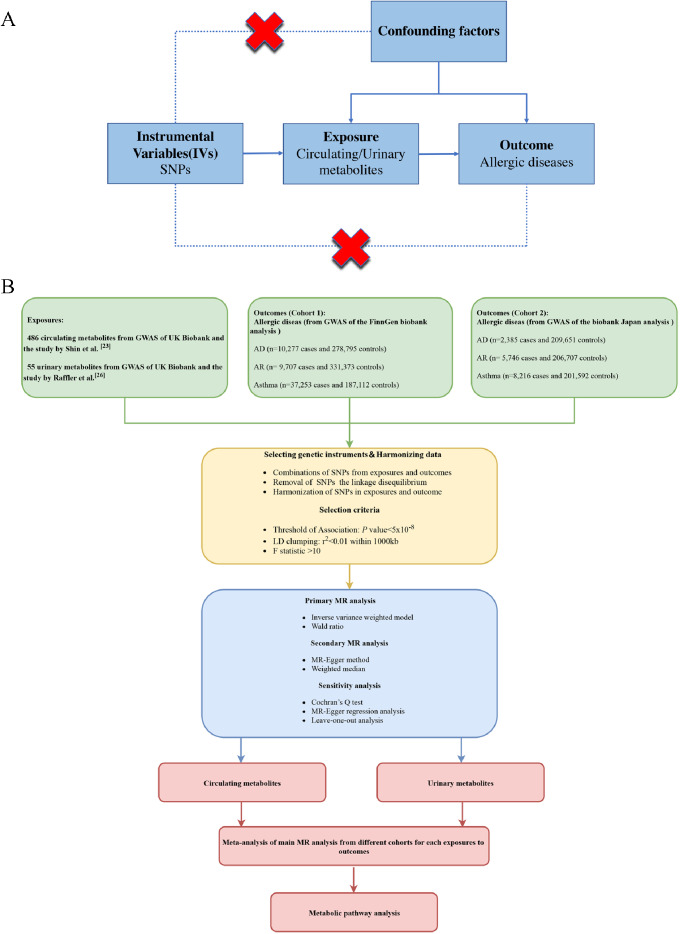
Allergic diseases exert a considerable impact on global health, thus necessitating investigations into their etiology and pathophysiology for devising effective prevention and treatment strategies. This study employs a Mendelian randomization (MR) analysis and meta-analysis to identify metabolite targets potentially associated with allergic diseases.
A two-sample MR analysis was conducted to explore potential causal relationships between circulating and urinary metabolites and allergic diseases. Exposures were derived from a genome-wide association study (GWAS) of 486 circulating metabolites and a GWAS of 55 targeted urinary metabolites. Outcome data for allergic diseases, including atopic dermatitis (AD), allergic rhinitis (AR), and asthma, were obtained from the FinnGen biobank in Europe (cohort 1) and the Biobank Japan in Asia (cohort 2). MR results from both cohorts were combined using a meta-analysis.
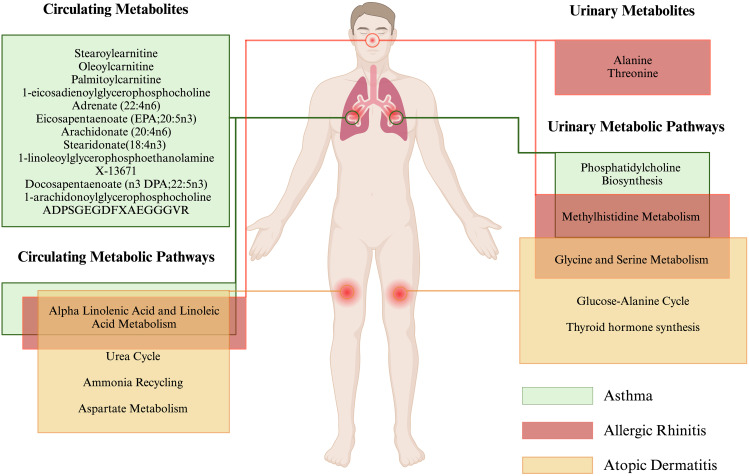
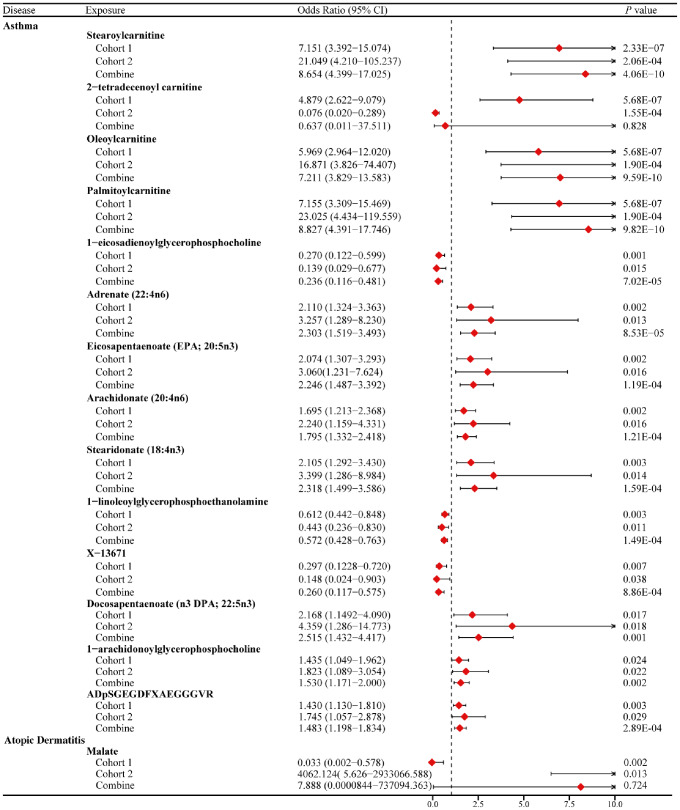
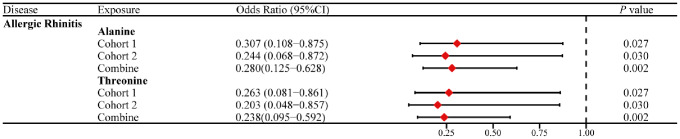
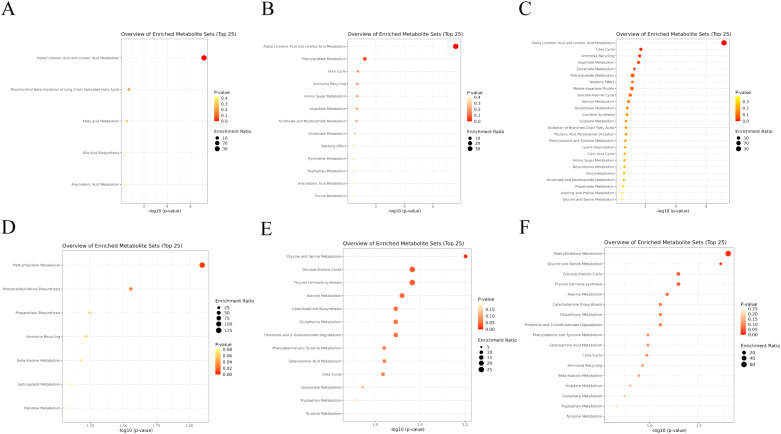
MR analysis identified 50 circulating metabolites and 6 urinary metabolites in cohort 1 and 54 circulating metabolites and 2 urinary metabolites in cohort 2 as potentially causally related to allergic diseases. A meta-analysis of the MR results revealed stearoylcarnitine (OR 8.654; 95% CI 4.399-17.025; P = 4.06E-10) and 1-arachidonoylglycerophosphoinositol (OR 2.178; 95% CI 1.388-3.419; P = 7.15E-04) as the most reliable causal circulating metabolites for asthma and AR, respectively. Further, histidine (OR 0.734; 95% CI: 0.594-0.907; P = 0.004), tyrosine (OR 0.601; 95% CI: 0.380-0.952; P = 0.030), and alanine (OR 0.280; 95% CI: 0.125-0.628; P = 0.002) emerged as urinary metabolites with the greatest protective effects against asthma, AD, and AR, respectively.
Imbalances in numerous circulating and urinary metabolites may be implicated in the development and progression of allergic diseases. These findings have significant implications for the development of targeted strategies for the prevention and treatment of allergic diseases.
过敏性疾病对全球健康造成了相当大的影响,因此需要研究其病因和病理生理学,以制定有效的预防和治疗策略。本研究采用孟德尔随机化(MR)分析和荟萃分析来确定与过敏性疾病相关的潜在代谢物靶点。
进行了两样本 MR 分析,以探讨循环和尿液代谢物与过敏性疾病之间的潜在因果关系。暴露来自于 486 种循环代谢物的全基因组关联研究(GWAS)和 55 种靶向尿液代谢物的 GWAS。过敏性疾病的结果数据,包括特应性皮炎(AD)、过敏性鼻炎(AR)和哮喘,来自欧洲的 FinnGen 生物库(队列 1)和亚洲的 Biobank Japan(队列 2)。使用荟萃分析合并来自两个队列的 MR 结果。
MR 分析在队列 1 中确定了 50 种循环代谢物和 6 种尿液代谢物,在队列 2 中确定了 54 种循环代谢物和 2 种尿液代谢物,与过敏性疾病可能有因果关系。MR 结果的荟萃分析显示,硬脂酰肉碱(OR 8.654;95%CI 4.399-17.025;P=4.06E-10)和 1-花生四烯酰甘油磷酸肌醇(OR 2.178;95%CI 1.388-3.419;P=7.15E-04)分别是哮喘和 AR 最可靠的因果循环代谢物。此外,组氨酸(OR 0.734;95%CI:0.594-0.907;P=0.004)、酪氨酸(OR 0.601;95%CI:0.380-0.952;P=0.030)和丙氨酸(OR 0.280;95%CI:0.125-0.628;P=0.002)作为尿液代谢物,对哮喘、AD 和 AR 具有最大的保护作用。
许多循环和尿液代谢物的失衡可能与过敏性疾病的发生和发展有关。这些发现对于制定预防和治疗过敏性疾病的靶向策略具有重要意义。