Meier Katharina, Riepl Angela, Voitl Peter, Lischka Lena, Voitl Julian J M, Langer Klara, Kuzio Ulrike, Redlberger-Fritz Monika, Diesner-Treiber Susanne C
First Vienna Pediatric Medical Center, Vienna, Austria.
Sigmund Freud University Vienna, Vienna, Austria.
Front Pediatr. 2024 Feb 6;12:1342399. doi: 10.3389/fped.2024.1342399. eCollection 2024.
Respiratory syncytial virus (RSV) is one of the leading causes of hospitalisation, morbidity, and mortality due to respiratory infection in the first years of life. This longitudinal prospective study outlines the 2022/23 season's viral patterns in Austria after the epidemiological changes determined by public health measures. We aimed to highlight differences within the RSV subtypes and genotypes in 0-36-month-old children without chronic diseases in the outpatient setting.
From November 2022 to March 2023 children younger than 36 months admitted to Vienna's largest paediatric primary healthcare centre with an acute respiratory infection were enrolled in this study. Nasal swabs and multiplex PCR panels detected 20 viruses including RSV subtypes and genotypes. Clinical presentation, features, and treatment of the participants were documented and analysed using the Modified Tal Score (MTS). Patients were scheduled for a telemedical follow-up one week after the initial appointment. Analysis was done using descriptive statistics, including Cramér V and binominal logarithmic regression.
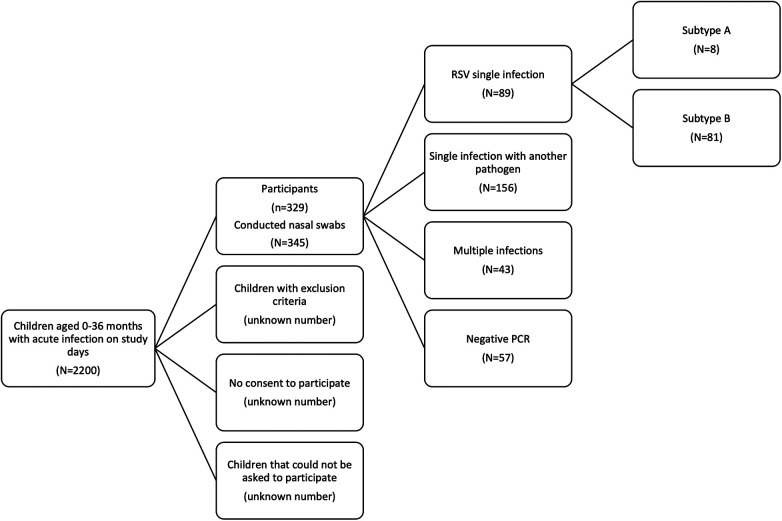
Among the 345 samples from 329 children, RSV was the most common virus (31.9%), followed by influenza (17.5%) and rhinovirus infections (20.58%). Of the RSV positive samples, only 13 cases were RSV subtype A (11.8%), whereas 97 were of subtype B (87.3%); ON1 and BA9 were the only detectable RSV genotypes (ON1: BA9 = 1:9.25). RSV was the main predictor of hospitalisation (OR: 7.5, 95% CI: (1.46-38.40), and age had a significant but smaller effect (OR: 0.89, 95% CI: (0.81-0.99). Almost all patients' clinical status improved within the first days.
RSV cases showed a rapid onset in late November 2022, and subtype B was predominant throughout the season. RSV infection was associated with higher hospitalisation rates, even after excluding high-risk patients (preterm and severe chronic diseases population).Further testing in the upcoming winter seasons will improve our knowledge of the dominant subtype and its association with disease severity, especially with the development of novel RSV vaccine candidates.
呼吸道合胞病毒(RSV)是导致1岁以内儿童因呼吸道感染住院、发病和死亡的主要原因之一。这项纵向前瞻性研究概述了在公共卫生措施导致流行病学变化后,2022/23赛季奥地利的病毒流行模式。我们旨在突出门诊环境中0至36个月无慢性疾病儿童的RSV亚型和基因型之间的差异。
2022年11月至2023年3月,纳入维也纳最大的儿科初级医疗中心收治的患有急性呼吸道感染的36个月以下儿童。鼻拭子和多重PCR检测板检测20种病毒,包括RSV亚型和基因型。使用改良塔尔评分(MTS)记录并分析参与者的临床表现、特征和治疗情况。患者在初次就诊一周后安排远程医疗随访。分析采用描述性统计,包括克莱姆V检验和二项对数回归。
在来自329名儿童的345份样本中,RSV是最常见的病毒(31.9%),其次是流感(17.5%)和鼻病毒感染(20.58%)。在RSV阳性样本中,只有13例是A亚型(11.8%),而97例是B亚型(87.3%);ON1和BA9是仅可检测到的RSV基因型(ON1:BA9 = 1:9.25)。RSV是住院的主要预测因素(OR:7.5,95%CI:(1.46 - 38.40)),年龄有显著但较小的影响(OR:0.89,95%CI:(0.81 - 0.99))。几乎所有患者的临床状况在最初几天内都有所改善。
RSV病例在2022年11月下旬发病迅速,整个季节B亚型占主导。即使排除高危患者(早产和严重慢性疾病人群),RSV感染仍与较高的住院率相关。在即将到来的冬季进行进一步检测将提高我们对优势亚型及其与疾病严重程度关联的认识,特别是随着新型RSV候选疫苗的研发。