Department of Gynecology and Obstetrics, Taizhou Hospital of Zhejiang Province, Zhejiang University, Linhai, Zhejiang Province, China.
BMC Pregnancy Childbirth. 2024 Feb 21;24(1):151. doi: 10.1186/s12884-024-06344-y.
Cesarean scar pregnancy (CSP) is a long-term complication of cesarean section characterized by the localization of a subsequent gestational sac within the scar area or niche developed as a result of a previous cesarean section. Its incidence has increased substantially because of the high global cesarean section rate in recent decades. Several surgical and drug treatments exist for this condition; however, there is currently no optimal treatment. This study compared the effectiveness of direct hysteroscopic removal of the gestational tissue and hysteroscopy combined with vacuum suction for the treatment of CSP.
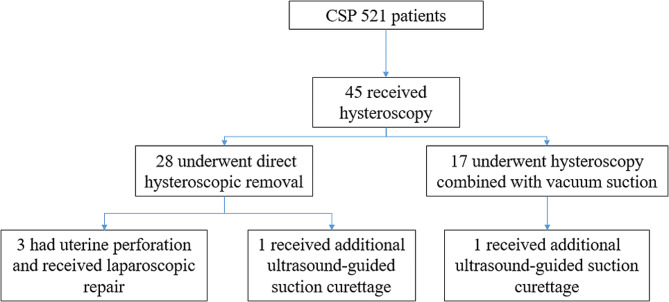
From 2017 to 2023, 521 patients were diagnosed with CSP at our hospital. Of these patients, 45 underwent hysteroscopy. Among them, 28 underwent direct hysteroscopic removal (hysteroscopic removal group) and 17 underwent hysteroscopy combined with vacuum suction (hysteroscopic suction group). The clinical characteristics and outcomes of the hysteroscopic removal group and hysteroscopic suction group were analyzed.
Among the 45 patients, the amount of bleeding and hospitalization cost were significantly higher in the hysteroscopic removal group than in the hysteroscopic suction group (33.8 mL vs. 9.9 mL, P < 0.001; and 8744.0 yuan vs. 5473.8 yuan, P < 0.001; respectively). The operation time and duration of hospitalization were significantly longer in the hysteroscopic removal group than in the hysteroscopic suction group (61.4 min vs. 28.2 min, P < 0.001; and 3.8 days vs. 2.4 days, P = 0.026; respectively). Three patients in the hysteroscopic removal group had uterine perforation and received laparoscopic repair during operation. No complications occurred in the hysteroscopic suction group. One patient in the hysteroscopic removal group received ultrasound-guided suction curettage due to postoperative moderate vaginal bleeding, and one patient in the hysteroscopic suction group received ultrasound-guided suction curettage due to postoperative gestational residue and elevated serum beta-human chorionic gonadotropin levels. Reproductive function was preserved in all patients.
Hysteroscopy is an effective method for treating CSP. Compared with direct hysteroscopic removal, hysteroscopy combined with vacuum suction is more suitable for CSP. However, multicenter prospective studies with large sample sizes are required for verification of these findings.
剖宫产瘢痕妊娠(CSP)是剖宫产的一种长期并发症,其特征是在下一次妊娠囊位于剖宫产瘢痕区域或由于剖宫产而形成的陷窝内。由于近几十年来全球剖宫产率较高,其发病率显著增加。对于这种情况,存在几种手术和药物治疗方法;然而,目前尚无最佳治疗方法。本研究比较了直接宫腔镜下切除妊娠组织和宫腔镜联合真空抽吸治疗 CSP 的效果。
2017 年至 2023 年,我院共诊断出 521 例 CSP 患者。其中 45 例行宫腔镜检查。其中 28 例行直接宫腔镜切除(宫腔镜切除组),17 例行宫腔镜联合真空抽吸(宫腔镜抽吸组)。分析宫腔镜切除组和宫腔镜抽吸组的临床特征和结局。
在 45 例患者中,宫腔镜切除组的出血量和住院费用明显高于宫腔镜抽吸组(33.8 毫升比 9.9 毫升,P<0.001;8744.0 元比 5473.8 元,P<0.001)。宫腔镜切除组的手术时间和住院时间明显长于宫腔镜抽吸组(61.4 分钟比 28.2 分钟,P<0.001;3.8 天比 2.4 天,P=0.026)。宫腔镜切除组有 3 例发生子宫穿孔,术中行腹腔镜修补术。宫腔镜抽吸组无并发症发生。宫腔镜切除组 1 例术后中等量阴道出血行超声引导下清宫术,宫腔镜抽吸组 1 例术后妊娠物残留、血清β-人绒毛膜促性腺激素水平升高行超声引导下清宫术。所有患者均保留了生殖功能。
宫腔镜是治疗 CSP 的有效方法。与直接宫腔镜切除相比,宫腔镜联合真空抽吸更适用于 CSP。然而,需要进行更大样本量的多中心前瞻性研究来验证这些发现。