Little Matthew, Brockington Meghan, Aker Amira, Kenny Tiff-Annie, Andrade-Rivas Federico, Ayotte Pierre, Lemire Mélanie
School of Public Health and Social Policy, University of Victoria, 3800 Finnerty Rd, Victoria, BC, Canada.
Department of Population Medicine, University of Guelph, Guelph, ON, Canada.
Public Health Nutr. 2024 Feb 22;27(1):e81. doi: 10.1017/S1368980024000491.
To measure vitamin D status and estimate factors associated with serum 25-hydroxyvitamin D (25(OH)D) in Nunavimmiut (Inuit living in Nunavik) adults in 2017.
Data were from ? 2017 Nunavik Inuit Health Survey, a cross-sectional study conducted in August-October 2017. Participants underwent a questionnaire, including an FFQ, and blood samples were analysed for total serum 25(OH)D.
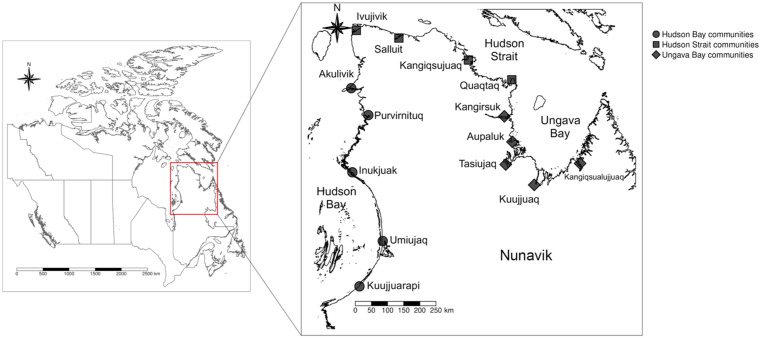
Nunavik, northern Québec, Canada.
A stratified proportional model was used to select respondents, including 1,155 who identified as Inuit and had complete data.
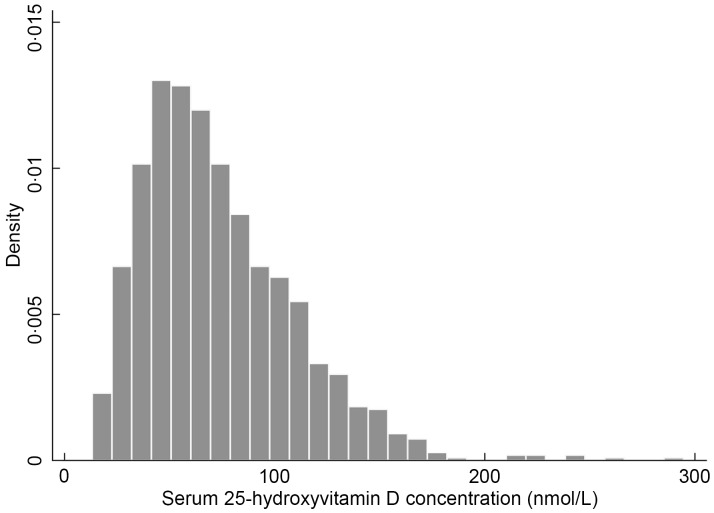
Geometric mean serum vitamin D levels were 65·2 nmol/l (95 % CI 62·9-67·6 nmol/l) among women and 65·4 nmol/l (95 % CI 62·3-68·7 nmol/l) among men. The weighted prevalence of serum 25(OH)D < 75 nmol/l, <50 nmol/l <30 nmol/l was 61·2 %, 30·3 % and 7·0 %, respectively. Individuals who were older, female, lived in smaller and/or more southerly communities and/or consumed more country (traditional) foods were at a reduced risk of low vitamin D status. Higher consumption of wild fish was specifically associated with increased serum 25(OH)D concentration.
It is important that national, regional and local policies and programs are in place to secure harvest, sharing and consumption of nutritious and culturally important country foods like Arctic char and other wild fish species, particularly considering ongoing climate change in the Arctic which impacts the availability, access and quality of fish as food.
测定2017年努纳维克地区(居住在努纳维克的因纽特人)成年人的维生素D状况,并评估与血清25-羟基维生素D(25(OH)D)相关的因素。
数据来自2017年努纳维克因纽特人健康调查,这是一项于2017年8月至10月进行的横断面研究。参与者接受了问卷调查,包括一份食物频率问卷,同时采集血样分析血清总25(OH)D。
加拿大魁北克省北部的努纳维克。
采用分层比例模型选取受访者,其中包括1155名认定为因纽特人且数据完整的受访者。
女性血清维生素D水平的几何平均值为65.2 nmol/l(95%置信区间62.9 - 67.6 nmol/l),男性为65.4 nmol/l(95%置信区间62.3 - 68.7 nmol/l)。血清25(OH)D < 75 nmol/l、< 50 nmol/l、< 30 nmol/l的加权患病率分别为61.2%、30.3%和7.0%。年龄较大、女性、居住在较小和/或更靠南的社区以及/或者食用更多乡村(传统)食物的个体维生素D水平低的风险降低。野生鱼类摄入量较高与血清25(OH)D浓度升高具体相关。
制定国家、地区和地方政策及项目以确保收获、分享和食用像北极红点鲑及其他野生鱼类等营养丰富且具有文化重要性的乡村食物非常重要,尤其考虑到北极地区持续的气候变化会影响鱼类作为食物的可得性、获取途径和质量。