Burchardt Paula, Buddenhagen Christopher E, Gaeta Marcos L, Souza Murilo D, Marques André, Vanzela André L L
Laboratório de Citogenética e Diversidade Vegetal, Departamento de Biologia Geral, CCB, Universidade Estadual de Londrina, Londrina, Brazil.
Forage Science, AgResearch Limited, Hamilton, New Zealand.
Front Plant Sci. 2020 Sep 10;11:536507. doi: 10.3389/fpls.2020.536507. eCollection 2020.
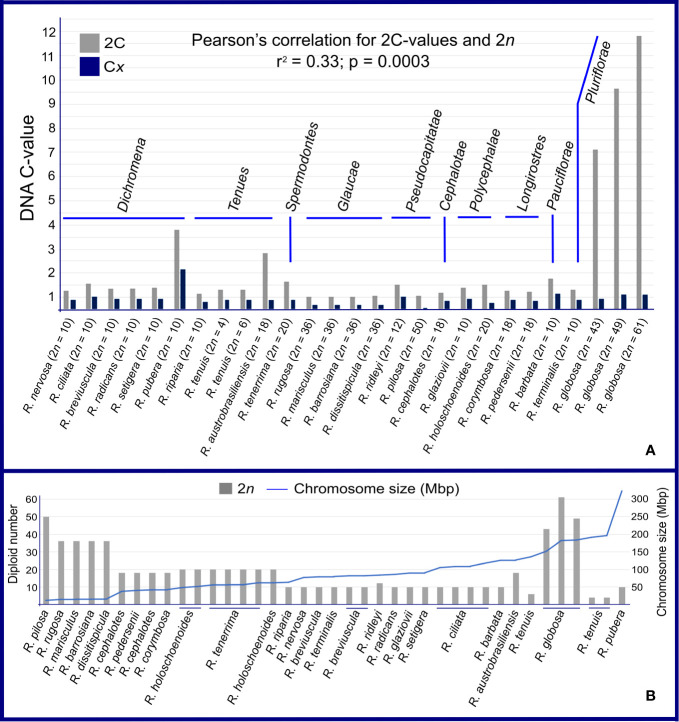
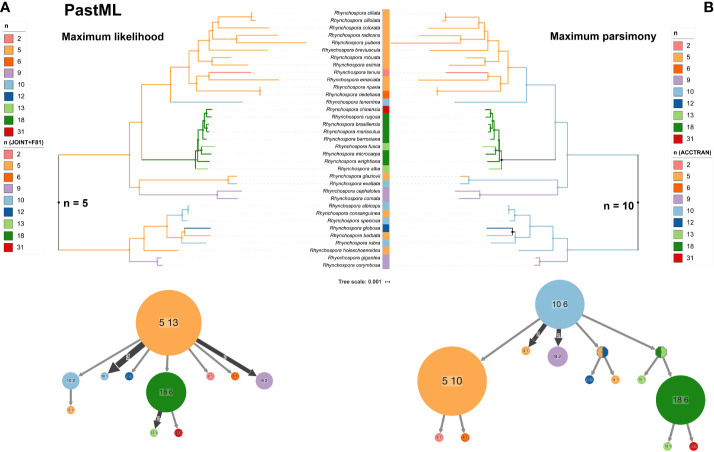
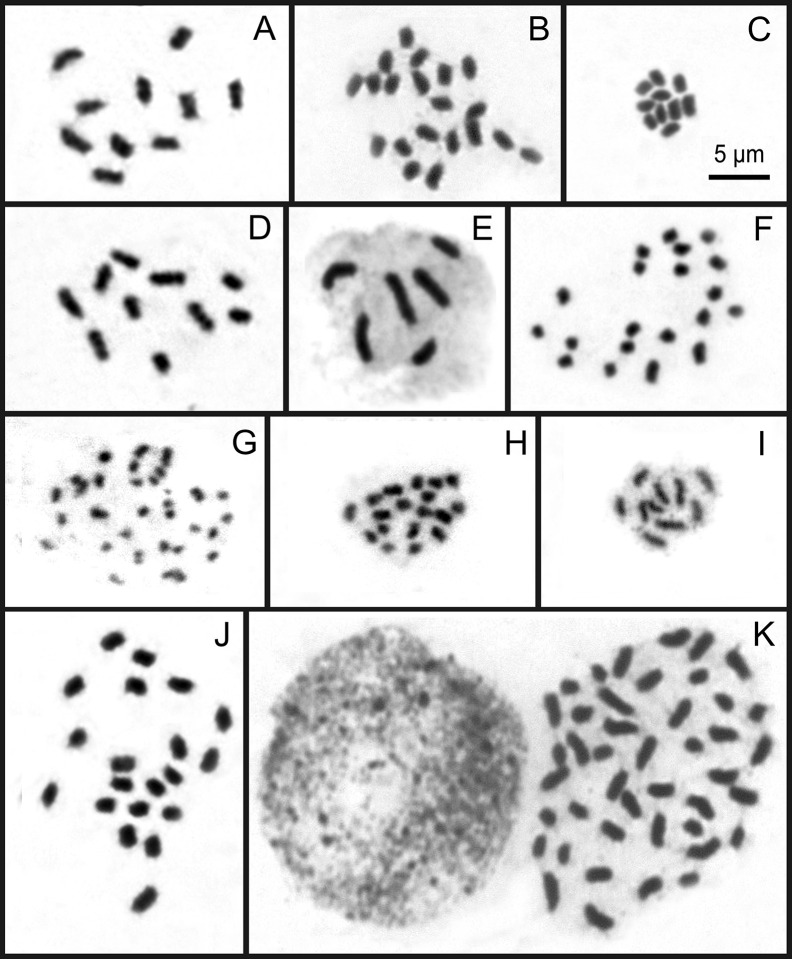
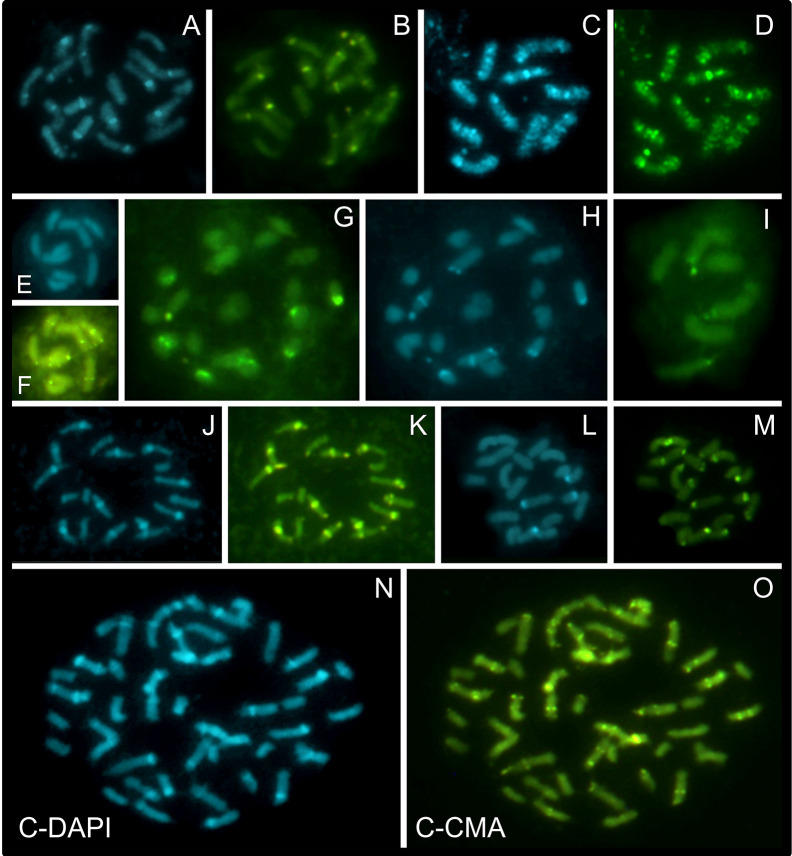
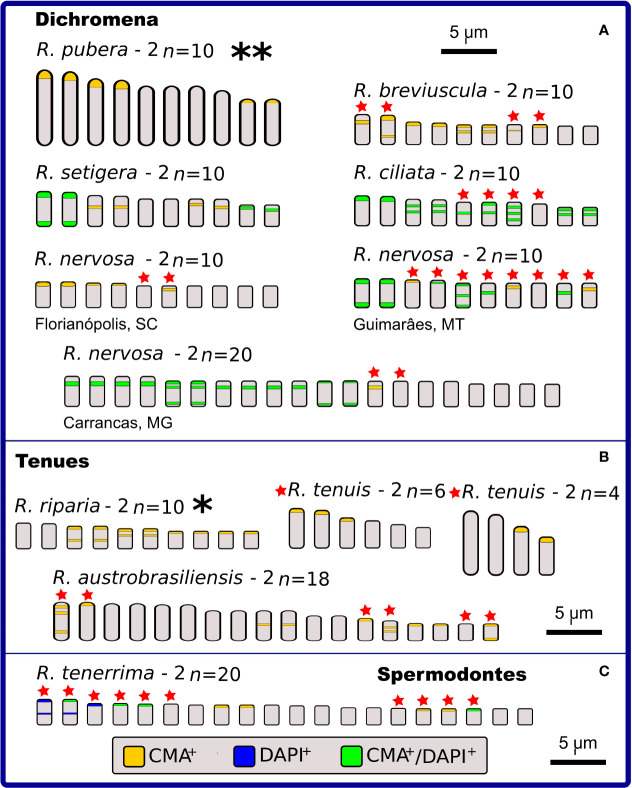
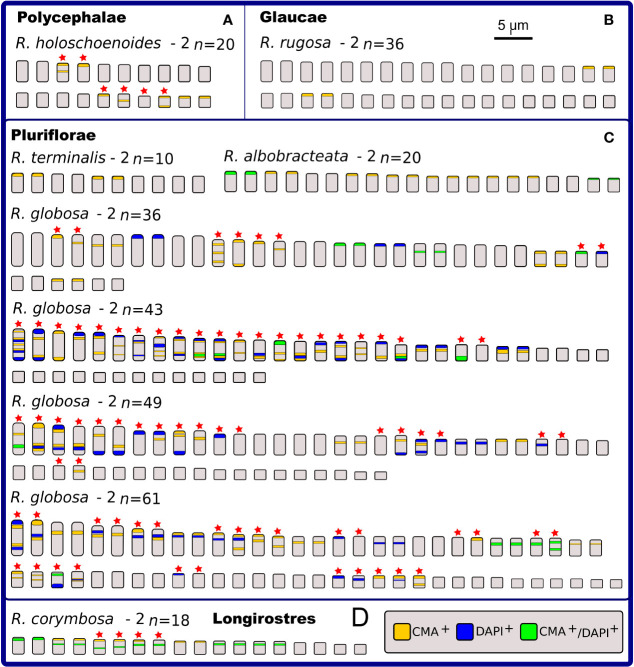
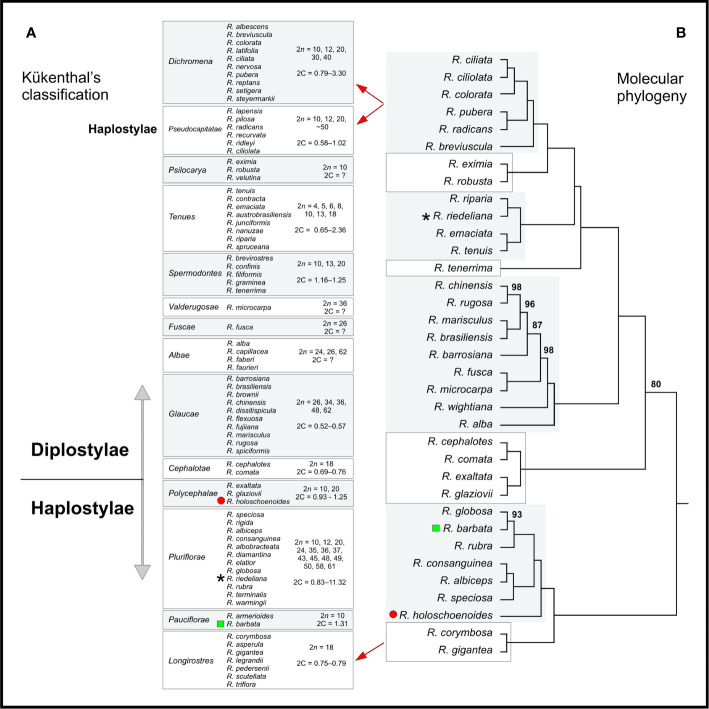
Cyperaceae is a family of Monocotyledons comprised of species with holocentric chromosomes that are associated with intense dysploidy and polyploidy events. Within this family the genus has recently become the focus of several studies that characterize the organization of the holocentric karyotype and genome structures. To broaden our understanding of genome evolution in this genus, representatives of were studied to contrast chromosome features, C-CMA/DAPI band distribution and genome sizes. Here, we carried out a comparative analysis for 35 taxa of , and generated new genome size estimates for 20 taxa. The DNA 2C-values varied up to 22-fold, from 2C = 0.51 pg to 11.32 pg, and chromosome numbers ranged from 2 = 4 to 61. At least 37% of our sampling exhibited 2 different from the basic number = 5, and chromosome rearrangements were also observed. A large variation in C-CMA/DAPI band accumulation and distribution was observed as well. We show that genome variation in is much larger than previously reported. Phylogenetic analysis showed that most taxa were grouped in clades corresponding to previously described taxonomic sections. Basic chromosome numbers are the same within every section, however, changes appeared in all the clades. Ancestral chromosome number reconstruction revealed = 5 as the most likely ancestral complements, but = 10 appears as a new possibility. Chromosome evolution models point to polyploidy as the major driver of chromosome evolution in , followed by dysploidy. A negative correlation between chromosome size and diploid number open the discussion for holokinetic drive-based genome evolution. This study explores relationships between karyotype differentiation and genome size variation in , and contrasts it against the phylogeny of this holocentric group.
莎草科是单子叶植物的一个科,由具有全着丝粒染色体的物种组成,这些物种与强烈的染色体数变异和多倍体事件相关。在这个科中,该属最近成为了几项研究的焦点,这些研究旨在描述全着丝粒核型和基因组结构的组织。为了拓宽我们对该属基因组进化的理解,我们研究了该属的代表物种,以对比染色体特征、C-CMA/DAPI带分布和基因组大小。在这里,我们对该属的35个分类群进行了比较分析,并对20个分类群进行了新的基因组大小估计。DNA的2C值变化高达22倍,从2C = 0.51 pg到11.32 pg,染色体数从2n = 4到61不等。我们至少37%的样本显示染色体数与基数x = 5不同,并且还观察到了染色体重排。同时也观察到C-CMA/DAPI带积累和分布的巨大差异。我们表明,该属的基因组变异比以前报道的要大得多。系统发育分析表明,大多数分类群被归入与先前描述的分类组相对应的分支中。每个组内的基本染色体数相同,然而,所有分支中都出现了变化。祖先染色体数重建显示x = 5是最可能的祖先染色体组,但x = 10也成为了一种新的可能性。染色体进化模型表明多倍体是该属染色体进化的主要驱动力,其次是染色体数变异。染色体大小与二倍体数之间的负相关开启了基于全着丝粒驱动的基因组进化的讨论。本研究探讨了该属核型分化与基因组大小变异之间的关系,并将其与这个全着丝粒类群的系统发育进行了对比。