Wolny Elzbieta, Mur Luis A J, Ohmido Nobuko, Yin Zujun, Wang Kai, Hasterok Robert
Plant Cytogenetics and Molecular Biology Group, Faculty of Natural Sciences, Institute of Biology, Biotechnology and Environmental Protection, University of Silesia in Katowice, 40-032 Katowice, Poland.
Department of Life Sciences, Aberystwyth University, Edward Llwyd Building, Aberystwyth SY23 3DA, UK.
Int J Mol Sci. 2025 Jul 21;26(14):7013. doi: 10.3390/ijms26147013.
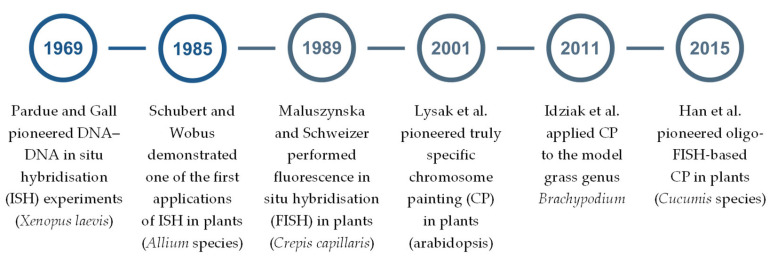
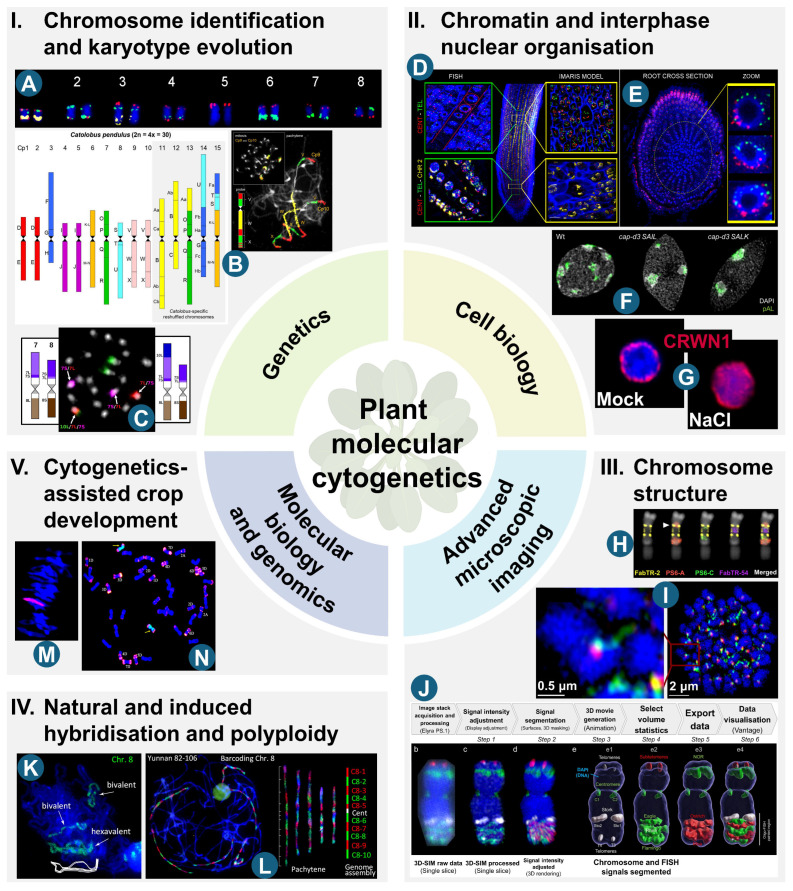
Nearly four decades have passed since fluorescence in situ hybridisation was first applied in plants to support molecular cytogenetic analyses across a wide range of species. Subsequent advances in DNA sequencing, bioinformatic analysis, and microscopy, together with the immunolocalisation of various nuclear components, have provided unprecedented insights into the cytomolecular organisation of the nuclear genome in both model and non-model plants, with crop species being perhaps the most significant. The ready availability of sequenced genomes is now facilitating the application of state-of-the-art cytomolecular techniques across diverse plant species. However, these same advances in genomics also pose a challenge to the future of plant molecular cytogenetics, as DNA sequence analysis is increasingly perceived as offering comparable insights into genome organisation. This perception persists despite the continued relevance of FISH-based approaches for the physical anchoring of genome assemblies to chromosomes. Furthermore, cytogenetic approaches cannot currently rival purely genomic methods in terms of throughput, standardisation, and automation. This review highlights the latest key topics in plant cytomolecular research, with particular emphasis on chromosome identification and karyotype evolution, chromatin and interphase nuclear organisation, chromosome structure, hybridisation and polyploidy, and cytogenetics-assisted crop improvement. In doing so, it underscores the distinctive contributions that cytogenetic techniques continue to offer in genomic research. Additionally, we critically assess future directions and emerging opportunities in the field, including those related to CRISPR/Cas-based live-cell imaging and chromosome engineering, as well as AI-assisted image analysis and karyotyping.
自荧光原位杂交首次应用于植物以支持对广泛物种进行分子细胞遗传学分析以来,近四十年已经过去。随后在DNA测序、生物信息分析和显微镜技术方面的进展,以及各种核成分的免疫定位,为模式植物和非模式植物核基因组的细胞分子组织提供了前所未有的见解,其中作物物种可能是最重要的。现已测序的基因组唾手可得,这正推动最先进的细胞分子技术在多种植物物种中的应用。然而,基因组学的这些同样进展也给植物分子细胞遗传学的未来带来了挑战,因为DNA序列分析越来越被认为能提供关于基因组组织的类似见解。尽管基于荧光原位杂交的方法对于将基因组组装物理锚定到染色体上仍然具有相关性,但这种观念依然存在。此外,目前细胞遗传学方法在通量、标准化和自动化方面无法与纯基因组方法相媲美。本综述重点介绍了植物细胞分子研究中的最新关键主题,特别强调了染色体鉴定和核型进化、染色质和间期核组织、染色体结构、杂交和多倍体,以及细胞遗传学辅助作物改良。在此过程中,它强调了细胞遗传学技术在基因组研究中继续做出的独特贡献。此外,我们批判性地评估了该领域的未来方向和新出现的机会,包括与基于CRISPR/Cas的活细胞成像和染色体工程相关的机会,以及人工智能辅助的图像分析和核型分析。