Department of Radiology, Union Hospital, Tongji Medical College, Huazhong University of Science and Technology, Wuhan, People's Republic of China.
Hubei Province Key Laboratory of Molecular Imaging, Wuhan, People's Republic of China.
Eur Respir J. 2024 Jul 18;64(1). doi: 10.1183/13993003.01612-2023. Print 2024 Jul.
This study aimed to evaluate the longitudinal progression of residual lung abnormalities (ground-glass opacities, reticulation and fibrotic-like changes) and pulmonary function at 3 years following coronavirus disease 2019 (COVID-19).
This prospective, longitudinal cohort study enrolled COVID-19 survivors who exhibited residual lung abnormalities upon discharge from two hospitals. Follow-up assessments were conducted at 6 months, 12 months, 2 years and 3 years post-discharge, and included pulmonary function tests, 6-min walk distance (6MWD), chest computed tomography (CT) scans and symptom questionnaires. Non-COVID-19 controls were retrospectively recruited for comparative analysis.
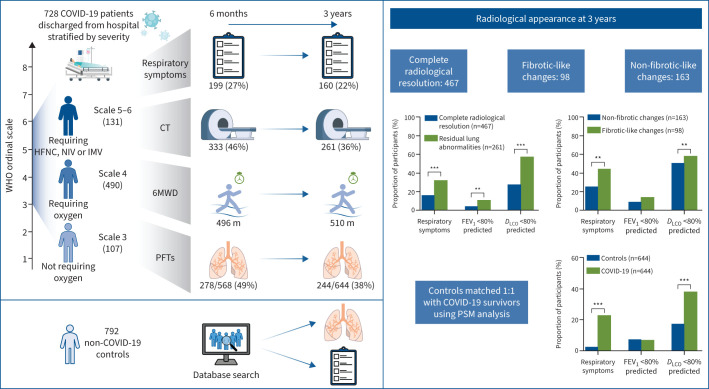
728 COVID-19 survivors and 792 controls were included. From 6 months to 3 years, there was a gradual improvement in reduced diffusing capacity of the lung for carbon monoxide ( <80% predicted: 49% 38%; p=0.001), 6MWD (496 510 m; p=0.002) and residual lung abnormalities (46% 36%; p<0.001), regardless of disease severity. Patients with residual lung abnormalities at 3 years more commonly had respiratory symptoms (32% 16%; p<0.001), lower 6MWD (494 510 m; p=0.003) and abnormal (57% 27%; p<0.001) compared with those with complete resolution. Compared with controls, the proportions of impairment (38% 17%; p<0.001) and respiratory symptoms (23% 2.2%; p<0.001) were significantly higher in the matched COVID-19 survivors at the 3-year follow-up.
Most patients exhibited improvement in radiological abnormalities and pulmonary function over time following COVID-19. However, more than a third continued to have persistent lung abnormalities at the 3-year mark, which were associated with respiratory symptoms and reduced diffusion capacity.
本研究旨在评估 COVID-19 后 3 年时残留肺部异常(磨玻璃影、网状影和纤维化样改变)和肺功能的纵向进展情况。
本前瞻性纵向队列研究纳入了在两家医院出院时存在残留肺部异常的 COVID-19 幸存者。在出院后 6 个月、12 个月、2 年和 3 年进行随访评估,包括肺功能检查、6 分钟步行距离(6MWD)、胸部计算机断层扫描(CT)和症状问卷。回顾性招募非 COVID-19 对照者进行比较分析。
纳入 728 例 COVID-19 幸存者和 792 例对照者。从 6 个月到 3 年,一氧化碳弥散量降低(<80%预计值:49% 38%;p=0.001)、6MWD(496 510m;p=0.002)和残留肺部异常(46% 36%;p<0.001)逐渐改善,与疾病严重程度无关。3 年时存在残留肺部异常的患者更常见有呼吸系统症状(32% 16%;p<0.001)、6MWD 较低(494 510m;p=0.003)和异常(57% 27%;p<0.001)。与对照组相比,匹配的 COVID-19 幸存者在 3 年随访时,肺功能障碍(38% 17%;p<0.001)和呼吸系统症状(23% 2.2%;p<0.001)的比例显著更高。
大多数患者在 COVID-19 后随时间推移肺部异常和肺功能逐渐改善。然而,超过三分之一的患者在 3 年时仍有持续性肺部异常,这些异常与呼吸系统症状和弥散能力降低有关。