Li Fangyi, Omar Dev Roxana Dev, Soh Kim Geok, Wang Chen, Yuan Yubin
Department of Sports Studies Faculty of Educational Studies, Universiti Putra Malaysia, Serdang, Malaysia.
BMC Sports Sci Med Rehabil. 2024 Feb 22;16(1):55. doi: 10.1186/s13102-024-00843-3.
Pilates is becoming increasingly popular amongst a wide range of people and is gaining more attention. It is also an effective means of physical rehabilitation. The aim of this systematic review is to explore the effects of Pilates on spinal deformity and posture.
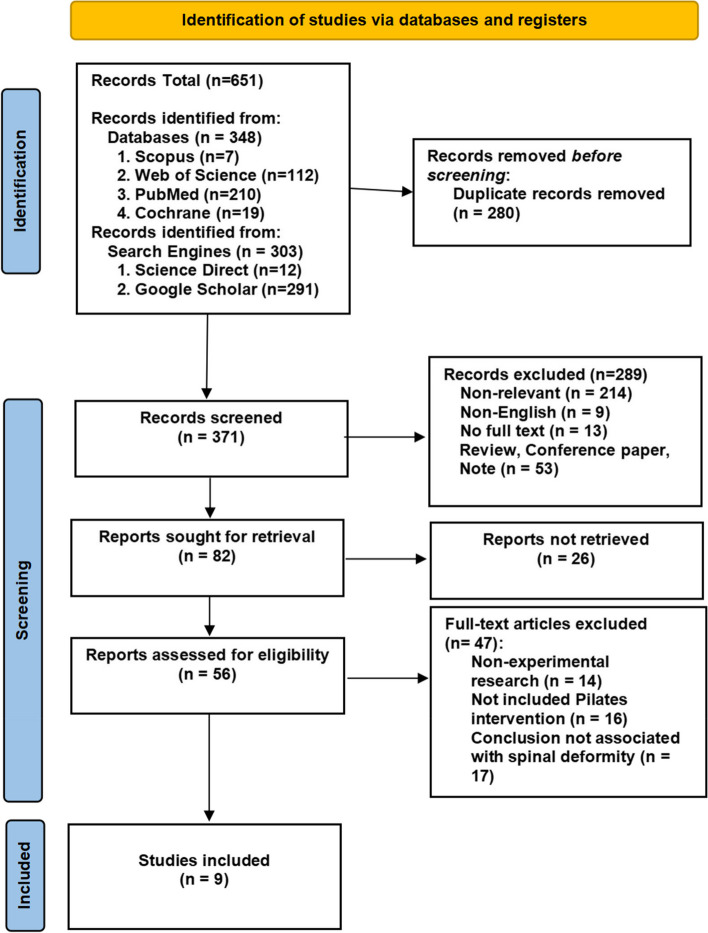
This systematic review was conducted using four recognised academic and scientific databases (Scopus, Web of Science, PubMed and Cochrane) to identify articles that met the inclusion criteria. The secondary search used the Google Scholar and the Science Direct search engines. The search for articles for this review began in July 06, 2023 and was concluded on February 01, 2024. The search process for this study was documented using the Preferred Reporting Items for Systematic Reviews and Meta-Analyses (PRISMA 2020). The PEDro scale was used to assess the internal validity and data statistics of the studies included in this systematic review and to evaluate the quality of the studies.
The systematic review included nine studies that met the inclusion criteria from the 651 studies retrieved, involving a total of 643 participants. The PEDro scale scores of the studies included in this systematic review ranged from 3 to 8. The intervention was in the form of Pilates or Pilates combined exercises. The studies included in this review used outcome measures of Cobb angle, angle of trunk rotation (ATR), range of motion (ROM), chest expansion, Scoliosis Research Society Questionnaire (SRS-22r) and postural assessment. Research has shown that Pilates is effective in correcting spinal deformities and posture, as well as improving quality of life, pain relief, function and fitness.
This systematic review provide substantial evidence that Pilates has a positive impact on improving spinal deformity and posture. However, more research is needed to validate whether Pilates can be used effectively as a physical therapy for spinal deformity rehabilitation. Pilates has considerable potential for public health interventions.
普拉提在广泛人群中越来越受欢迎,并受到更多关注。它也是一种有效的身体康复手段。本系统评价的目的是探讨普拉提对脊柱畸形和姿势的影响。
本系统评价使用四个公认的学术和科学数据库(Scopus、科学网、PubMed和考科蓝)来识别符合纳入标准的文章。二次检索使用谷歌学术和科学Direct搜索引擎。本次综述的文章检索始于2023年7月6日,于2024年2月1日结束。本研究的检索过程使用系统评价和Meta分析的首选报告项目(PRISMA 2020)进行记录。PEDro量表用于评估本系统评价中纳入研究的内部效度和数据统计,并评估研究质量。
该系统评价纳入了从检索到的651项研究中符合纳入标准的9项研究,共涉及643名参与者。本系统评价中纳入研究的PEDro量表得分在3至8分之间。干预形式为普拉提或普拉提组合练习。本综述纳入的研究使用了Cobb角、躯干旋转角度(ATR)、活动范围(ROM)、胸廓扩张度、脊柱侧弯研究学会问卷(SRS-22r)和姿势评估等结局指标。研究表明,普拉提在矫正脊柱畸形和姿势、改善生活质量、缓解疼痛、功能和健康状况方面是有效的。
本系统评价提供了大量证据表明普拉提对改善脊柱畸形和姿势有积极影响。然而,需要更多研究来验证普拉提是否能有效地用作脊柱畸形康复的物理治疗方法。普拉提在公共卫生干预方面有相当大的潜力。