Herrera-Espejo Soraya, Fontserè Sara, Infante Carmen, Suárez-Benjumea Alejandro, Carretero-Ledesma Marta, Suñer-Poblet Marta, González-Corvillo Carmen, Bernal Gabriel, Martín-Gutiérrez Guillermo, Pérez-Cáceres Juan Antonio, Pachón Jerónimo, Pachón-Ibáñez María Eugenia, Cordero Elisa
Clinical Unit of Infectious Diseases, Microbiology and Parasitology, Institute of Biomedicine of Seville (IBiS), Virgen del Rocio University Hospital/CSIC/University of Seville, 41013 Seville, Spain.
Institute of Biomedicine of Seville (IBiS), Virgen del Rocio University Hospital/CSIC/University of Seville, 41013 Seville, Spain.
Antibiotics (Basel). 2024 Jan 24;13(2):116. doi: 10.3390/antibiotics13020116.
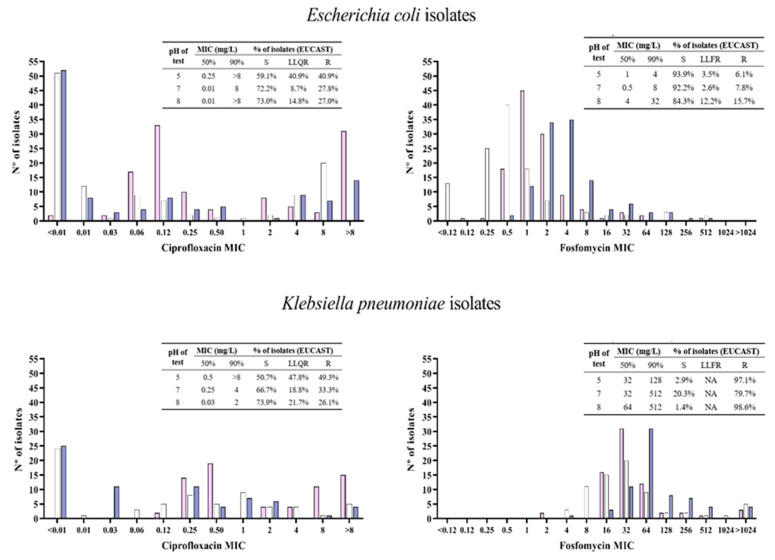
Different factors, including antimicrobial resistance, may diminish the effectiveness of antibiotic therapy, challenging the management of post-transplant urinary tract infection (UTI). The association of acidic urine pH with microbiological and clinical outcomes was evaluated after fosfomycin or ciprofloxacin therapy in 184 kidney transplant recipients (KTRs) with UTI episodes by (N = 115) and (N = 69). Initial urine pH, antimicrobial therapy, and clinical and microbiological outcomes, and one- and six-month follow-up were assessed. Fosfomycin was prescribed in 88 (76.5%) and 46 (66.7%) UTI episodes in the total cohort. When the urine pH ≤ 6, fosfomycin was prescribed in 60 (52.2%) and 29 (42.0%) . Initial urine pH ≤ 6 in UTI was associated with symptomatic episodes (8/60 vs. 0/55, = 0.04) at one-month follow-up, with a similar trend in those patients receiving fosfomycin (7/47 vs. 0/41, = 0.09). Acidic urine pH was not associated with microbiological or clinical cure in UTI. At pH 5, the ciprofloxacin MIC increased from 8 to >8 mg/L in and from 4 to >8 mg/L in . At pH 5, the fosfomycin MIC decreased from 8 to 4 mg/L in and from 512 to 128 mg/L in . Acidic urine is not associated with the microbiological efficacy of fosfomycin and ciprofloxacin in KTRs with UTI, but it is associated with symptomatic UTI episodes at one-month follow-up in episodes.
包括抗菌药物耐药性在内的不同因素可能会降低抗生素治疗的效果,这对移植后尿路感染(UTI)的管理构成了挑战。在184例发生UTI的肾移植受者(KTRs)中,通过(N = 115)和(N = 69)评估了磷霉素或环丙沙星治疗后酸性尿液pH值与微生物学和临床结局之间的关联。评估了初始尿液pH值、抗菌治疗、临床和微生物学结局以及1个月和6个月的随访情况。在整个队列中,88例(76.5%)和46例(66.7%)UTI发作时使用了磷霉素。当尿液pH值≤6时,60例(52.2%)和29例(42.0%)使用了磷霉素。UTI时初始尿液pH值≤6与1个月随访时的症状性发作(8/60 vs. 0/55,P = 0.04)相关,接受磷霉素治疗的患者也有类似趋势(7/47 vs. 0/41,P = 0.09)。酸性尿液pH值与UTI的微生物学或临床治愈无关。在pH值为5时,环丙沙星的最低抑菌浓度(MIC)在中从8增加到>8 mg/L,在中从4增加到>8 mg/L。在pH值为5时,磷霉素的MIC在中从8降低到4 mg/L,在中从512降低到128 mg/L。酸性尿液与KTRs中UTI患者使用磷霉素和环丙沙星的微生物学疗效无关,但与1个月随访时UTI发作的症状性发作有关。