Lin Yupei, Burt Bryan M, Lee Hyun-Sung, Nguyen Thinh T, Jang Hee-Jin, Lee Claire, Hong Wei, Ripley Robert Taylor, Amos Christopher I, Cheng Chao
Department of Medicine, Baylor College of Medicine, Houston, TX, 77030, USA.
Institute for Clinical and Translational Research, Baylor College of Medicine, Houston, TX, 77030, USA.
NPJ Precis Oncol. 2024 Feb 23;8(1):47. doi: 10.1038/s41698-024-00531-y.
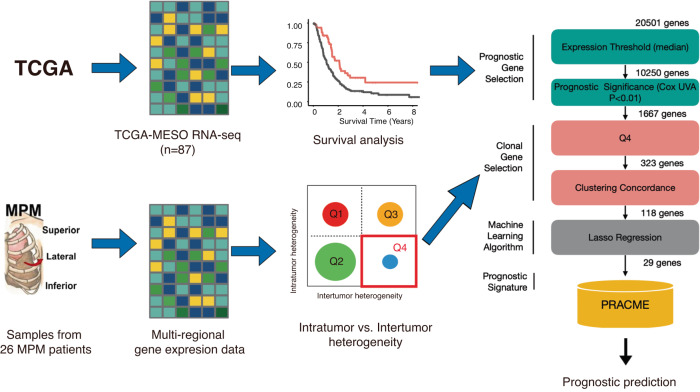
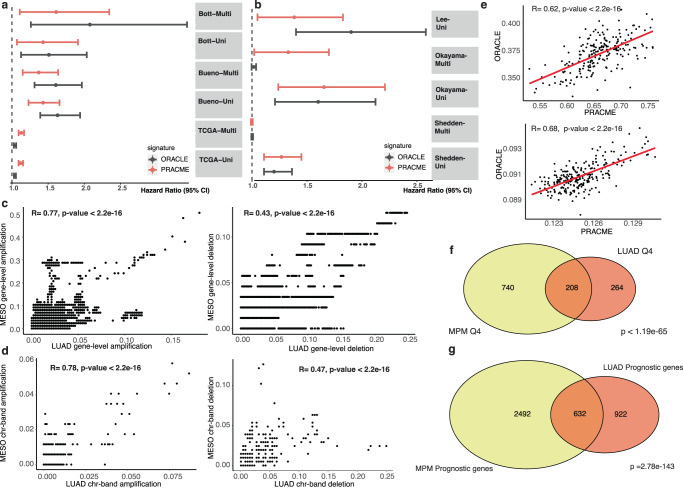
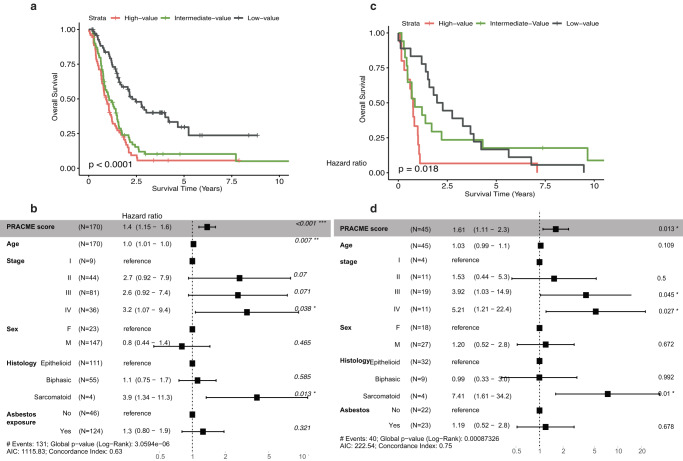
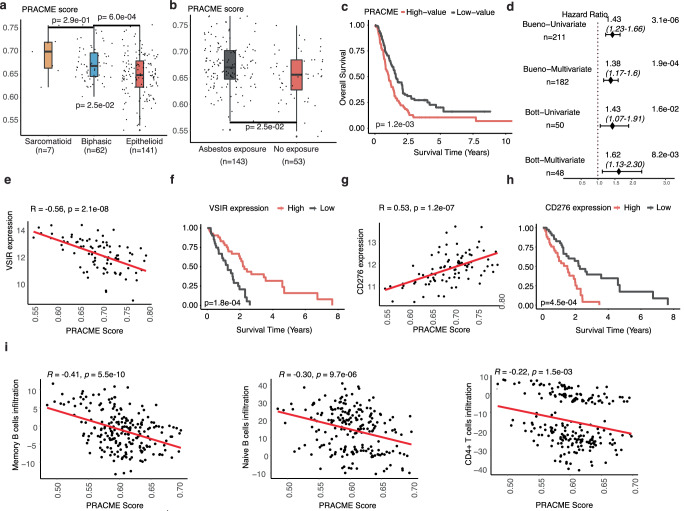
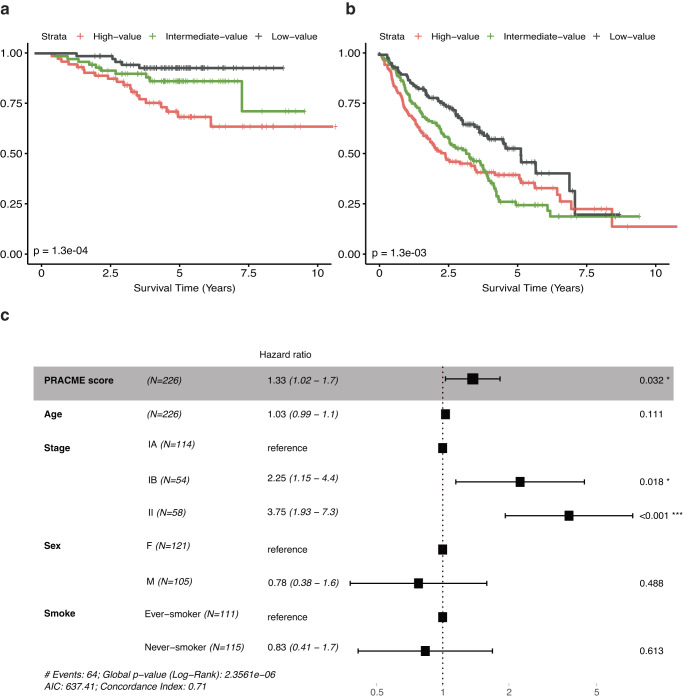
Malignant pleural mesothelioma (MPM) is a rare but lethal pleural cancer with high intratumor heterogeneity (ITH). A recent study in lung adenocarcinoma has developed a clonal gene signature (ORACLE) from multiregional transcriptomic data and demonstrated high prognostic values and reproducibility. However, such a strategy has not been tested in other types of cancer with high ITH. We aimed to identify biomarkers from multi-regional data to prognostically stratify MPM patients. We generated a multiregional RNA-seq dataset for 78 tumor samples obtained from 26 MPM patients, each with one sample collected from a superior, lateral, and inferior region of the tumor. By integrating this dataset with the Cancer Genome Atlas MPM RNA-seq data, we selected 29 prognostic genes displaying high variability across different tumors but low ITH, which named PRACME (Prognostic Risk Associated Clonal Mesothelioma Expression). We evaluated PRACME in two independent MPM datasets and demonstrated its prognostic values. Patients with high signature scores are associated with poor prognosis after adjusting established clinical factors. Interestingly, the PRACME and the ORACLE signatures defined respectively from MPM and lung adenocarcinoma cross-predict prognosis between the two cancer types. Further investigation indicated that the cross-prediction ability might be explained by the high similarity between the two cancer types in their genomic regions with copy number variation, which host many clonal genes. Overall, our clonal signature PRACME provided prognostic stratification in MPM and this study emphasized the importance of multi-regional transcriptomic data for prognostic stratification based on clonal genes.
恶性胸膜间皮瘤(MPM)是一种罕见但致命的胸膜癌,具有高度的肿瘤内异质性(ITH)。最近一项针对肺腺癌的研究从多区域转录组数据中开发出了一种克隆基因特征(ORACLE),并证明了其具有较高的预后价值和可重复性。然而,这种策略尚未在其他具有高度ITH的癌症类型中进行测试。我们旨在从多区域数据中识别生物标志物,以便对MPM患者进行预后分层。我们为26例MPM患者的78个肿瘤样本生成了一个多区域RNA测序数据集,每个患者从肿瘤的上、外侧和下区域各采集一个样本。通过将该数据集与癌症基因组图谱MPM RNA测序数据整合,我们选择了29个在不同肿瘤中表现出高变异性但ITH较低的预后基因,将其命名为PRACME(预后风险相关克隆间皮瘤表达)。我们在两个独立的MPM数据集中评估了PRACME,并证明了其预后价值。在调整既定临床因素后,特征评分高的患者预后较差。有趣的是,分别从MPM和肺腺癌中定义的PRACME和ORACLE特征可以交叉预测这两种癌症类型之间的预后。进一步的研究表明,这种交叉预测能力可能是由于两种癌症类型在具有拷贝数变异的基因组区域具有高度相似性,这些区域包含许多克隆基因。总体而言,我们的克隆特征PRACME为MPM提供了预后分层,本研究强调了多区域转录组数据对于基于克隆基因进行预后分层的重要性。