Department of General Surgery (Gastrointestinal Surgery), The Affiliated Hospital of Southwest Medical University, 25 Taiping Street, Luzhou, Sichuan, 646000, People's Republic of China.
Sci Rep. 2024 Feb 24;14(1):4524. doi: 10.1038/s41598-024-54273-9.
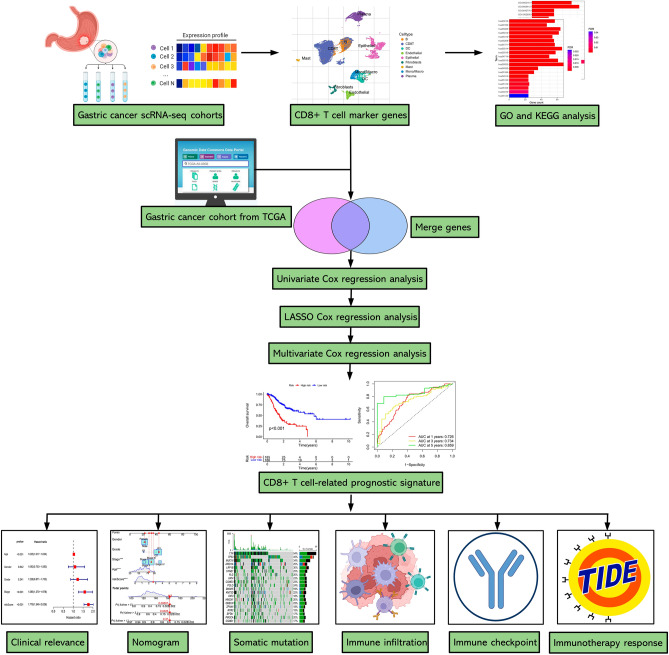
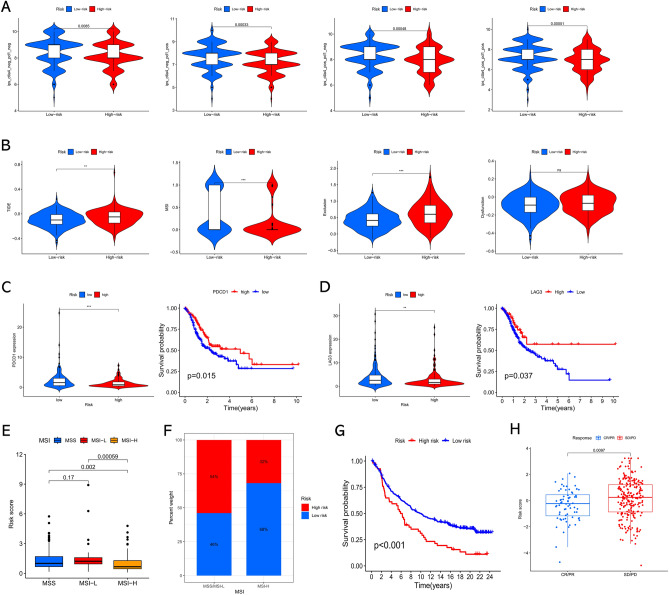
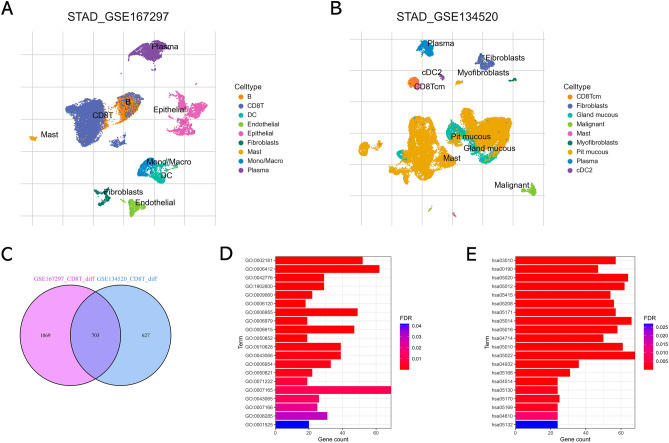
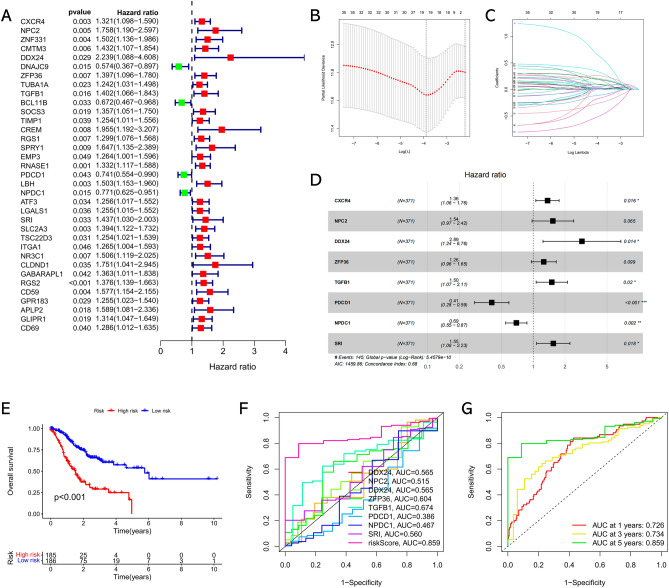
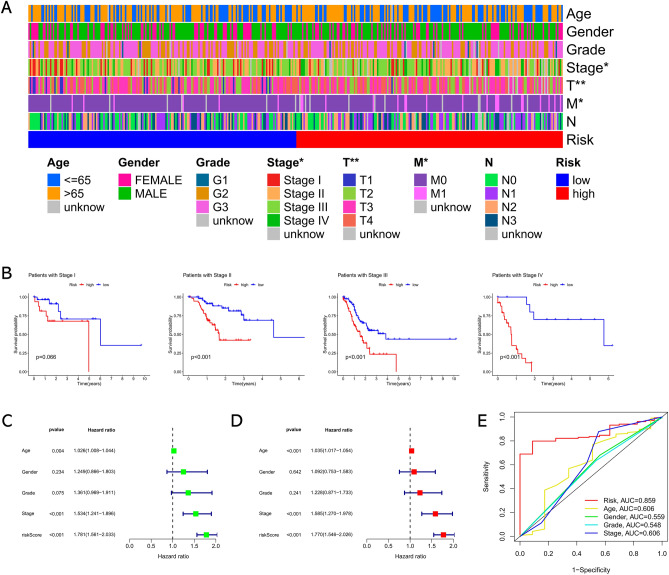
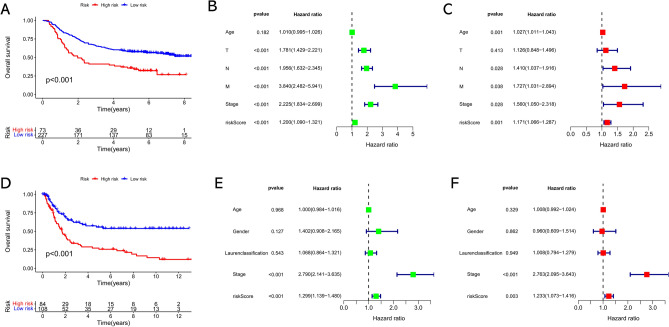
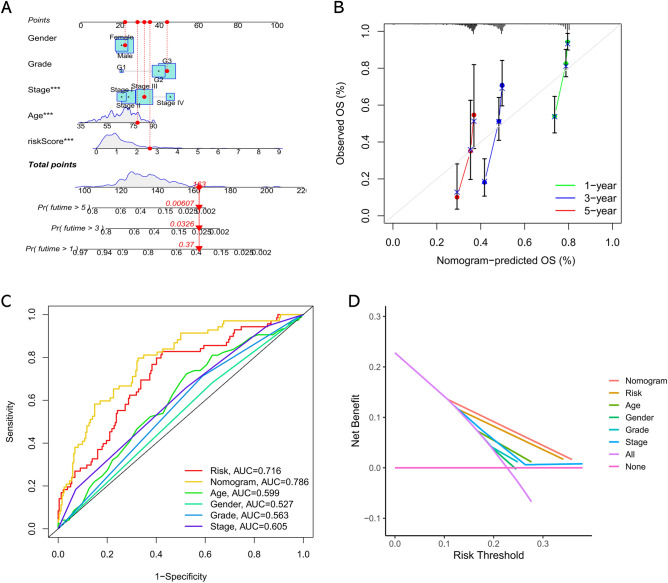
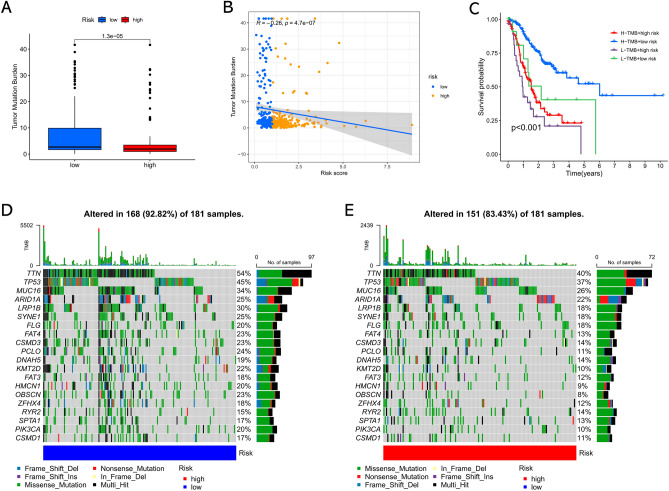
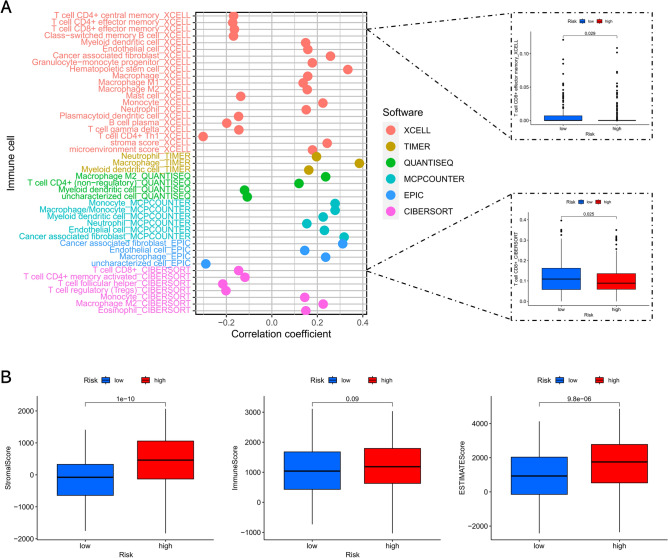
The universally poor clinical outcome makes gastric cancer (GC) still a significant public health threat, the main goal of our research is to develop a prognostic signature that can forecast the outcomes and immunological characteristics of GC via integrating single-cell and bulk RNA-sequencing. The CD8+ T cell feature genes were screened out by exploring single-cell RNA-sequencing (scRNA-seq) profiles retrieved from the TISCH2 database. Then, Cox and LASSO regressions were exploited for constructing a prognostic model in TCGA cohort based on these CD8+ T cell feature genes. Survival analysis was conducted to investigate the predictive capability of the signature for the clinical outcome of GC patients in TCGA and GEO cohorts. Additionally, we further examined the correlations between the risk signature and tumor immunotherapeutic response from the perspectives of immune infiltration, tumor mutation burden (TMB), immune checkpoint biomarker (ICB) expression, tumor microenvironment (TME), microsatellite instability (MSI), TIDE, and TCIA scores. In total, 703 CD8+ T cell feature genes were identified, eight of which were selected for constructing a prognostic signature. GC patients who possess high-risk score had significantly poorer survival outcomes than those who possess low-risk score in TCGA and GEO cohorts. Immune infiltration analysis proved that the risk score was negatively connected with the infiltration abundance of CD8+ T cells. Then, our findings demonstrated that GC patients in the high-risk subgroup possess a higher proportion of MSI-L/MSS, lower immune checkpoint biomarker expression, lower TMB, higher TIDE scores and lower TCIA scores compared to those in the low-risk subgroup. What's more, immunotherapy cohort analysis confirmed that patients who possess high-risk score are not sensitive to anti-cancer immunotherapy. Our study developed a reliable prognostic signature for GC that was significantly correlated with the immune landscape and immunotherapeutic responsiveness. The risk signature may guide clinicians to adopt more accurate and personalized treatment strategies for GC patients.
普遍较差的临床预后使胃癌(GC)仍然是一个重大的公共卫生威胁,我们的主要研究目标是通过整合单细胞和批量 RNA 测序,开发一种预测 GC 患者结局和免疫特征的预后标志物。通过探索从 TISCH2 数据库中检索到的单细胞 RNA 测序(scRNA-seq)图谱,筛选出 CD8+T 细胞特征基因。然后,基于这些 CD8+T 细胞特征基因,在 TCGA 队列中利用 Cox 和 LASSO 回归构建预后模型。在 TCGA 和 GEO 队列中进行生存分析,以研究该标志物对 GC 患者临床结局的预测能力。此外,我们还从免疫浸润、肿瘤突变负荷(TMB)、免疫检查点生物标志物(ICB)表达、肿瘤微环境(TME)、微卫星不稳定性(MSI)、TIDE 和 TCIA 评分等方面进一步探讨了风险标志物与肿瘤免疫治疗反应之间的相关性。总共鉴定出 703 个 CD8+T 细胞特征基因,其中 8 个基因被用于构建预后标志物。在 TCGA 和 GEO 队列中,高风险评分的 GC 患者的生存结局明显比低风险评分的患者差。免疫浸润分析证实,风险评分与 CD8+T 细胞浸润丰度呈负相关。然后,我们的研究结果表明,与低风险亚组相比,高风险亚组的 GC 患者具有更高比例的 MSI-L/MSS、更低的免疫检查点生物标志物表达、更低的 TMB、更高的 TIDE 评分和更低的 TCIA 评分。此外,免疫治疗队列分析证实,高风险评分的患者对抗癌免疫治疗不敏感。我们的研究为 GC 开发了一个可靠的预后标志物,该标志物与免疫图谱和免疫治疗反应性显著相关。该风险标志物可以指导临床医生为 GC 患者采用更准确和个性化的治疗策略。