Tohoku Medical Megabank Organization, Tohoku University.
Graduate School of Medicine, Tohoku University.
J Epidemiol. 2024 Sep 5;34(9):434-443. doi: 10.2188/jea.JE20230241. Epub 2024 Jul 31.
The purpose of this study was to report the basic profile of the Miyagi Prefecture part of a repeated center-based survey during the second period of the Tohoku Medical Megabank Community-Based Cohort Study (TMM CommCohort Study), as well as the participants' characteristics based on their participation type in the baseline survey.
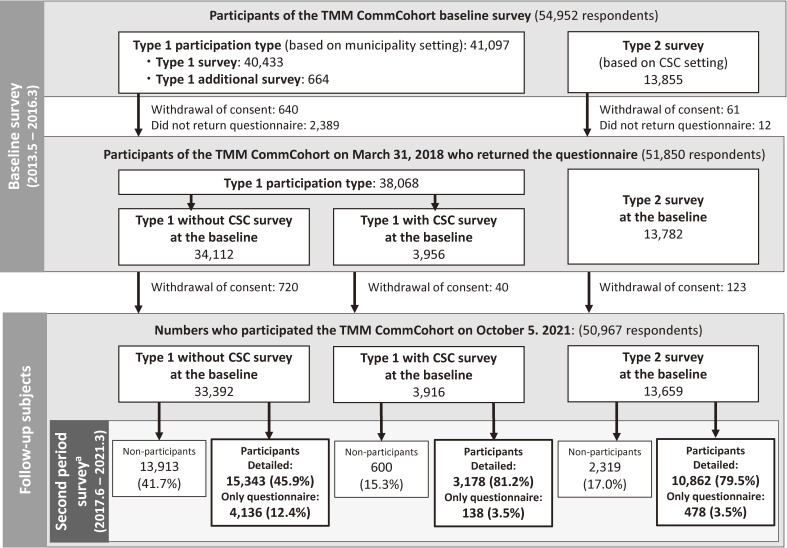
The second period survey, conducted from June 2017 to March 2021, included participants of the TMM CommCohort Study (May 2013 to March 2016). In addition to the questionnaire, blood, urine, and physiological function tests were performed during the second period survey. There were three main ways of participation in the baseline survey: Type 1, Type 1 additional, or Type 2 survey. The second period survey was conducted in the same manner as the Type 2 survey, which was based on the community support center (CSC).
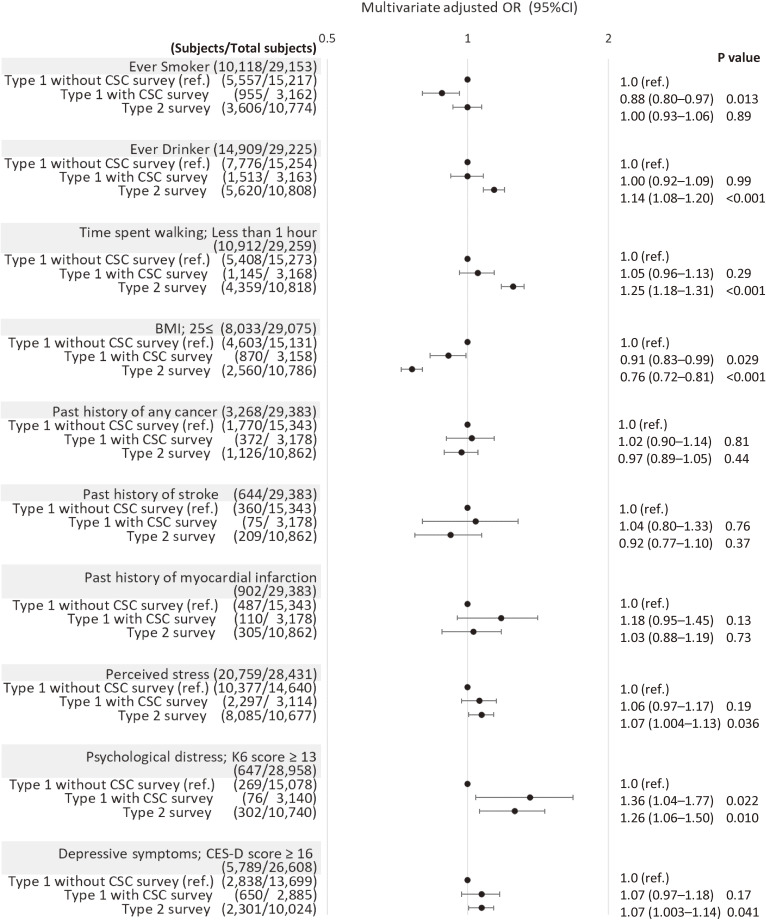
In Miyagi Prefecture, 29,383 (57.7%) of 50,967 participants participated in the second period survey. The participation rate among individuals who had visited the CSC was approximately 80%. Although some factors differed depending on the participation type in the baseline survey, the second period survey respondents in the Type 1 and Type 2 survey groups at baseline had similar traits.
The second period survey of the TMM CommCohort Study provided detailed follow-up information. Following up on the health conditions of the participants will clarify the long-term effects of disasters and contribute to personalized prevention.
本研究旨在报告第二次东北医药巨型银行社区为基础队列研究(TMM CommCohort 研究)期间宫城县部分重复中心为基础调查的基本概况,以及根据基线调查中的参与类型,参与者的特征。
第二期调查于 2017 年 6 月至 2021 年 3 月进行,包括 TMM CommCohort 研究的参与者(2013 年 5 月至 2016 年 3 月)。第二期调查除了问卷调查外,还进行了血液、尿液和生理功能检查。基线调查有三种主要参与方式:1 型、1 型附加或 2 型调查。第二期调查以社区支持中心(CSC)为基础,以与 2 型调查相同的方式进行。
在宫城县,50967 名参与者中有 29383 名(57.7%)参加了第二期调查。去过 CSC 的人的参与率约为 80%。尽管基线调查中不同的参与类型存在一些差异,但基线调查的 1 型和 2 型调查组的第二期调查受访者具有相似的特征。
TMM CommCohort 研究的第二期调查提供了详细的随访信息。跟踪参与者的健康状况将阐明灾害的长期影响,并有助于进行个性化预防。