Ghadipasha Masoud, Talaie Ramin, Mahmoodi Zohreh, Karimi Salah Eddin, Forouzesh Mehdi, Morsalpour Masoud, Mahdavi Seyed Amirhosein, Mousavi Seyed Shahram, Ashrafiesfahani Shayesteh, Kordrostami Roya, Dadashzadehasl Nahid
Legal Medicine Research Center, Legal Medicine Organization, Tehran, Iran.
Department of Gastroenterology and Hepatology, School of Medicine, Shahid Modarres Hospital, Shahid Beheshti University of Medical Sciences, Tehran, Iran.
Front Psychiatry. 2024 Feb 9;15:1261621. doi: 10.3389/fpsyt.2024.1261621. eCollection 2024.
Suicide is a public health issue and a main cause of mortality among adolescents and the youth worldwide, particularly in developing countries.
The present research is a systematic review aiming to investigate the spatial, geographical, and demographic factors related to suicide among adolescents and the youth.
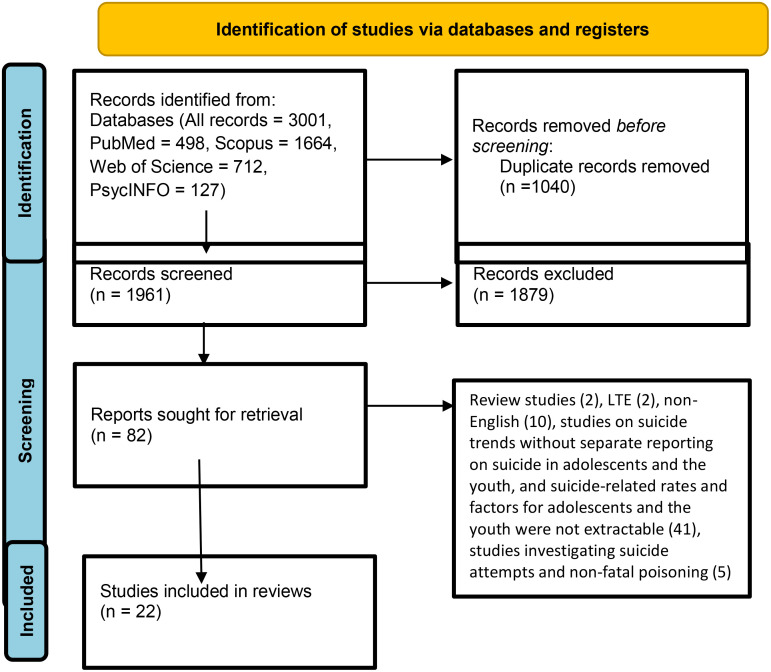
In this systematic review, two researchers examined PsycINFO, Web of Science, Scopus, and PubMed databases on December 7, 2022 with no time limits from the beginning of publication until 2022 to identify the primary studies on spatial and geographic analysis on adolescent and youth suicides. Once duplicate studies were identified and removed, the titles and abstracts of studies were examined and irrelevant studies were also removed. Finally, 22 studies were reviewed based on the inclusion criteria.
Our findings show that suicide rates are generally higher among men, residents of rural and less densely populated regions, coastal and mountainous regions, natives, 15-29 age group, less privileged populations with social fragmentation, unemployed, divorced or lonely people, those who live in single parent families, people with mental health issues, and those with low levels of education.
Stronger evidence supports the effects of geographic and demographic variables on youth and adolescent suicide rates as compared with spatial variables. These findings suggest that policy makers take spatial and demographic factors into consideration when health systems allocate resources for suicide prevention, and that national policymakers integrate demographic and geographic variables into health service programs.
https://www.crd.york.ac.uk/prospero/, identifier CRD42023430994.
自杀是一个公共卫生问题,是全球青少年和青年死亡的主要原因,在发展中国家尤为如此。
本研究是一项系统评价,旨在调查与青少年和青年自杀相关的空间、地理和人口因素。
在这项系统评价中,两名研究人员于2022年12月7日检索了PsycINFO、科学网、Scopus和PubMed数据库,从出版物开始到2022年没有时间限制,以确定关于青少年和青年自杀的空间和地理分析的主要研究。一旦识别并删除重复的研究,就会检查研究的标题和摘要,并删除无关的研究。最后,根据纳入标准对22项研究进行了综述。
我们的研究结果表明,男性、农村居民、人口密度较低地区的居民、沿海和山区居民、本地人、15-29岁年龄组、社会碎片化程度较低的弱势群体、失业者、离婚或孤独的人、单亲家庭的人、有心理健康问题的人以及教育水平较低的人自杀率通常较高。
与空间变量相比,更强的证据支持地理和人口变量对青少年自杀率的影响。这些发现表明,卫生系统在分配自杀预防资源时,政策制定者应考虑空间和人口因素,国家政策制定者应将人口和地理变量纳入卫生服务项目。