Plotnikovs Konstantins, Kamenska Jekaterina, Movcans Jevgenijs, Pasters Vitalijs, Solomin Leonid, Plaudis Haralds
Department of Traumatology and Orthopaedics, Riga East Clinical University Hospital, Riga, Latvia.
Department of Traumatology and Orthopaedics, Riga East Clinical University Hospital, Latvia.
Strategies Trauma Limb Reconstr. 2023 Sep-Dec;18(3):133-139. doi: 10.5005/jp-journals-10080-1599.
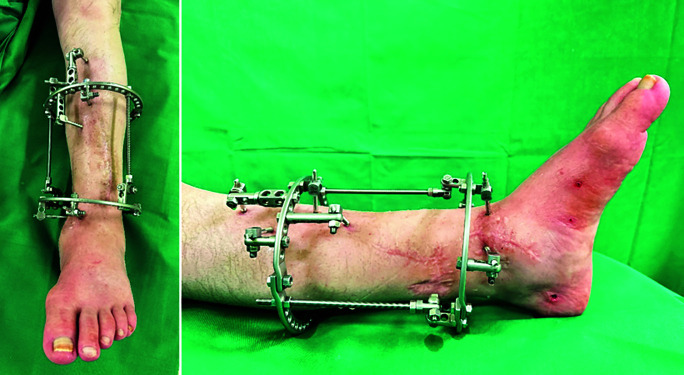
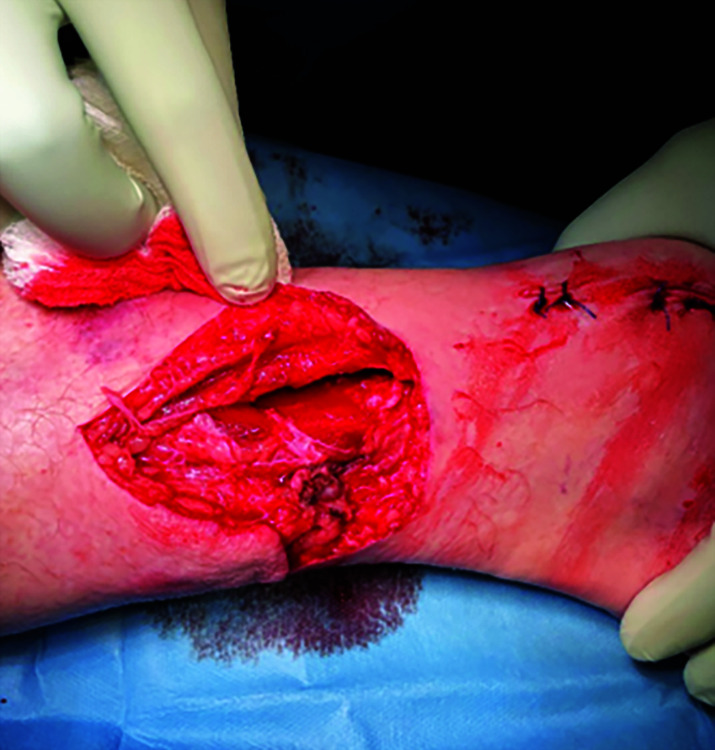
Soft tissue and bone defects that occur consequence of high-energy trauma are serious and challenging problems. The aim of this retrospective cohort study is to show that the artificial deformity creation (ADCr) method allows the closure of soft-tissue defects, avoids amputation, and can facilitate the reconstruction of bone defects and restore limb length.
Twenty-six adult patients (age range 20-81 years) with soft tissue defects of the lower limb were treated at the Riga East University Hospital from 2018 to 2021. All patients were treated using the ADCr method which is the technique of establishing an interim deformity for resolving tissue loss. The lower extremity functional scale (LEFS) and application of methods of ilizarov (ASAMI) criteria were used for the evaluation of bone healing and lower extremity function.
Complete union was achieved in all cases. The functional evaluation showed that most patients could achieve excellent and good results and return to activities of daily living. The functional result was poor in one case of a multi-fragmentary distal tibial articular fracture for which an ankle fusion was performed. Final union in this case was achieved with some residual deformity.
The method of ADCr is an effective surgical technique in cases of severe tibial injuries with concomitant loss of bone and soft tissues. This method could be used in cases when either a plastic or microsurgeon is not available or for instances when closing the defect with a flap is either impossible or contraindicated. Excellent and good functional results are possible without severe complications.
Plotnikovs K, Kamenska J, Movcans J, . Artificial Deformity Creation as a Method for Limb Salvage for Patients with Massive Tibial and Soft Tissue Defects: A Report of 26 Cases. Strategies Trauma Limb Reconstr 2023;18(3):133-139.
高能创伤导致的软组织和骨缺损是严重且具有挑战性的问题。这项回顾性队列研究的目的是表明人工造形(ADCr)方法能够闭合软组织缺损,避免截肢,并有助于骨缺损的重建以及恢复肢体长度。
2018年至2021年期间,里加东部大学医院对26例成年患者(年龄范围20 - 81岁)的下肢软组织缺损进行了治疗。所有患者均采用ADCr方法进行治疗,该方法是一种通过建立临时畸形来解决组织缺损的技术。采用下肢功能量表(LEFS)和伊里扎洛夫方法应用标准(ASAMI)对骨愈合情况和下肢功能进行评估。
所有病例均实现完全愈合。功能评估显示,大多数患者能够取得优异和良好的结果并恢复日常生活活动。1例胫骨远端多段关节骨折患者功能结果较差,为此进行了踝关节融合术。该病例最终实现愈合,但仍有一些残余畸形。
ADCr方法是治疗伴有骨和软组织缺损的严重胫骨损伤的一种有效手术技术。当无法获得整形或显微外科医生,或者用皮瓣闭合缺损不可能或禁忌时,可采用该方法。该方法可取得优异和良好的功能结果且无严重并发症。
Plotnikovs K, Kamenska J, Movcans J, 等。人工造形作为治疗大面积胫骨和软组织缺损患者肢体挽救的方法:26例报告。创伤肢体重建策略2023;18(3):133 - 139。