Nabilpour Magshoud, Zouita Amira, Mayhew Jerry, Mohammad Rahimi Gholam Rasul, Alikhajeh Yaser, Taheri Morteza, Irandoust Khadijeh, Youzbashi Leila, Granacher Urs, Zouhal Hassane
Department of Exercise Physiology, Faculty of Educational Sciences and Psychology, University of Mohaghegh Ardabili, Ardabil, Iran.
Higher Institute of Sports Sciences and Physical Education ksar said, University of la Manouba, Research Laboratory (UR23JS01) "Sport Performance, Health & Society", Tunisia.
J Exerc Sci Fit. 2024 Apr;22(2):140-144. doi: 10.1016/j.jesf.2024.02.001. Epub 2024 Feb 5.
The performance of sodium citrate has been investigated in high-intensity exercises, but fewer studies have addressed the role of citrate in weight-bearing exercises.
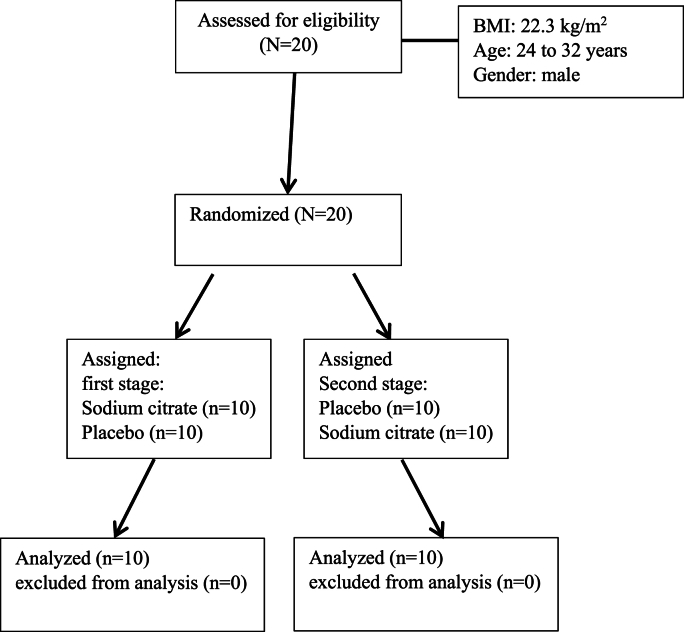
Twenty fitness challenge athletes, aged 24-32 years, volunteered to participate in this crossover, placebo-controlled, double-blind study. Initially, ten athletes were given a placebo and asked to complete a fitness challenge (i.e., chin-ups, squat jumps, dips, walking lunges, sit-ups, and burpees-devil press). Another ten athletes were supplemented with sodium citrate 0.5 g/kg body mass supplements 3 h prior to performing the fitness challenges. The same procedures were completed two days later with the supplement and placebo dextrose groups switched in a cross-over design. Athletes and assessors were blinded for the experimental condition (placebo vs. verum). Lactate levels were measured 5 min after exercise. The athletes' performance on each item of the fitness challenge as well as their lactate levels, were compared. Differences between the means of the measured variables were contrasted using a dependent -test.
Supplementing sodium citrate substantially improved athletes' performance in all six fitness challenge items (p < 0.05, 0.69<Cohen's d < 2.52, moderate to large). In addition, lactate levels registered after the fitness challenge were lower in the citrate sodium supplementation vs. placebo condition (p = 0.001, Cohen's d = 0.63, moderate).
Acute sodium citrate supplementation may help fitness challengers postpone muscular fatigue and increase performance, potentially via the prevention of lactate accumulation.
柠檬酸钠在高强度运动中的表现已得到研究,但针对柠檬酸盐在负重运动中的作用的研究较少。
20名年龄在24至32岁之间的健身挑战运动员自愿参与了这项交叉、安慰剂对照、双盲研究。最初,10名运动员服用安慰剂,并被要求完成一项健身挑战(即引体向上、深蹲跳、俯卧撑、弓步走、仰卧起坐和波比跳-恶魔推举)。另外10名运动员在进行健身挑战前3小时补充0.5克/千克体重的柠檬酸钠。两天后,补充剂组和安慰剂葡萄糖组进行交叉设计互换,完成相同程序。运动员和评估者对实验条件(安慰剂与真药)不知情。运动后5分钟测量乳酸水平。比较运动员在健身挑战各项中的表现以及他们的乳酸水平。使用配对t检验对比测量变量均值之间的差异。
补充柠檬酸钠显著提高了运动员在所有六项健身挑战项目中的表现(p<0.05,0.69<科恩d值<2.52,中等到较大)。此外,与安慰剂组相比,补充柠檬酸钠组在健身挑战后测得的乳酸水平更低(p = 0.001,科恩d值 = 0.63,中等)。
急性补充柠檬酸钠可能有助于健身挑战者推迟肌肉疲劳并提高表现,可能是通过预防乳酸积累实现的。