Choi Annette, Stout Alison E, Rollins Alicia, Wang Kally, Guo Qinghua, Jaimes Javier A, Kennedy Monica, Wagner Bettina, Whittaker Gary R
Departments of Microbiology & Immunology, Ithaca NY and Sutton Animal Hospital, New York NY.
Population Medicine & Diagnostic Sciences, Ithaca NY and Sutton Animal Hospital, New York NY.
bioRxiv. 2024 Sep 3:2024.02.13.580068. doi: 10.1101/2024.02.13.580068.
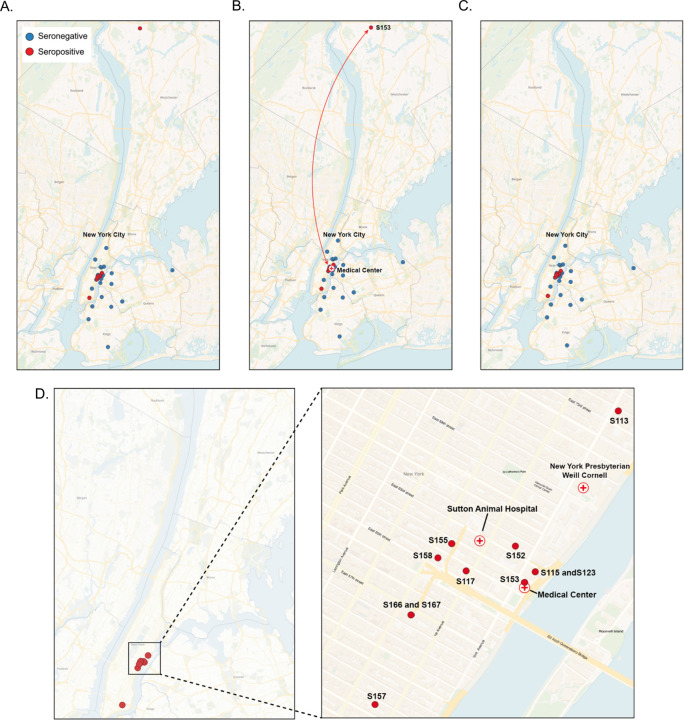
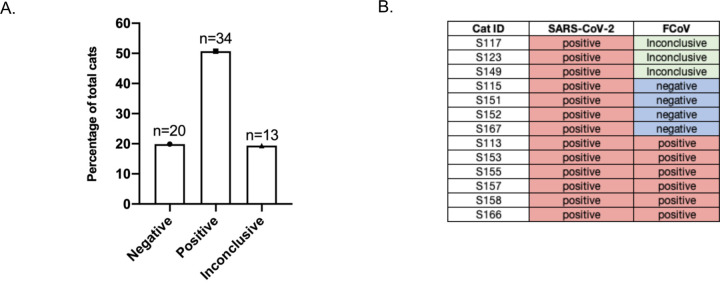
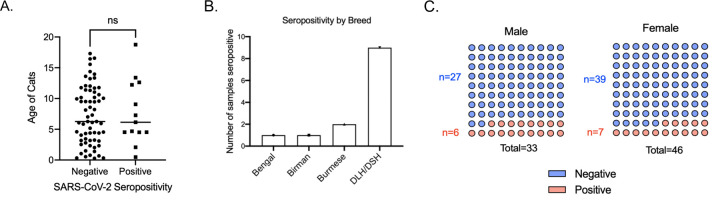
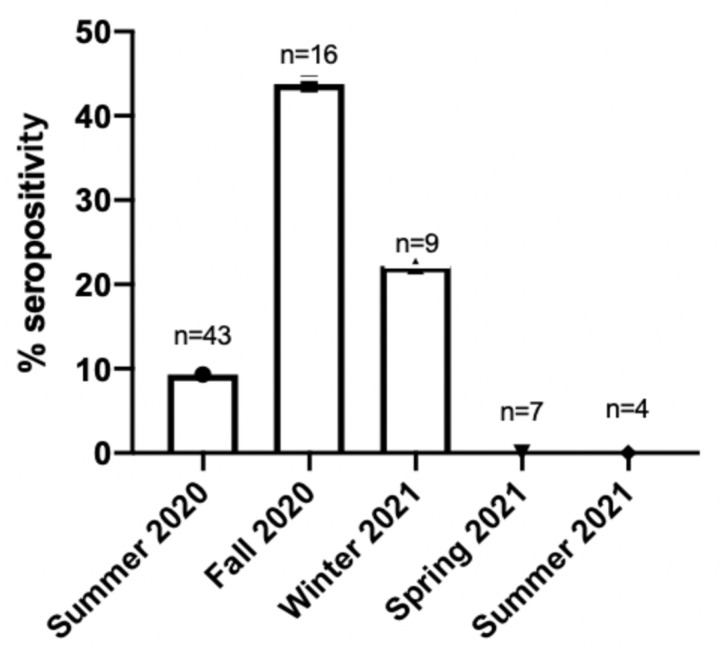
SARS-CoV-2, the cause of the ongoing COVID-19 pandemic, not only infects humans but is also known to infect various species, including domestic and wild animals. While many species have been identified as susceptible to SARS-CoV-2, there are limited studies on the prevalence of SARS-CoV-2 in animals. Both domestic and non-domestic cats are now established to be susceptible to infection by SARS-CoV-2. While serious disease in cats may occur in some instances, the majority of infections appear to be subclinical. Differing prevalence data for SARS-CoV-2 infection of cats have been reported, and are highly context-dependent. Here, we report a retrospective serological survey of cats presented to an animal practice in New York City, located in close proximity to a large medical center that treated the first wave of COVID-19 patients in the U.S. in the Spring of 2020. We sampled 79, mostly indoor, cats between June 2020 to May 2021, the early part of which time the community was under a strict public health "lock-down". Using a highly sensitive and specific fluorescent bead-based multiplex assay, we found an overall prevalence of 13/79 (16%) serologically-positive animals for the study period; however, cats sampled in the Fall of 2020 had a confirmed positive prevalence of 44%. For SARS-CoV-2 seropositive cats, we performed viral neutralization test with live SARS-CoV-2 to additionally confirm presence of SARS-CoV-2 specific antibodies. Of the thirteen seropositive cats, 7/13 (54%) were also positive by virus neutralization, and two of seropositive cats had previously documented respiratory signs, with high neutralization titers of 1/1024 and 1/4096; overall however, there was no statistically significant association of SARS-CoV-2 seropositivity with respiratory signs, or with breed, sex or age of the animals. Follow up sampling of cats showed that positive serological titers were maintained over time. In comparison, we found an overall confirmed positive prevalence of 51% for feline coronavirus (FCoV), an endemic virus of cats, with 30% confirmed negative for FCoV. We demonstrate the impact of SARS-CoV-2 in a defined feline population during the first wave of SARS-CoV-2 infection of humans, and suggest that human-cat transmission was substantial in our study group. Our study provide a new context for SARS-CoV-2 transmission events across species.
正在肆虐的新冠疫情的病原体严重急性呼吸综合征冠状病毒2(SARS-CoV-2)不仅感染人类,还会感染包括家畜和野生动物在内的多种物种。虽然已确定许多物种对SARS-CoV-2易感,但关于SARS-CoV-2在家畜中流行情况的研究却很有限。目前已证实家养猫和非家养猫均易感染SARS-CoV-2。虽然在某些情况下猫可能会出现严重疾病,但大多数感染似乎是亚临床的。已报告的猫感染SARS-CoV-2的流行率数据有所不同,且高度依赖具体情况。在此,我们报告了一项针对纽约市一家动物诊所收治的猫的回顾性血清学调查,该诊所紧邻一家大型医疗中心,该中心在2020年春季治疗了美国第一波新冠患者。我们在2020年6月至2021年5月期间对79只主要为室内饲养的猫进行了采样,在此期间的早些时候,社区处于严格的公共卫生“封锁”状态。使用高度灵敏且特异的基于荧光微球的多重检测方法,我们发现研究期间血清学阳性动物的总体流行率为13/79(16%);然而,2020年秋季采样的猫确诊阳性率为44%。对于SARS-CoV-2血清学阳性的猫,我们用活的SARS-CoV-2进行了病毒中和试验,以进一步确认SARS-CoV-2特异性抗体的存在。在这13只血清学阳性的猫中,7/13(54%)通过病毒中和试验也呈阳性,其中两只血清学阳性的猫之前有呼吸道症状记录,中和效价分别高达1/1024和1/4096;然而总体而言,SARS-CoV-2血清学阳性与呼吸道症状、动物品种、性别或年龄之间没有统计学上的显著关联。对猫的后续采样显示,阳性血清学效价随时间保持稳定。相比之下,我们发现猫冠状病毒(FCoV)(猫的一种地方性病毒)的总体确诊阳性率为51%,30%确诊为FCoV阴性。我们证明了在人类第一波SARS-CoV-2感染期间SARS-CoV-2对特定猫群的影响,并表明在我们的研究组中人际传播很显著。我们的研究为跨物种的SARS-CoV-2传播事件提供了新的背景情况。