Barroso Ricardo, Vieira-Pires Alexandre, Antunes Agostinho, Fidalgo-Carvalho Isabel
Department of Biology, Faculty of Sciences, University of Porto, Rua do Campo Alegre, s/n, 4169-007 Porto, Portugal.
Equigerminal, S.A., Rua Eduardo Correia, n°13 lote 20.12, 3030-507 Coimbra, Portugal.
Microorganisms. 2022 Feb 2;10(2):345. doi: 10.3390/microorganisms10020345.
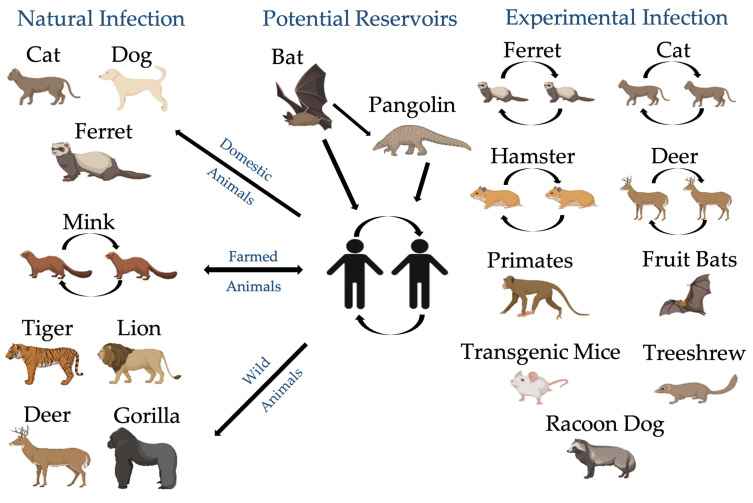
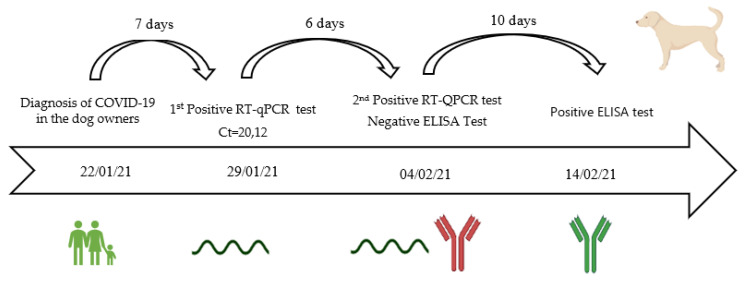
Betacoronavirus (β-CoV) are positive single-stranded RNA viruses known to infect mammals. In 2019, a novel zoonotic β-CoV emerged, the severe acute respiratory syndrome (SARS)-CoV-2. Although the most frequent SARS-CoV-2 transmission route is within humans, spillover from humans to domestic and wild animals has been reported, including cats (), dogs (), and minks (). In order to understand the potential role of domestic animals in SARS-CoV-2 global transmission, as well their susceptibility to infection, a seroepidemiologic survey of cats and dogs in Portugal was conducted. Antibodies against SARS-CoV-2 were detected in 15/69 (21.74%) cats and 7/148 (4.73%) dogs. Of the SARS-CoV-2 seropositive animals, 11/22 (50.00%) were possibly infected by human-to-animal transmission, and 5/15 (33.33%) cats were probably infected by cat-to-cat transmission. Moreover, one dog tested positive for SARS-CoV-2 RNA. Data suggest that cats and dogs are susceptible to SARS-CoV-2 infection in natural conditions. Hence, a one-health approach is crucial in the SARS-CoV-2 pandemic to understand the risk factors beyond infection in a human-animal environment interface.
β冠状病毒(β-CoV)是已知可感染哺乳动物的正链单股RNA病毒。2019年,一种新型人畜共患β-CoV出现,即严重急性呼吸综合征(SARS)-CoV-2。尽管SARS-CoV-2最常见的传播途径是在人类之间,但已报道了从人类传播到家养动物和野生动物的情况,包括猫()、狗()和水貂()。为了了解家养动物在SARS-CoV-2全球传播中的潜在作用及其对感染的易感性,在葡萄牙对猫和狗进行了血清流行病学调查。在69只猫中有15只(21.74%)和148只狗中有7只(4.73%)检测到了针对SARS-CoV-2的抗体。在SARS-CoV-2血清阳性动物中,11/22(50.00%)可能是通过人传动物感染的,15只猫中有5只(33.33%)可能是通过猫传猫感染的。此外,一只狗的SARS-CoV-2 RNA检测呈阳性。数据表明,猫和狗在自然条件下对SARS-CoV-2感染易感。因此,在SARS-CoV-2大流行中,采取“同一健康”方法对于了解人类-动物环境界面中感染之外的风险因素至关重要。