Rodriguez Nadira Yusif, Ahuja Aarit, Basu Debaleena, McKim Theresa H, Desrochers Theresa M
Department of Neuroscience, Brown University.
Department of Biosciences and Bioengineering, IIT Bombay, Mumbai, Maharashtra, India.
bioRxiv. 2024 Sep 11:2024.02.13.580192. doi: 10.1101/2024.02.13.580192.
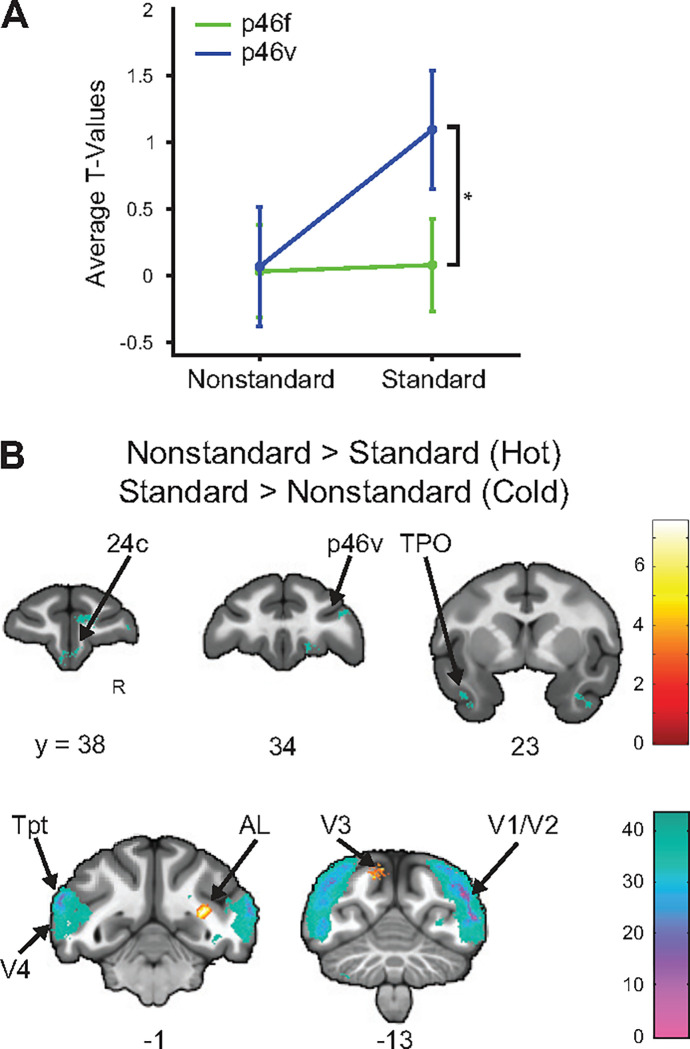
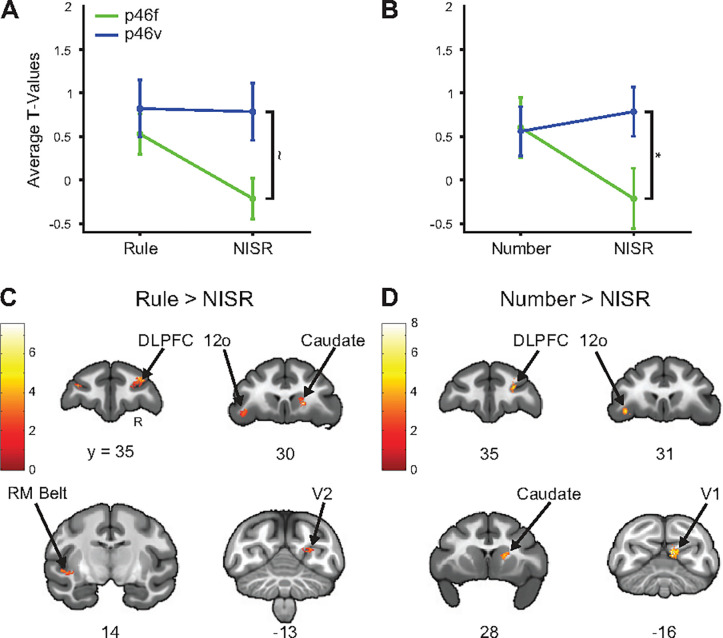
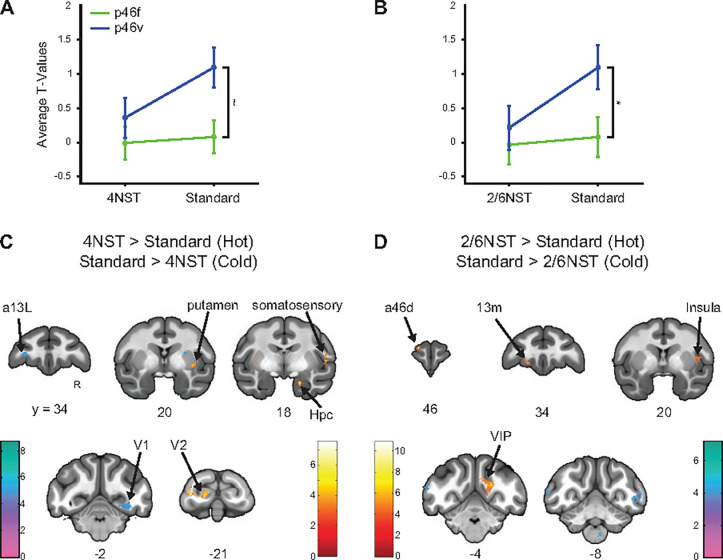
Sequential information permeates daily activities, such as when watching for the correct series of buildings to determine when to get off the bus or train. These sequences include periodicity (the spacing of the buildings), the identity of the stimuli (the kind of house), and higher-order more abstract rules that may not depend on the exact stimulus (e.g. house, house, house, business). Previously, we found that the posterior fundus of area 46 in the monkey lateral prefrontal cortex (LPFC) responds to rule changes in such abstract visual sequences. However, it is unknown if this region responds to other components of the sequence, i.e., image periodicity and identity, in isolation. Further, it is unknown if this region dissociates from other, more ventral LPFC subregions that have been associated with sequences and their components. To address these questions, we used awake functional magnetic resonance imaging in three male macaque monkeys during two no-report visual tasks. One task contained abstract visual sequences, and the other contained no visual sequences but maintained the same image periodicity and identities. We found the fundus of area 46 responded only to abstract sequence rule violations. In contrast, the ventral bank of area 46 responded to changes in image periodicity and identity, but not changes in the abstract sequence. These results suggest a functional specialization within anatomical substructures of LPFC to signal different kinds of stimulus regularities. This specialization may provide key scaffolding to identify abstract patterns and construct complex models of the world for daily living.
Daily tasks, such as a bus commute, require tracking or monitoring your place (same, same, same, different building) until your stop. Sequence components such as rule, periodicity (timing), and item identity are involved in this process. While prior work located responses to sequence rule changes to area 46 of monkey lateral prefrontal cortex (LPFC) using awake monkey fMRI, less was known about other components. We found that LPFC subregions differentiated between sequence components. Area 46 posterior fundus responded to abstract visual sequence rule changes, but not to changes in image periodicity or identity. The converse was true for the more ventral, adjacent shoulder region. These results suggest that interactions between adjacent LPFC subregions provide key scaffolding for complex daily behaviors.
顺序信息渗透于日常活动中,比如在观察一系列正确的建筑物以确定何时从公交车或火车上下来时。这些序列包括周期性(建筑物的间距)、刺激物的特征(房屋的类型)以及可能不依赖于确切刺激物的更高级、更抽象的规则(例如房屋、房屋、房屋、商业建筑)。此前,我们发现猴子外侧前额叶皮层(LPFC)中46区的后基底对这类抽象视觉序列中的规则变化有反应。然而,尚不清楚该区域是否单独对序列的其他成分,即图像周期性和特征有反应。此外,也不清楚该区域是否与其他已被证明与序列及其成分有关的、更靠腹侧的LPFC子区域有所区分。为了解决这些问题,我们在两项无需报告的视觉任务中,对三只雄性猕猴进行了清醒状态下的功能磁共振成像研究。一项任务包含抽象视觉序列,另一项任务不包含视觉序列,但保持相同的图像周期性和特征。我们发现46区的基底仅对抽象序列规则的违反有反应。相反,46区的腹侧缘对图像周期性和特征的变化有反应,但对抽象序列的变化无反应。这些结果表明,LPFC的解剖子结构内存在功能特化,以表征不同类型的刺激规律。这种特化可能为识别抽象模式和构建日常生活中复杂的世界模型提供关键框架。
日常任务,比如乘坐公交车上下班,需要追踪或监测你的位置(相同、相同、相同、不同建筑物)直到你到达目的地。这个过程涉及到序列成分,如规则、周期性(时间安排)和项目特征。虽然之前的研究利用清醒猕猴的功能磁共振成像将对序列规则变化的反应定位到猴子外侧前额叶皮层(LPFC)的46区,但对于其他成分了解较少。我们发现LPFC子区域在序列成分之间存在差异。46区后基底对抽象视觉序列规则变化有反应,但对图像周期性或特征的变化无反应。对于更靠腹侧的相邻区域则反之。这些结果表明,相邻LPFC子区域之间的相互作用为复杂的日常行为提供了关键框架。