D'Ippolito Ilenia, Menduni Marika, D'Amato Cinzia, Andreadi Aikaterini, Lauro Davide, Spallone Vincenza
Endocrinology Section, Department of Systems Medicine, University of Rome Tor Vergata, Rome, Italy.
Diabetes Metab J. 2024 Nov;48(6):1114-1125. doi: 10.4093/dmj.2023.0301. Epub 2024 Feb 26.
The aim was to investigate if autonomic symptoms questionnaire Composite Autonomic Symptom Score (COMPASS) 31 has different association with cardiovascular autonomic neuropathy (CAN) and diagnostic performance between type 1 diabetes mellitus (T1DM) and type 2 diabetes mellitus (T2DM).
Seventy-nine participants with T1DM and 140 with T2DM completed COMPASS 31 before cardiovascular reflex tests (CARTs) for CAN, and assessment of symptoms, signs, vibration, and thermal perception thresholds for diabetic polyneuropathy (DPN) diagnosis.
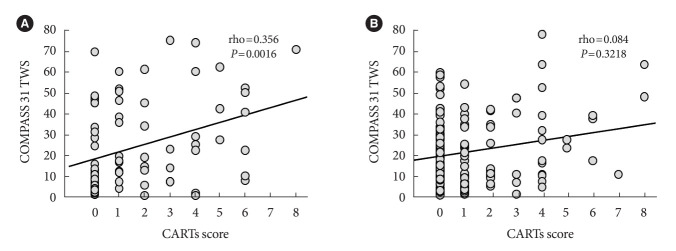
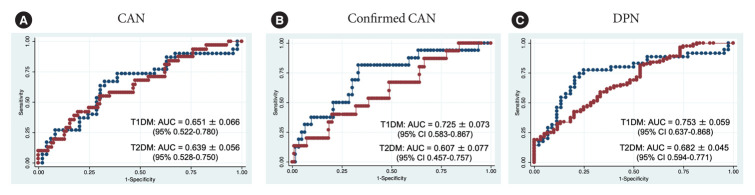
COMPASS 31 total weighted score (TWS) was similar in the two groups, but significantly associated with confirmed CAN only in T1DM (P=0.0056) and not T2DM group (P=0.1768) and correlated with CARTs score more strongly in T1DM (rho=0.356, P=0.0016) than in T2DM group (rho=0.084, P=0.3218) (P=0.016). Only in T1DM and not T2DM group, the area under the receiver operating characteristic curve (AUC) reached a fair diagnostic accuracy (>0.7) for confirmed CAN (0.73±0.07 vs. 0.61±0.08) and DPN (0.75±0.06 vs. 0.68±0.05), although without a significant difference. COMPASS 31 TWS (cut-off 16.44) reached acceptable diagnostic performance in T1DM, with sensitivity for confirmed CAN 81.2% and sensitivity and specificity for DPN 76.3% and 78%, compared to T2DM group (all <70%). AUC for DPN of orthostatic intolerance domain was higher in T1DM compared to T2DM group (0.73±0.05 vs. 0.58±0.04, P=0.027).
COMPASS 31 is more weakly related to CAN in T2DM than in T1DM, with a fair diagnostic accuracy for confirmed CAN only in T1DM. This difference supports a multifactorial origin of symptoms and should be considered when using COMPASS 31.
目的是研究自主神经症状问卷综合自主神经症状评分(COMPASS)31在1型糖尿病(T1DM)和2型糖尿病(T2DM)中与心血管自主神经病变(CAN)的关联以及诊断性能是否存在差异。
79名T1DM参与者和140名T2DM参与者在进行CAN的心血管反射测试(CARTs)之前完成了COMPASS 31,并对糖尿病性多发性神经病变(DPN)诊断的症状、体征、振动和热感觉阈值进行了评估。
两组的COMPASS 31总加权评分(TWS)相似,但仅在T1DM组中与确诊的CAN显著相关(P = 0.0056),而在T2DM组中不相关(P = 0.1768),并且T1DM组中COMPASS 31与CARTs评分的相关性更强(rho = 0.356,P = 0.0016),高于T2DM组(rho = 0.084,P = 0.3218)(P = 0.016)。仅在T1DM组而非T2DM组中,确诊CAN的受试者工作特征曲线下面积(AUC)达到了较好的诊断准确性(>0.7)(0.73±0.07对0.61±0.08)以及DPN的诊断准确性(0.75±0.06对0.68±0.05),尽管差异不显著。COMPASS 31 TWS(临界值为16.44)在T1DM中达到了可接受的诊断性能,确诊CAN的敏感性为81.2%,DPN的敏感性和特异性分别为76.3%和78%,相比之下T2DM组(均<70%)。T1DM组中体位性不耐受域的DPN的AUC高于T2DM组(0.73±0.05对0.58±0.04,P = 0.027)。
COMPASS 31在T2DM中与CAN的相关性比在T1DM中更弱,仅在T1DM中对确诊CAN具有较好的诊断准确性。这种差异支持症状的多因素起源,在使用COMPASS 31时应予以考虑。